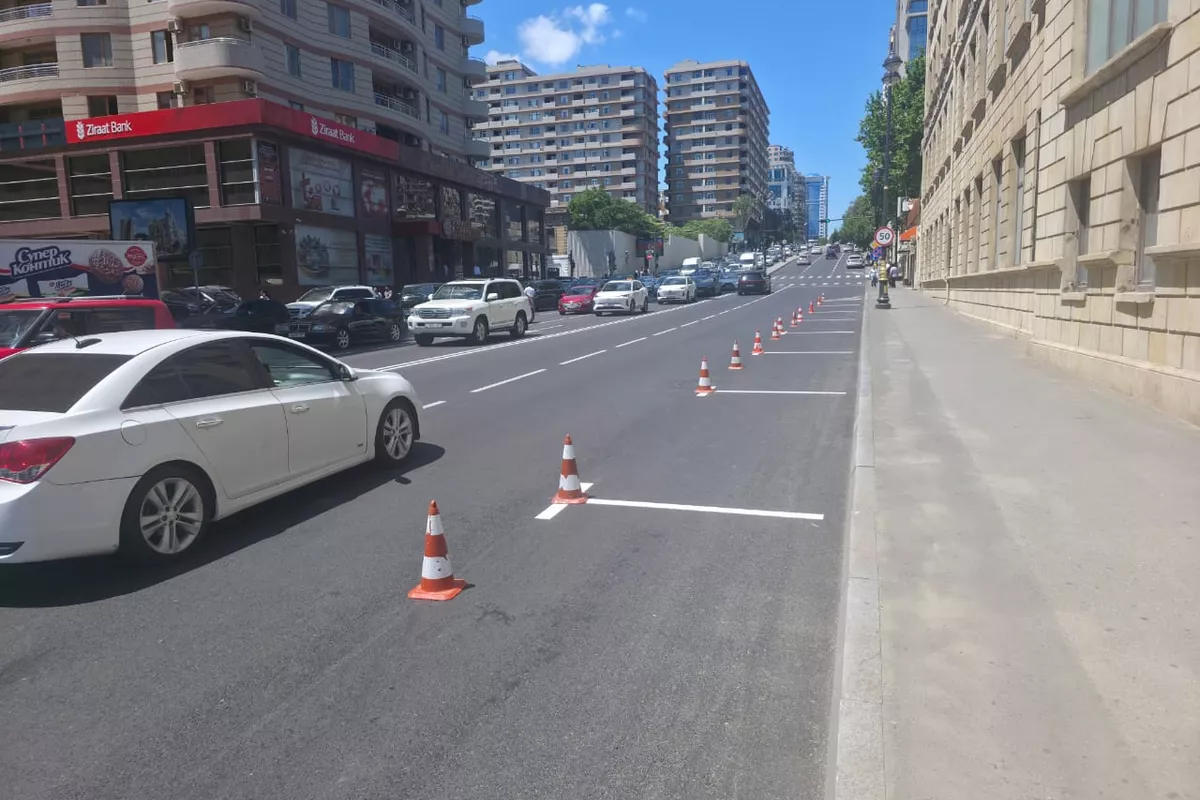
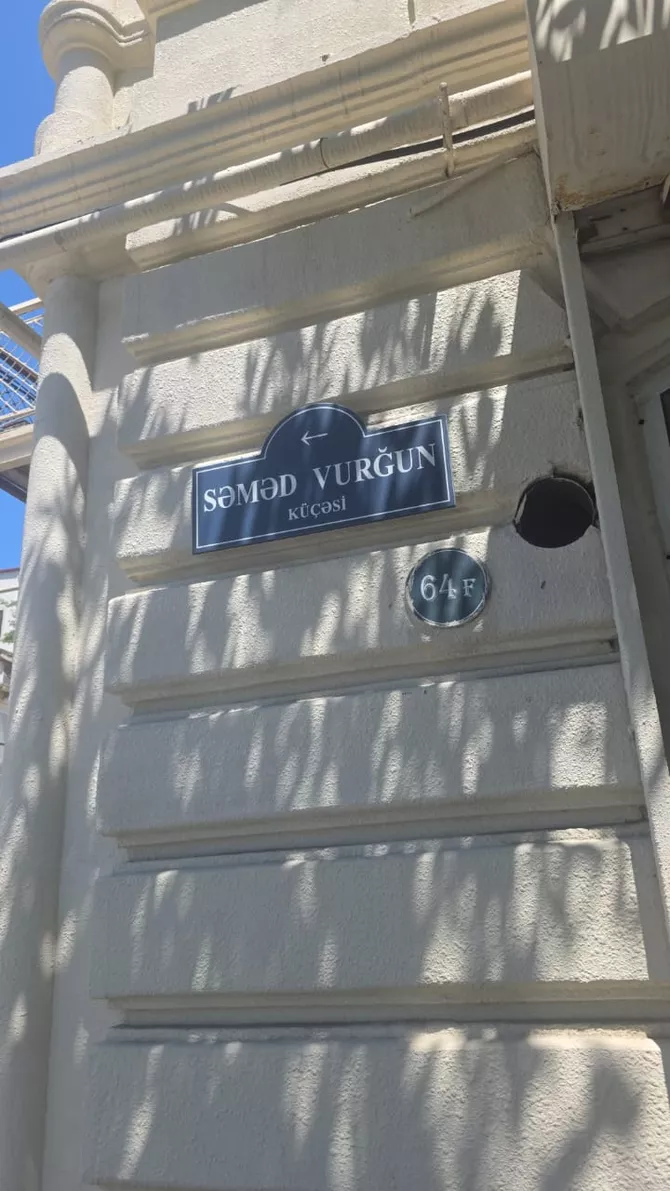
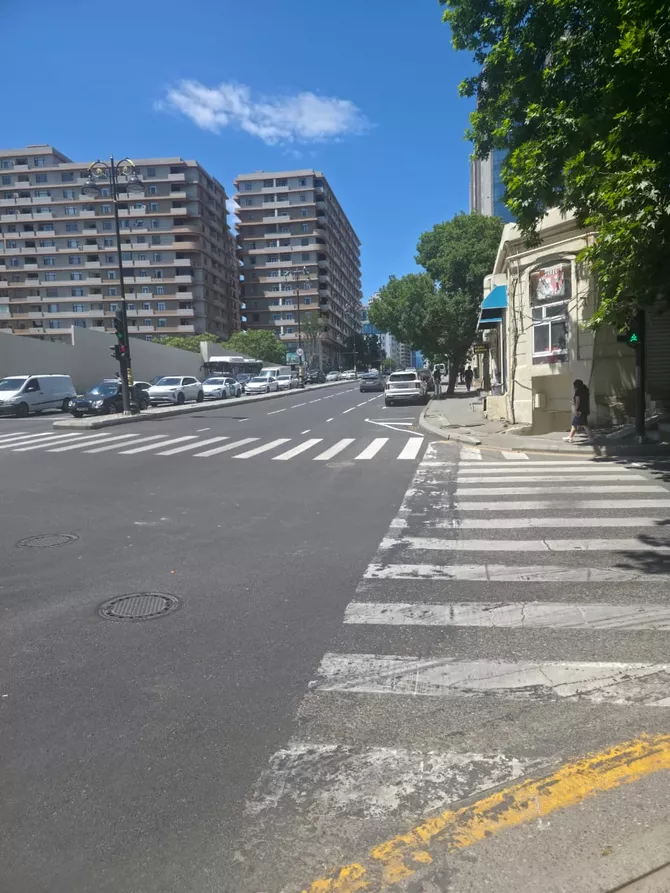
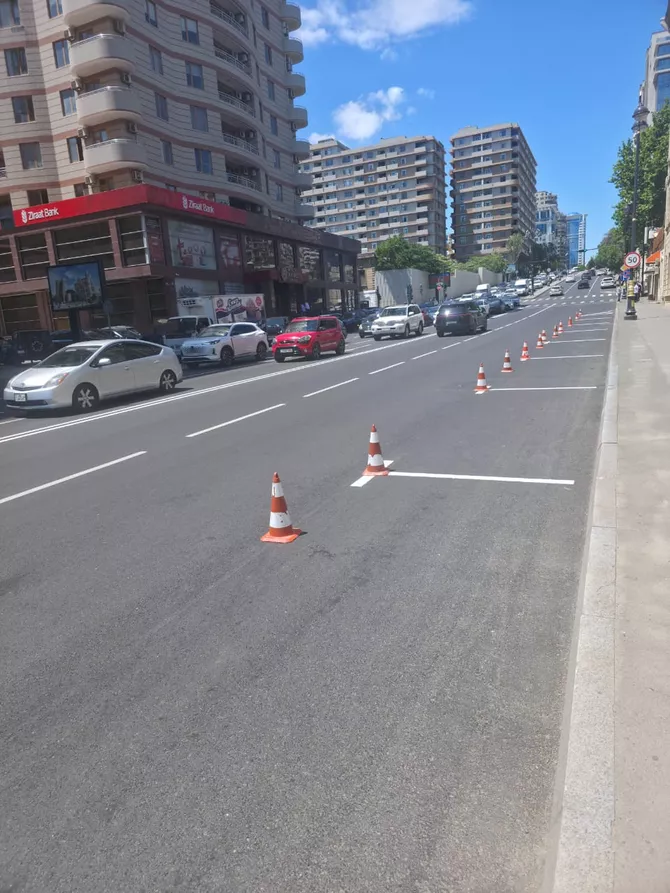
At first glance, it is an ordinary urban scene. Samed Vurgun Street in central Baku: heavy traffic, a dense flow of cars, sidewalks, pedestrian crossings, building facades, fresh asphalt and new road markings. Everything looks almost exemplary. The lines have been drawn neatly, the parking spaces are clearly marked, and the street appears to be becoming more orderly. It seems as though chaos is retreating and urban discipline is taking over.
But it is precisely in such details that the real problem often becomes visible.
On one section of Samed Vurgun Street, the new parking markings effectively narrow the roadway. What may be described on paper as the “organization of parking spaces” turns into a reduction of space for moving vehicles on the road itself. The right side of the carriageway is given over to parking, while the active traffic flow is left with less room to maneuver. A street that already carries a serious traffic load becomes narrower, more tense and less functional.
This is not a minor technical detail. It is a question of urban logic.
The roadway is intended first and foremost for movement. That is its primary function. Parking may be part of urban infrastructure, but it must not replace the very purpose of the road. If a road begins to be used as reserve territory for parked cars, the city is effectively admitting that it is solving one problem by creating another: compensating for a shortage of parking infrastructure by worsening mobility.
For many post-Soviet cities, this situation is very familiar. Streets designed decades ago were not built for the current level of motorization. In the Soviet period, road planning was based on a different transport reality: there were far fewer cars, mobility patterns were different, demand for roadside parking was lower, and public transport played a much more important role. Today, cities such as Baku face a fundamentally different situation. The number of cars has grown, business activity has intensified, and central streets are overloaded with private vehicles, taxis, buses, delivery services and pedestrian flows.
That is why mechanically creating parking spaces on the roadway of such streets means placing an additional burden on infrastructure that was never originally designed for it. This is especially dangerous in central districts, where the transport system is already operating at its limit.
In such conditions, every meter of road matters.
Creating parking spaces at the expense of the carriageway means directly reducing the transport capacity of the street. Even if the traffic lanes formally remain, drivers in practice have less space for safe movement and maneuvering. As a result, the road turns into a bottleneck: the flow slows down, drivers change lanes more often, queues form, and tension increases.
That is why turning part of an active roadway into a parking zone cannot be seen as an ordinary administrative decision. It directly affects the street’s capacity, road safety, public transport, access for emergency vehicles and the daily lives of thousands of people. When a lane is narrowed or effectively removed from normal traffic, the consequences are felt immediately: cars move more slowly, drivers make sudden lane changes, irritation grows, congestion forms, the risk of minor accidents rises, and buses, taxis, ambulances, fire engines and other emergency vehicles face greater difficulty getting through.
In dense urban traffic, one meter of road taken away can cost hundreds of drivers dozens of lost minutes. Such parking becomes not a convenience, but a daily generator of traffic jams.
Therefore, the question is simple but fundamental: what was prioritized when this decision was made - the free movement of vehicles or the formal increase in the number of paid parking spaces? Are we talking about improving the urban environment, or expanding parking statistics? Were the interests of the city truly placed first - or is this just another item in a departmental report?
Baku today lives under constant traffic pressure. Traffic jams have become one of the capital’s most sensitive problems. That is why any intervention in the street and road network must be carefully calculated, justified and publicly explained. A street is not an empty surface on which lines can simply be drawn. It is a living organism with its own rhythm, peak hours, weak points, turning zones, pedestrian crossings, bus stops, traffic lights, exits from courtyards, commercial facilities and everyday human behavior.
If this system is interfered with without sufficient analysis, the result may be the opposite of the stated goal.
Visually, the situation on Samed Vurgun Street in the direction of the intersection with Suleyman Rahimov Street looks exactly like this: part of the road has been marked for parking, temporary cones separate this zone, and cars continue to move along the remaining part of the carriageway. Formally, it looks like order. In reality, it is a clear narrowing of the road.
And here a paradox arises. The city seems to be fighting chaos, but it is doing so in a way that may create new chaos.
Parking spaces on the roadway create additional conflict points. One driver exits a parking space, another is forced to change lanes sharply, a third brakes, a pedestrian may step out from behind a parked car, and visibility for road users worsens. Such decisions are especially dangerous near intersections, public transport stops, pedestrian crossings and sections with heavy traffic.
The problem is not only that the road becomes narrower. The problem is that traffic becomes less predictable. And in a large city, the predictability of movement is one of the key elements of safety.
Parking policy is a sensitive issue for any major city. Parking spaces are necessary - that is obvious. Cars cannot simply disappear, especially in a dense urban environment where residential buildings, offices, shops and state institutions compete for limited space. A modern city needs paid parking, digital registration, resident permits, enforcement against violations and a system that prevents cars from occupying sidewalks.
But there is a fundamental boundary: parking reform must serve the city, not displace movement.
If parking is organized where it does not obstruct passage, frees sidewalks, helps residents and disciplines drivers, it is part of modern urban policy. But if parking appears at the expense of a busy roadway, the city risks getting “order” on paper and disorder in real life.
Such an approach does not solve the parking crisis; it merely changes its form. Instead of chaotic parking, the city gets an officially marked problem that worsens traffic. Formally, a parking space appears. In reality, part of the road disappears.
International practice is especially important here, because supporters of such decisions may often say that on-street parking exists in Europe, the United States and other developed countries. Formally, that is true. In many cities around the world, cars do indeed park along the curb, and parking lanes are part of the street space. But this very comparison does not work in favor of those who try to justify any narrowing of a road for parking.
In developed urban practice, parking on the roadway does not mean that part of the road can simply be taken away and marked as parking spaces. Such parking is permitted only where it is integrated into the transport scheme, does not undermine the street’s capacity, does not interfere with public transport, does not worsen visibility, does not create dangerous conflict points and does not turn movement into a permanent bottleneck.
In other words, international experience does not say that parking can be created anywhere. It says that every such decision must be the result of calculation.
In North America, for example, urban transport manuals treat a parking lane as a separate street element with a clear width, marking and function. But the logic of such approaches is not to mechanically cut space away from the roadway; it is to design the street as a single system, taking into account traffic lanes, safety, pedestrians, cyclists, public transport and the real load on the street.
The British approach also shows that on-street parking must be part of a design solution, not the result of formally drawing lines. On-street parking is considered in the context of the overall width of the road, vehicle movement, safety and the quality of the urban environment. Where parking spaces are created, they must correspond to the real function of the street, rather than appear at the cost of worsening traffic.
European urban policy in recent years has gone even further: parking is increasingly viewed not as an end in itself, but as part of sustainable mobility. Parking management is linked to a broader task - improving quality of life, reducing transport pressure, developing public transport and using street space more rationally.
This is fundamentally different from the approach of “there is space at the edge of the road, so we can turn it into parking.”
In France, for example, pedestrian safety has become a reason for removing parking spaces near crossings. The logic is simple: parking must not worsen visibility or create risks for road users. This is an important signal: even an existing parking space can be removed if it conflicts with safety.
Therefore, international practice does not give officials universal justification for creating parking spaces on the roadway. On the contrary, it imposes much stricter requirements on such decisions. Parking on the road may be acceptable on a calm residential street, where it does not obstruct traffic and may even help reduce vehicle speed. It may be justified where the street was originally designed with a parking lane. It may exist where sufficient width remains for the safe passage of cars, buses and emergency vehicles.
But this is not the same as creating parking spaces on an overloaded urban street, effectively narrowing the roadway and reducing its capacity.
The problem is not the very fact of on-street parking. The problem is when parking is created at the expense of movement. In international practice, this is a fundamental distinction. A parking lane can be part of a street, but it must not destroy the main function of the carriageway. If, after the markings are applied, traffic becomes slower, maneuvering becomes more difficult, public transport becomes less efficient and accident risks increase, then this is no longer European experience, but a formal imitation of it.
Moreover, many European cities today are moving in the opposite direction: street space is not being given more and more to cars; on the contrary, it is being returned to pedestrians, public transport, cycling infrastructure and public areas. This does not mean that cars are ignored. It means that the city no longer treats parking as the main purpose of the street.
Therefore, the reference to Europe in this case should sound different: yes, parking on the roadway exists in many countries, but there it is subordinate to transport logic. If parking worsens movement, narrows a busy street, creates the risk of congestion and irritates citizens, it is not defended as a “modern practice” but reconsidered as a planning mistake.
This is precisely what should be the main criterion for Baku.
Samed Vurgun Street is not an abstract line on a map. It is part of the city’s living transport system. If the new parking markings make movement less convenient and less safe, they cannot be justified by reference to foreign experience. In such a case, international practice does not protect this decision; on the contrary, it strengthens the questions around it.
Because a modern city is not a city where every free piece of asphalt is turned into paid parking. A modern city is one where every street-level decision passes the main test: has movement become safer, more rational and more convenient for the majority of people?
If the answer is no, then what we are seeing is not improvement, but a mistake - even if it is neatly marked in white paint.
There is another important aspect. The more parking spaces are created in an overloaded city center, the more the city encourages private cars to enter precisely where transport pressure should, on the contrary, be reduced. Modern cities take a different path: they develop public transport, create park-and-ride facilities, limit chaotic entry into the center, improve the pedestrian environment and make mobility more rational. If the city center is saturated with new parking spaces at the expense of the roadway, this stimulates an even greater flow of cars.
In other words, the city itself creates the demand it will later have to fight.
What is especially dangerous is that such decisions affect not only the transport situation, but also public trust.
An ordinary driver stuck in a traffic jam because the road has been narrowed does not think about transport modeling, road standards or administrative procedures. He asks a much simpler question: “Who came up with this?” Then comes the next reaction: “They have made things inconvenient again.” And then the complaint becomes broader: “They do not think about people.”
That is how one road marking turns into a chain of irritation. First - dissatisfaction. Then - distrust. Then - conversations in taxis, courtyards, buses and on social media. Very quickly, people stop discussing one specific section of one street. They begin talking about the system as a whole.
That is why such decisions are risky. They undermine not only transport logic, but also public mood. When the state invests significant resources in infrastructure, urban improvement, road modernization and improving the quality of city life, one poorly thought-out local decision can spoil the impression created by many correct projects.
One badly organized section can erase the effect of dozens of successful initiatives. It is like an expensive suit with a crookedly sewn button: the whole look immediately raises questions.
In this case, public questions will inevitably be addressed to the Azerbaijan Land Transport Agency - AYNA, which is responsible for organizing parking and transport decisions related to street infrastructure. Citizens have the right to ask: who conducted the analysis? Was the actual traffic intensity studied? Was the width of the roadway compared with the real traffic load? Were the consequences for capacity calculated? Was monitoring carried out before the markings were applied? Were the interests of public transport and emergency services taken into account? Were alternative solutions considered?
If parking markings reduce the functional width of the road, this is already an alarming management signal.
Urban transport policy cannot be built on the principle: “There is a free edge of the road - let us draw parking there.” A road is not leftover space. It is part of a complex urban mobility system. Every decision must be precise, calculated and understandable to society.
If a decision looks as though part of the space for movement has simply been taken away and handed over for parking, public irritation becomes inevitable.
There is also the question of motivation. When paid parking appears at the expense of the roadway on a busy street, citizens naturally begin to suspect: is the city trying to improve mobility, or is it simply turning every free meter of road into a source of revenue? Even if the real goal was different, public perception may be exactly this. And in urban policy, perception is often no less important than intention.
The word “sabotage” sounds harsh. But in everyday language, it is precisely such decisions that often make people use it. When the state speaks of development, comfort and a modern urban environment, while a driver on a specific street sees the roadway being narrowed, a sense of contradiction arises.
Some build roads; others narrow them. Some fight traffic jams; others create conditions for new congestion. Some speak about citizens’ comfort; others make decisions that reduce that comfort.
Perhaps this is not malicious intent. Perhaps it is the result of a formal approach, weak analysis or insufficient coordination between institutions. But for an ordinary resident, the difference is almost invisible. What matters to him is the result. And the result is obvious: driving has become less convenient.
That is why such actions are perceived as managerial sabotage of common sense - not necessarily against the state, but certainly against normal urban logic.
Baku truly needs a civilized parking system. The city cannot continue indefinitely in a mode of chaotic roadside parking, informal parking attendants and cars left wherever a free spot can be found. Paid parking, digital registration, enforcement against violations and resident regulation can be part of a modern approach.
But the main principle must remain untouchable: the road is intended first and foremost for movement.
Parking can be an element of urban infrastructure, but it must not become its main purpose. If parking policy begins to dominate street mobility, the city will pay a high price - not only in traffic jams, but also in public irritation.
And public irritation is the most expensive urban tax. It is not visible in the budget, but it accumulates every day.
Therefore, the situation on Samed Vurgun Street should become a reason for a broader audit. All sections where parking markings have been applied at the expense of the carriageway should be reviewed, especially where they may reduce street capacity or create additional conflict points.
AYNA should publicly explain such decisions in simple and clear language: why parking was organized exactly here, how it affects traffic, how many lanes remain, whether public transport is affected, how access for emergency vehicles is ensured and what alternatives were considered.
Urban policy without explanation turns into an irritant. Explanation without correction of mistakes turns into bureaucratic noise.
If a specific decision worsens traffic, it must be reviewed quickly and honestly, without institutional stubbornness. Admitting a mistake does not weaken the state. On the contrary, it shows that the system hears citizens and is capable of correcting its actions.
Baku needs order. But order must not be drawn over common sense.
Today the choice is very clear: either parking policy will work for the city, or the city will begin to work for parking statistics. The parking problem cannot be solved by worsening traffic. If the city creates parking spaces on the roadway of busy streets, it is effectively buying several parking spots at the cost of traffic jams, irritation, reduced safety and declining trust in urban governance.
This is not modern transport policy, but an attempt to draw order where calculation should have come first.
If the wrong choice is made, society will react quickly. Because a traffic jam is the fuse of a mass political rally that takes place without slogans, without permission and every morning.
What is now happening on Samed Vurgun Street may once again shake public trust in management decisions. And trust, like the roadway, should not be narrowed without extreme necessity.