In 1951, speaking as NATO's first supreme allied commander Europe, future US President Dwight D. Eisenhower declared that if the American troops deployed under the alliance's newly established command structure did not return home within a decade, the entire project would be deemed a failure. He stressed that the primary purpose of American support was to rebuild Europe's will and capacity to defend itself.
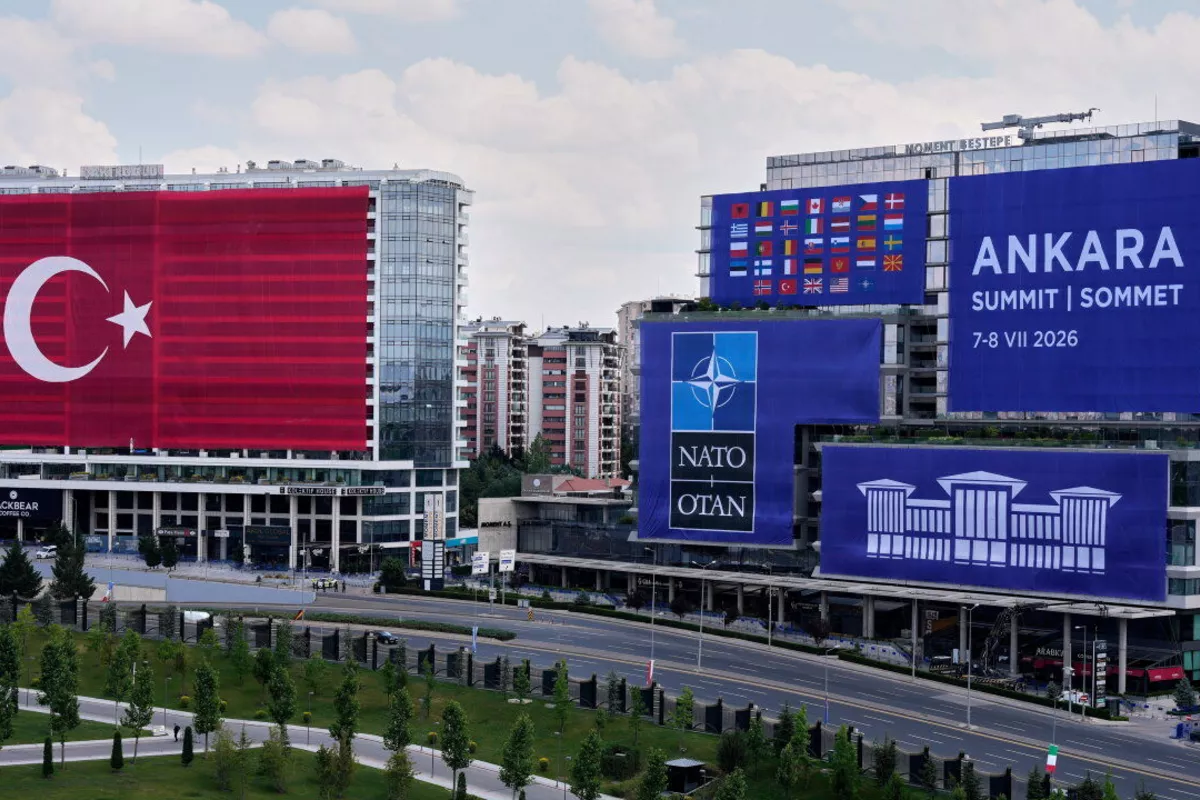
To the founding commander, the American presence in Europe was merely construction scaffolding, meant to be dismantled once Europe could stand on its own. Seventy-five years later, far from American troops leaving, this scaffolding has become the building's load-bearing pillar. As the alliance convenes in the Turkish capital Ankara on July 7-8, the very same question remains unanswered: When will Europe pull its own weight?
What is NATO 3.0?
Washington’s answer to the European question is currently being framed as "NATO 3.0." Rather than a rigid new doctrine, this concept should be viewed as a renegotiation of the alliance's core compact in response to shifting global power dynamics. The clearest articulation of these new terms came from Elbridge Colby, the US defense under secretary for policy, during his address at a NATO defense ministers' meeting in Brussels in February 2026.
The term itself, however, has been around longer than many realize. Back in 2012, in the wake of the Lisbon and Chicago summits, NATO Deputy Secretary General Alexander Vershbow suggested the alliance was moving toward a NATO 3.0 - one defined by expanding global partnerships. Ironically, Vershbow’s vision is precisely the model Colby now seeks to dismantle: an alliance heavily focused on out-of-area missions and global outreach.
Under the framework Colby envisions, which represents today's definition of NATO 3.0, Europe would assume primary responsibility for its own conventional defense. Meanwhile, the US would shift its strategic weight toward homeland defense and deterring China in the Indo-Pacific, effectively transforming the US-Europe dynamic from one of dependency into a genuine partnership.
In that same speech, Colby effectively recontextualized the alliance's history. According to his narrative, the deterrence-focused "NATO 1.0" of the Cold War lost its primary purpose when the Berlin Wall fell in 1989. It then morphed into "NATO 2.0," an era characterized by interventions stretching from the Balkans to Afghanistan, during which Washington simply tolerated Europe's chronically underfunded military budgets. NATO 3.0 envisions abandoning the habits of the past 35 years and returning to a model that closely mirrors the alliance's founding principles.
Whether intentionally or not, Colby's framework leads right back to Eisenhower’s original "scaffolding." Through this lens, what we are witnessing is not a revolution but rather, to borrow Washington’s own phrasing, a historical course correction.
Accurately assessing the current stage of this course correction is just as critical as understanding the concept itself. The "crossroads" metaphor, so frequently invoked in pre-summit commentary, wrongly implies that the alliance is still searching for its direction. In reality, that strategic trajectory was unanimously agreed upon last year. As member states gather at the Ankara summit, they are no longer faced with a question of which way to turn. Instead, the summit will be defined by a fundamental "make-or-break" test. Will the alliance actually stay the course it has chosen? NATO Secretary General Mark Rutte has framed the Ankara meeting as a summit of delivery and execution regarding the guarantees made last year in The Hague. Emphasizing that Ankara could prove even more pivotal than its predecessor, he issued a stark reminder that making a pledge is a far cry from actually fulfilling it.
The commitments Rutte was referring to were codified at the June 2025 summit in The Hague. There, all 32 allies signed a landmark pledge to allocate 5% of their gross domestic product (GDP) to defense. Under this framework, a strict baseline of 3.5% is earmarked for core defense capabilities, while up to 1.5% is directed toward security-adjacent domains such as infrastructure, resilience, and the defense industrial base. This exact moment is where the structural transformation, so often hinted at by the "crossroads" narrative, truly took place.
What do the Defense Spending Trends Reveal?
The data on NATO members' defense expenditures clearly illustrates this transformation. A look at defense spending as a percentage of national income between 2015 and 2025 shows that 31 of the 32 allies have increased their defense-to-GDP ratios. The US is the only member state to see its share decline. European allies and Canada have boosted their collective defense investments from 1.4% of GDP in 2014 to 2.3% in 2025. By Rutte's calculations, an additional $1.2 trillion has been injected into defense over the past decade. The jump from 2024 to 2025 alone represented a 20% surge, a massive $139 billion year-on-year increase.
Ultimately, this trajectory was set in motion by the outbreak of the Russia-Ukraine war in 2022. Donald Trump's second term did not initiate the shift, but rather acted as a powerful accelerant to a process that was already well underway.
The agenda for the Ankara summit is designed to build directly upon the commitments forged in The Hague. The gathering is anchored by three core priorities: scaling up defense investments, bolstering the transatlantic defense industrial base, and sustaining support for Ukraine. With several allies on track to hit the 5% target well ahead of schedule, some as early as 2026, the summit is less concerned with the sheer volume of new spending than with ensuring those funds are channeled into the right capabilities. The itinerary itself underscores this operational pivot. Nearly all of the summit's first day on July 7 was devoted to defense industry forums and negotiations. By allowing production, procurement, and technological integration to occupy more time than the standard leaders' sessions, the message is clear: The alliance’s center of gravity is shifting away from diplomatic communiques and toward factory floors, supply chains, and testing lines.
How Meaningful is the 5% Metric?
The most glaring lesson of the Russia-Ukraine war is that in a protracted conflict, industrial capacity ceases to be a mere support function and transforms into combat power in its own right. A layer above this industrial reality lies a profound political question: Can Europe’s political classes, who for three decades have treated defense as a mere accessory to foreign policy, once again place deterrence at the very center of statecraft?
At the highest level, however, there remains a critical need for an overarching conceptual framework to bind all these layers together. At present, NATO 3.0 functions more as a slogan than a concept. It is a framing device that still offers no clear answers regarding what exactly the alliance is collectively deterring, what the American commitment will actually look like once burden-sharing is achieved, or what the concrete criteria for "sufficient" sharing even entail. Until that strategic void is filled, the 5% target will remain little more than an accounting line item devoid of an actual strategy.
However, reducing the debate solely to the 5% threshold is misleading. While robust funding is a necessary precondition, it is far from sufficient. How that capital is deployed is just as critical as the top-line figure. Success hinges on everything from the agility of procurement cycles and the rapid scaling of industrial capacity to the elimination of duplicative European defense programs (such as the overlapping FCAS-GCAP, Sky Shield-SAMP/T, and Eurofighter-Rafale projects).
The scale of this fragmentation is stark. European militaries operate 178 different types of major weapon systems, compared to the roughly 30 fielded by the US. In armor alone, Europe maintains 17 distinct models of main battle tanks; the US relies on one. Ultimately, these deep-seated structural inefficiencies mean that a 5% spending target, viewed in isolation, will fail to translate into true operational effectiveness.
What will truly be tested in Ankara is whether written signatures can be translated into hard capabilities, capabilities into actionable doctrine, and doctrine into a coherent strategic vision for the alliance. If this progression materializes, it will mean that NATO 3.0 has finally begun its evolution from a hollow slogan into a concrete strategy. Should the outcome remain ambiguous, however, it is not the chosen path that will be called into question, but rather the alliance's political stamina to actually walk it. Ultimately, the European security architecture of the coming decade will lay bare the difference.
Find the original article here