One Year On, Washington Summit Shapes Azerbaijan-Armenia Peace
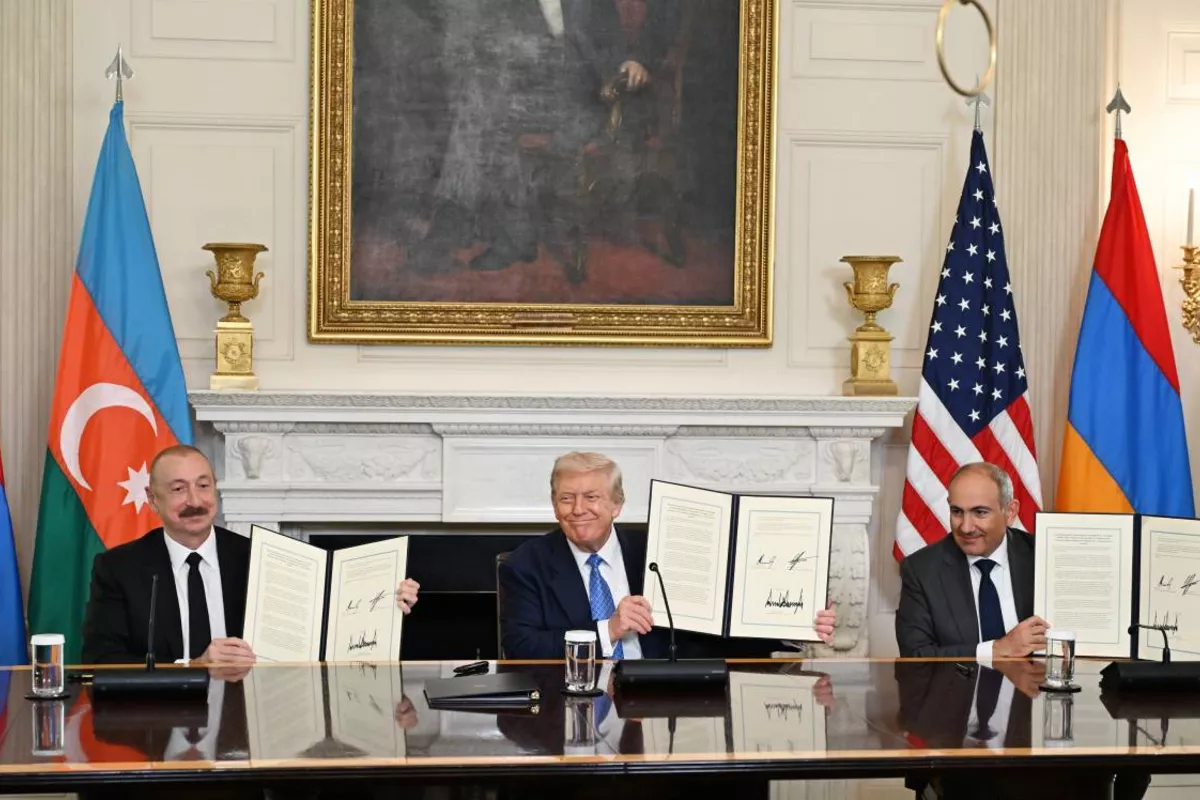
One year has passed since the landmark meeting in Washington between Azerbaijani President Ilham Aliyev, US President Donald Trump and Armenian Prime Minister Nikol Pashinyan on Aug. 8, 2025.
On that date, the three leaders signed a Joint Declaration outlining the outcome of the Washington summit.
The declaration stated that Ilham Aliyev, Nikol Pashinyan and Donald Trump witnessed the initialling by the foreign ministers of the agreed text of the Agreement on the Establishment of Peace and Interstate Relations between the Republic of Azerbaijan and the Republic of Armenia. It also noted that additional steps were needed before the agreement could be formally signed and ratified.
The meeting, held with the participation of President Trump, is considered one of the most significant milestones in the normalization of relations between Azerbaijan and Armenia.
The Joint Declaration on the outcome of the Washington summit reaffirmed the parties’ commitment to the peace agenda and their readiness to establish relations based on the principles of international law.
The document stressed the inadmissibility of using force or threatening to use force and highlighted the importance of building the region’s future on cooperation and mutual respect.
One of the key points of the declaration was the parties’ stated intention to close the chapter of hostility resulting from the past conflict.
The document specifically emphasized that revanchism would not be tolerated and that future relations would be built on peace and cooperation. This approach was viewed as an important political message aimed at creating an environment of trust in the region.
The initialling of the peace agreement text between Azerbaijan and Armenia was regarded as a significant breakthrough in the years-long negotiation process and a step toward establishing the legal foundations for a future peace treaty.
Following the Washington summit, the OSCE Minsk Group officially ceased its activities at the request of Azerbaijan and Armenia. After the agreement was initialled, restrictions on cargo transit from Azerbaijan to Armenia were lifted, allowing shipments such as Russian and Kazakh wheat to be transported to Armenia through Azerbaijani territory. Azerbaijan also began supplying oil products to Armenia.
Another outcome of the Washington summit was the acceleration of preparations for the TRIPP (Trump Route for International Peace and Prosperity) project. Technical and infrastructure preparations for implementing the transport route connecting Azerbaijan’s mainland with Nakhchivan have continued. Azerbaijan has expanded construction of road and railway infrastructure on its territory.
During this period, an Azerbaijani delegation led by Deputy Prime Minister Shahin Mustafayev visited Armenia. In April this year, the sides agreed on draft instructions for the delimitation process.
Thus, the document signed in Washington has gone down in history not only as a significant step toward normalizing relations between Azerbaijan and Armenia, but also as a strategic political factor for regional security, economic development and prospects for international cooperation.
The Washington summit has also been viewed by the international community as an important diplomatic step toward strengthening stability in the South Caucasus. Experts believe the document has created an important legal and political foundation for continuing direct dialogue between the parties, expanding opportunities for regional connectivity and economic cooperation, and moving toward the signing of a final peace agreement.