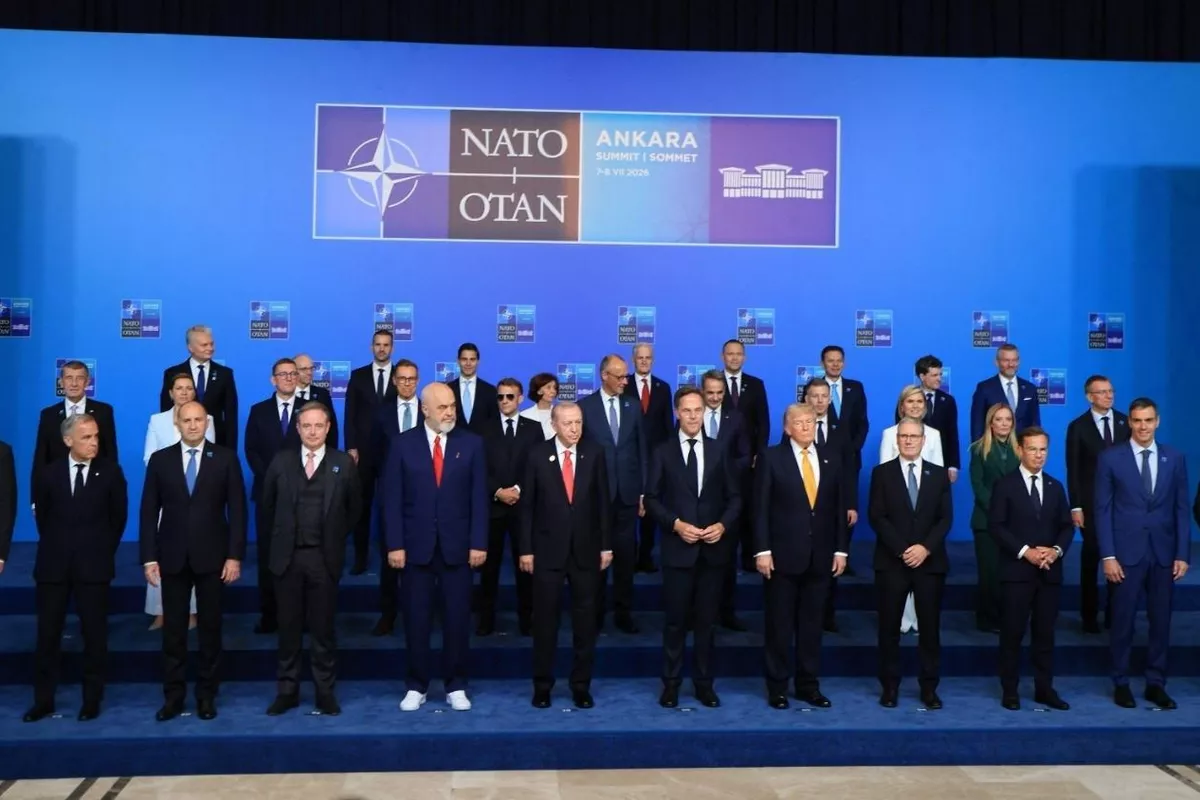
As Ankara hosted the 36th NATO Summit, the center of gravity of the transatlantic alliance appeared to shift decisively towards Türkiye. At a moment of profound geopolitical turbulence-from the wars in the Middle East to the war in Eastern Europe-the spotlight was firmly fixed on a country that has emerged not merely as a center of stability, but as an indispensable power in the evolving global security architecture.
On July 7 and 8, Turkish President Recep Tayyip Erdogan welcomed the heads of state and government of all 32 NATO member countries to Ankara, alongside nearly 100 ministers, senior diplomats, representatives of international organizations, and distinguished guests. The gathering marked the first time Türkiye had hosted the Alliance's highest-level summit since 2004.
Two decades on, however, Türkiye's position within NATO has been fundamentally transformed.
Beyond geography: A geopolitical powerhouse
Türkiye is no longer the Türkiye of the past. Ankara today receives its allies not simply as the guardian of NATO's southeastern frontier, but as a military power, diplomatic broker, and geopolitical center in its own right. With NATO's second-largest military after the US, Türkiye possesses a defense capacity few members of the Alliance can rival. Its formidable naval presence and the largest submarine force across the Mediterranean and Black Sea further place the country at the heart of the emerging maritime security equation.
Geography has always given Türkiye strategic importance and advantage. Yet geography alone no longer explains Ankara's growing international weight. From the Black Sea to the Eastern Mediterranean, and from the Balkans to the Middle East and North Africa, Türkiye is increasingly combining its geographic position with military capacity, diplomatic reach, and strategic autonomy.
The Ankara Summit convened at a defining geopolitical moment. To Türkiye's north, the Russia-Ukraine war continues to affect Eastern Europe with no decisive end in sight. Across the Middle East, the repercussions of the US-Israeli war against Iran have generated new waves of instability throughout the Gulf and the wider region. The Israeli genocidal onslaught and aggression towards Gaza are ongoing as the humanitarian crisis deepens, while the future stability of Syria, Lebanon, and Libya continues to carry consequences far beyond their national borders.
Meanwhile, the United States is increasingly recalibrating its international commitments. Washington is turning its strategic attention inward and reconsidering the scale of military resources it may make available to NATO in times of crisis or war, while simultaneously urging its European allies to shoulder a greater share of the collective defense burden.
As old assumptions underpinning the Western security order begin to erode, one reality is becoming increasingly difficult to ignore: Türkiye is no longer a peripheral actor in the global security equation. It is becoming one of its principal architects.
The rise of indigenous defense capabilities
This transformation is perhaps most visible in Türkiye's defense industry. The era in which the country merely consumed imported defense technologies is over. Under President Erdogan's leadership, Türkiye has entered an age of indigenous production, technological capability, and defense exports. The shift from consuming to producing-and from importing to exporting-has fundamentally altered Türkiye's strategic position within NATO and on the world stage. Military strength, however, represents only one dimension of Türkiye's growing influence.
In the Russia-Ukraine war, Ankara has preserved channels of communication in pursuit of a diplomatic settlement. At a time when dialogue between competing powers has become increasingly difficult, Ankara's ability to mediate between Moscow and Washington has given it a unique geopolitical reach. In the tensions between Iran and the United States, Ankara has consistently advocated restraint, diplomacy, and the preservation of conditions necessary for lasting peace.
From Gaza and Lebanon to Libya, Türkiye continues to champion ceasefires, regional stability, and multilateral cooperation. During the Ankara Summit, discussions once again focused on securing a lasting ceasefire in Gaza, ending the Russia-Ukraine war through diplomacy, preserving the understanding between Iran and the United States, and establishing sustainable stability in Syria. This is the essence of Türkiye's emerging strategic identity: security provider, diplomatic bridge, and regional stabilizer.
The next chapter of the Transatlantic alliance
The intensive two-day Ankara Summit demonstrated that Türkiye is now a central actor shaping NATO's security agenda-a country capable of keeping channels of dialogue open during crises, preserving a broader vision of regional peace, and making a tangible contribution to the Alliance's transformation through its expanding defense-industrial capacity.
Ankara's strategy of balance, foresight, and active engagement has enabled Türkiye to contain the spillover of successive regional crises while steadily consolidating its position on NATO's southern flank. In a geography encompassing the Mediterranean, the Middle East, and North Africa, Türkiye increasingly represents the Alliance's most consequential strategic anchor.
This may also offer a glimpse into NATO's next chapter. As Europe is compelled to assume greater responsibility for its own security and the United States recalibrates its global posture, the Alliance will increasingly depend on members capable not only of possessing military strength but also of producing defense capabilities, understanding regional dynamics, and operating across competing geopolitical spheres. Türkiye possesses all four.
The 2026 NATO Summit therefore carried a significance extending far beyond the meeting rooms of Ankara. It showed the world that Türkiye is not merely a powerful NATO ally. It is a strategic leading actor that produces peace, provides security, manages crises, and commands international respect.
Today, Türkiye is a leading country that the world listens to. It speaks with determination and conviction to help ensure world peace and global security for the future of the international order. The emerging security architecture of the twenty-first century will not be shaped solely in Washington or Brussels. Increasingly, strategic calculations will have to run through Ankara. Türkiye is emerging as one of the world's great powers-a central state in the evolving international order and one of the countries positioned to shape the future balance of global power. The Ankara Summit confirmed a new strategic reality: as the global security order is rewritten, Türkiye will be at the center of shaping what comes next.
Find the original article here