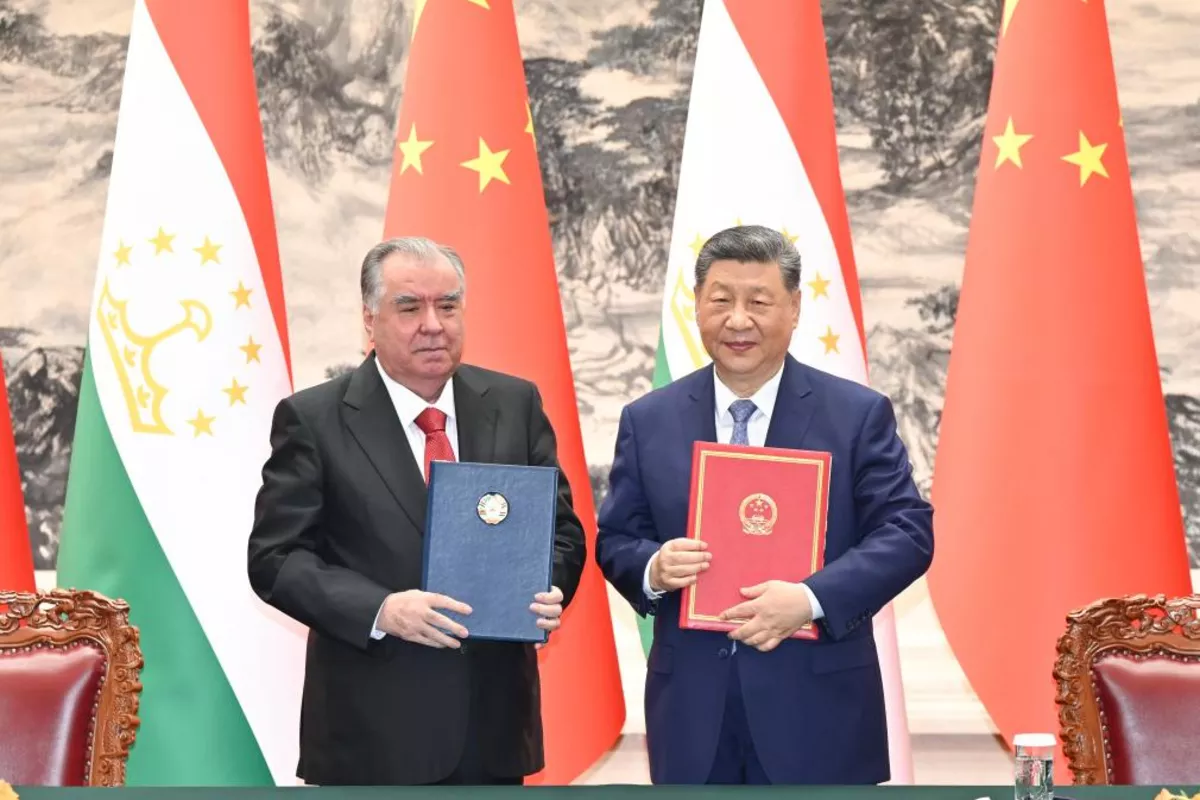
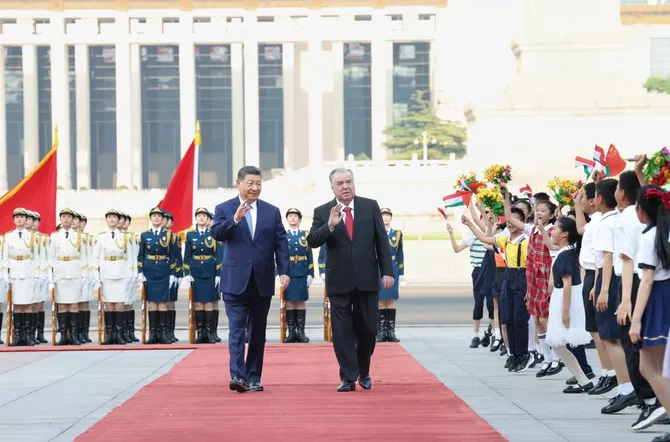
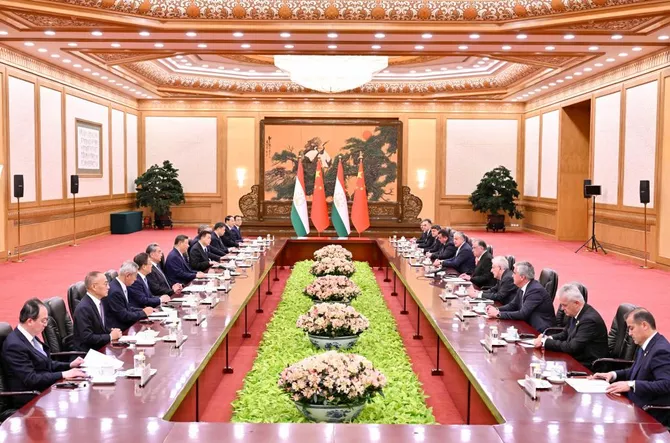
Relations between China and Tajikistan have entered a new and more ambitious stage following talks in Beijing between Chinese President Xi Jinping and Tajik President Emomali Rahmon. The visit was marked not only by symbolic diplomatic gestures, but also by the signing of long-term strategic agreements that reveal how both countries increasingly view each other as indispensable partners in a rapidly changing geopolitical environment.
The meeting demonstrated that China-Tajikistan ties are evolving beyond traditional political goodwill into a multidimensional strategic partnership involving infrastructure, security, technology, energy, and regional governance. The signing of the Treaty on Permanent Good-Neighborliness, Friendship and Cooperation indicates that both states are attempting to institutionalize their relationship for decades ahead, according to Xinhua.
For Beijing, Tajikistan occupies a critical position in Central Asia due to its geographic location bordering Afghanistan and its growing role within China’s Belt and Road Initiative (BRI). For Dushanbe, closer alignment with China offers economic modernization opportunities, investment inflows, technological support, and additional geopolitical balancing power at a time of uncertainty in Eurasia.
Source: Xinhua
A Strategic Partnership Rooted in Security and Geography
One of the most important aspects of the new phase in China-Tajikistan relations is the increasing security dimension. Xi Jinping’s emphasis on combating terrorism, separatism, and extremism reflects Beijing’s long-standing concerns regarding stability in Central Asia and western China, particularly in Xinjiang.
Tajikistan shares a long and sensitive border with Afghanistan, making it strategically significant for regional counterterrorism efforts. Since the Taliban’s return to power in Afghanistan, neighboring countries have become increasingly concerned about cross-border extremism, narcotics trafficking, and militant movements. China sees Tajikistan as a frontline state in maintaining regional stability and preventing security spillovers into Central Asia and Chinese territory.
For years, security cooperation between the two countries has steadily expanded through bilateral mechanisms and multilateral frameworks such as the Shanghai Cooperation Organization. However, the latest agreements suggest that security coordination is becoming more deeply embedded in the broader strategic relationship.
Beijing’s approach toward Central Asia has evolved from purely economic engagement into a hybrid model combining development and security. China increasingly believes that economic corridors and infrastructure projects cannot succeed without regional stability. As a result, Tajikistan’s role is no longer simply that of a transit country; it is becoming a security partner crucial to protecting China’s western strategic interests.
Rahmon’s strong support for the one-China principle and his endorsement of China’s global initiatives also reflect the growing political alignment between the two governments. Tajikistan has consistently supported Beijing on issues such as Taiwan and Xinjiang, while China has backed Tajikistan’s sovereignty and political stability.
This political convergence is particularly important at a time when global politics is becoming increasingly polarized. Smaller and medium-sized states like Tajikistan are seeking reliable partnerships that can provide both economic and security guarantees without demanding sweeping political reforms or ideological alignment.
Economic Cooperation Moves Beyond Infrastructure
While infrastructure remains central to bilateral ties, the newest agreements reveal that China-Tajikistan economic cooperation is entering a more technologically advanced stage.
In earlier years, Chinese investment in Tajikistan largely focused on roads, tunnels, energy facilities, and transportation networks under the Belt and Road Initiative. Those projects helped improve Tajikistan’s connectivity and reduced some of the country’s long-standing infrastructure bottlenecks. However, the latest talks indicate a shift toward sectors associated with future economic competitiveness.
Xi Jinping specifically highlighted cooperation in green energy, artificial intelligence, digital economy, and smart city development. This signals that China wants its partnerships in Central Asia to evolve alongside its own economic transformation toward high-tech and innovation-driven growth.
For Tajikistan, this transition could be highly significant. The country possesses major hydropower potential and substantial reserves of critical minerals that are increasingly important for global green technology supply chains. China’s interest in green mining and advanced technologies suggests Beijing sees Tajikistan as part of its broader strategy to secure resources needed for electric vehicles, renewable energy systems, and advanced manufacturing.
At the same time, Tajikistan hopes Chinese investment can accelerate industrialization and reduce dependence on remittances and commodity exports. The country’s National Development Strategy 2030 aligns closely with Beijing’s vision of connectivity and industrial modernization. The synchronization of these national plans gives both governments a long-term framework for cooperation.
Another notable element is the expansion of educational, cultural, and people-to-people exchanges. China increasingly recognizes that sustainable influence in Central Asia requires social and cultural engagement alongside economic investment. Scholarships, university partnerships, language programs, and media cooperation are becoming key tools in strengthening long-term bilateral relations.
The signing of agreements covering agriculture, market supervision, inspection systems, and housing development also indicates that cooperation is broadening into practical sectors affecting everyday economic life. This reflects a maturing partnership that is no longer dependent solely on flagship infrastructure projects.
Source: Xinhua
China’s Expanding Role in Central Asia
The deepening of China-Tajikistan relations must also be viewed within the wider context of Central Asia’s geopolitical transformation.
For decades, Russia remained the dominant external power in Central Asia through military ties, labor migration networks, and historical influence. However, China has steadily emerged as the region’s most powerful economic actor. Beijing’s growing engagement with Tajikistan reflects a broader trend in which Central Asian states are diversifying their partnerships and reducing overdependence on any single external power.
The China-Central Asia mechanism, referenced during the talks, has become increasingly important in institutionalizing Beijing’s regional role. Through this platform, China is building direct strategic relations with Central Asian governments independent of Russian-led structures.
At the same time, China is presenting itself as a supporter of “true multilateralism” and a more “equitable” global governance system. These concepts resonate with many developing states that seek greater autonomy in international affairs and more diversified economic partnerships.
For Tajikistan, stronger relations with China provide access to capital, technology, and political support without the conditions often associated with Western aid and investment. However, this growing dependence on Chinese financing and trade also creates long-term questions regarding debt sustainability, economic leverage, and strategic balance.
Nevertheless, the current trajectory suggests that both Beijing and Dushanbe view their partnership as increasingly indispensable. The newly signed treaty formalizes a relationship that is already becoming one of the most strategically important bilateral partnerships in Central Asia.
The latest summit between Xi Jinping and Emomali Rahmon therefore represents more than a routine diplomatic meeting. It marks the emergence of a deeper strategic alignment shaped by shared security concerns, economic modernization goals, and shifting geopolitical realities across Eurasia.
As China continues expanding its political and economic presence in Central Asia, Tajikistan is positioning itself not merely as a passive participant in regional projects, but as an active strategic partner in Beijing’s long-term Eurasian vision.