Türkiye is preparing to send its first spacecraft beyond Earth orbit, a mission designed not only to study the Moon but also to test whether satellite technologies can operate autonomously in deep space.
The spacecraft is targeted for launch in the second quarter of 2027, according to the mission’s project manager. It will travel for about two months before entering a circular polar orbit roughly 100 kilometers (62 miles) above the lunar surface. It is expected to operate there for at least three months, with the mission potentially extended to up to 1.5 years depending on performance.
“We will obtain important images from the Moon, have high-resolution cameras and collect scientific data,” Burak Yaglioglu, project manager for the mission at the Scientific and Technological Research Council of Türkiye’s Space Technologies Research Institute (TUBITAK UZAY), told Anadolu at the International Astronautical Congress in Antalya.
The mission is the first phase of Türkiye’s Lunar Research Program, one of the 10 strategic targets of its National Space Program. Its broader purpose is to move the country’s space capabilities beyond Earth orbit and prepare the technology and experience needed for more ambitious lunar missions.
A first step beyond Earth
Türkiye has developed and operated Earth-orbiting satellites for years, including the IMECE Earth-observation satellite and the TURKSAT 6A communications satellite.
But working around the Moon is a substantially different challenge.
The lunar spacecraft, weighing about 3.5 tons, has a domestic content rate of more than 80%, according to TUBITAK. Production, assembly and integration were completed in September, and the spacecraft has now entered system-level environmental testing ahead of its launch.
The spacecraft uses the TstarD-100 platform developed by TUBITAK UZAY specifically for deep-space missions. Of its 65 mission-critical components, 56 were manufactured using domestic capabilities, while several systems draw on technology previously developed for Türkiye’s IMECE and TURKSAT 6A programs.
“For the first time, we will enter the orbit of a body other than Earth and conduct operations there,” Yaglioglu said.
He said the team designed the spacecraft and mission architecture itself and that its software is also being developed domestically.
The point, he said, is not simply to reach the Moon but to demonstrate that Türkiye can design, operate and extract scientific data from a spacecraft operating deep in space.
How will it find its way around the Moon?
One of the mission's more ambitious technology demonstrations involves autonomous navigation.
A spacecraft orbiting the Moon cannot rely on GPS in the way a vehicle on Earth can. Instead, Türkiye is developing an image-based navigation system that will use recognizable features on the lunar surface, including craters, to determine the spacecraft’s position and orientation.
“We are developing an image-based navigation system,” Yaglioglu said. “These will determine the position and orientation of our spacecraft by looking at craters on the lunar surface, so our spacecraft will be able to carry out autonomous operations in lunar orbit.”
That capability could become particularly important for future missions in which a spacecraft needs to navigate with less reliance on commands from Earth.
The spacecraft will also carry four scientific payloads. Two were developed domestically, while two were developed through international cooperation with researchers in Sweden and China. The instruments will study, among other things, the interaction between solar wind and the lunar surface, the Moon’s local magnetic environment and processes related to water formation.
Its imaging system is designed to provide panchromatic images at resolutions of up to 0.7 meters, alongside wide-area RGB imaging and video.
What happens after the science?
The first mission is not designed to make a soft landing.
After completing its planned scientific operations in lunar orbit, the spacecraft is expected to be deliberately sent toward the lunar surface through controlled maneuvers using its propulsion system. TUBITAK describes this as a hard landing at the end of the first mission.
A hybrid propulsion system developed domestically with Turkish company DeltaV will be used for key maneuvers, including raising the spacecraft’s orbit and the final controlled descent.
The distinction matters because the soft landing comes later.
Türkiye’s second lunar mission is planned to build on the first mission’s experience and attempt a controlled landing on the Moon, followed by the deployment of a rover for surface exploration.
Yaglioglu said the two missions are therefore being considered together.
"The second mission involves a soft landing and taking a rover to the surface," he said. While working on the first mission, he added, the team has also been planning for the second, designing its systems around an architecture suited to landing and surface exploration.
Why does the mission matter?
For Türkiye, the lunar program is intended as a test of a much broader technological capability.
The country’s National Space Program was unveiled in 2021 and includes goals ranging from developing domestic satellite technologies to sending a spacecraft to the Moon. Türkiye also carried out its first human spaceflight mission in 2024, when astronaut Alper Gezeravci traveled to the International Space Station.
The lunar mission takes the next step: operating a spacecraft in an environment far beyond Earth orbit.
Yaglioglu said the spacecraft’s communications, power systems, flight computers, software and other components will gain what the industry calls “flight heritage” -- operational experience that can inform future missions.
“This has also given us important experience,” he said, referring to the development of the first spacecraft and the preparations for the second mission.
For Türkiye, that experience may ultimately be as important as the scientific data gathered from the Moon.
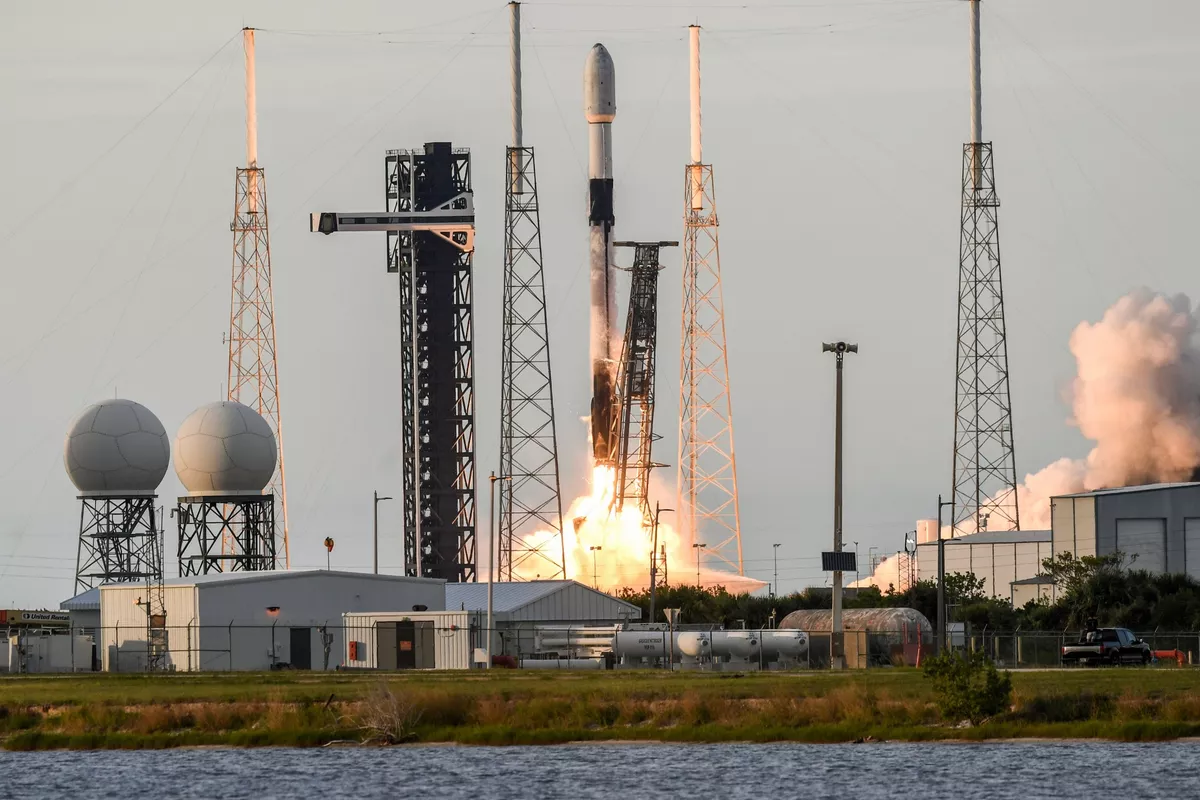
The spacecraft is now undergoing acoustic, vibration, thermal-vacuum and electromagnetic-compatibility testing designed to simulate the conditions it will face during launch and in space. If testing and final preparations proceed as planned, it will be transported to the Kennedy Space Center in the US where a SpaceX launch vehicle will carry it into Earth orbit.
The spacecraft will then use its DeltaV propulsion system to begin its journey toward the Moon.
Türkiye aims to become the ninth country to carry out a lunar mission, according to Industry and Technology Minister Mehmet Fatih Kacir.
As Yaglioglu put it, the objective is not simply to go to the Moon but to turn the technologies, engineering and scientific capabilities developed for the journey into a foundation for Türkiye’s next generation of deep-space missions.
Find the original article here