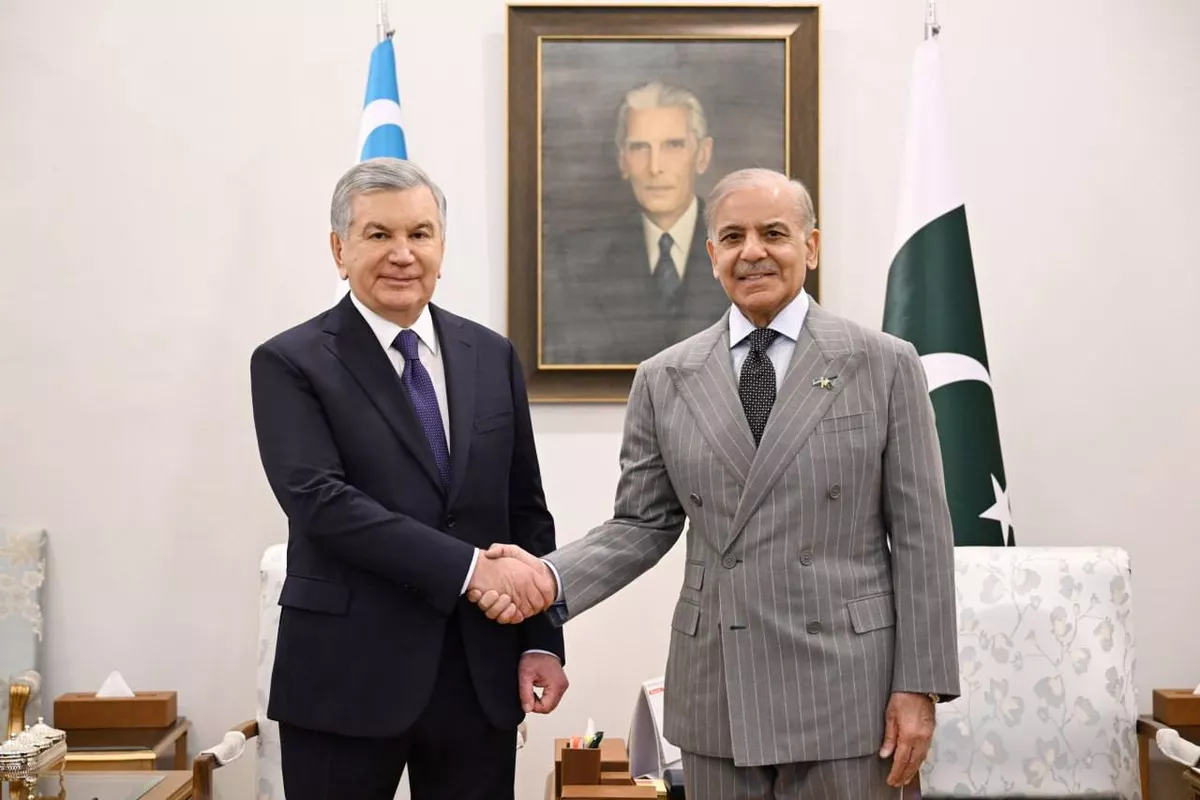
When Uzbek President Shavkat Mirziyoyev and Pakistani Prime Minister Shehbaz Sharif met in Islamabad on February 5, the immediate headline was clear and ambitious: both sides agreed on a roadmap to elevate bilateral relations to a strategic partnership and set a target of increasing mutual trade to $2 billion in the coming years. On its own, such a declaration might sound familiar in diplomatic practice, where lofty targets are often announced but not always realized. Yet the real importance of the meeting lies less in the number itself and more in the framework constructed around it-a framework built on institutions, sectoral cooperation, trade facilitation, and connectivity.
This meeting marked more than a ceremonial reaffirmation of ties. It signaled a transition in how Uzbekistan and Pakistan approach one another: from a relationship shaped largely by political goodwill and episodic engagement to one increasingly grounded in governance, implementation, and regional integration. In this sense, describing the moment as a “new page” is justified-not because bilateral relations were previously dormant, but because they are now being reorganized into a more systematic and durable form.
The challenge ahead is clear. Aspirations alone will not deliver a fourfold increase in trade or reshape regional connectivity. Success will depend on whether Tashkent and Islamabad can sustain momentum, translate political alignment into bureaucratic execution, and anchor their partnership in concrete economic mechanisms.
From Political Goodwill to Institutional Depth
A key detail of the February 5 talks was their format. In addition to a restricted meeting between the two leaders, discussions were held within the framework of the first meeting of the High-Level Strategic Cooperation Council. This is not a routine diplomatic flourish. Such councils are designed to address one of the most persistent weaknesses in bilateral relations: the gap between political intent and administrative delivery.
Even when leaders share a clear vision, implementation can falter if government agencies operate in silos, move at different speeds, or lack clear coordination. A high-level council is meant to provide continuity between summits, keep decisions alive within bureaucracies, and ensure that agreements are not lost in procedural inertia.
During the talks, Mirziyoyev and Sharif emphasized the need for practical steps to implement previously agreed decisions. They highlighted the steady intensification of political dialogue, the expansion of inter-parliamentary contacts, and deeper engagement between ministries and agencies. While such language is standard in diplomatic communiqués, in this context it carries a more concrete meaning. Both sides appear to recognize that achieving strategic partnership status requires institutional stamina, not just shared intent at the top.
In practical terms, this means building administrative capacity: harmonizing regulations, coordinating customs authorities, aligning standards, and ensuring that trade and investment initiatives survive changes in personnel or political cycles. Without this governance layer, ambitious targets risk becoming rhetorical benchmarks rather than measurable outcomes.
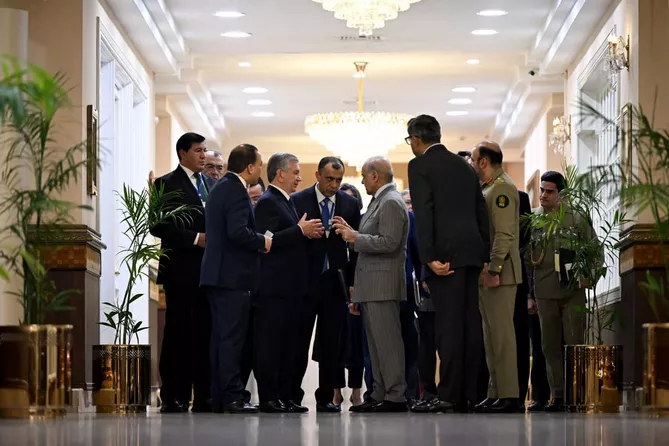
Photo: Uzbekistan President's press service
Trade Growth: A Solid Base, But a Steep Climb Ahead
The economic dimension of the relationship offers both encouragement and realism. By the end of last year, bilateral trade had approached $500 million. This is a meaningful figure, especially given the geographic distance and logistical constraints that have historically limited exchange between Central and South Asia. It demonstrates that commercial channels exist and that there is demand on both sides.
Equally significant is the presence of approximately 230 enterprises with Pakistani capital operating in Uzbekistan. Investment-backed trade tends to be more resilient than purely transactional exchange. Joint ventures and production facilities create long-term interests that incentivize governments to maintain stable trade regimes, reliable logistics, and predictable financial conditions.
At the same time, the numbers highlight the magnitude of the task ahead. Moving from $500 million to $2 billion implies a fourfold increase in trade volumes. This is achievable only if growth is driven by structural changes rather than incremental gains. Recognizing this, both sides outlined specific mechanisms aimed at removing bottlenecks and expanding the range of tradable goods.
Among the measures discussed were the expansion of the list of products covered under the Preferential Trade Agreement, the broadening of phytosanitary permits for Uzbek agricultural exports, and the more active use of Uzbekistan’s trade houses in Lahore and Karachi. These steps may appear technical, but they address precisely the obstacles that often cap trade growth: limited product coverage, non-tariff barriers, and the absence of effective commercial representation in key markets.
In this respect, the meeting did more than set a numerical target. It identified the levers through which that target might realistically be reached.
Trade Facilitation as the Decisive Battleground
If the next phase of Uzbekistan-Pakistan relations succeeds, it will be largely because both sides manage to improve trade facilitation. This is where many bilateral ambitions falter-not due to lack of political will, but because of unresolved administrative friction.
Expanding the preferential trade list is not merely a tariff issue. It requires trust that sensitive sectors can be opened gradually without causing domestic disruption. It also demands that customs authorities are prepared to process a wider range of goods efficiently, with clear rules on classification, origin, and valuation.
Phytosanitary permits are even more revealing. Agricultural trade is often constrained less by tariffs than by regulatory barriers. Approving new products for export implies confidence in inspection regimes, quality standards, and enforcement mechanisms. When leaders explicitly prioritize phytosanitary expansion, they acknowledge that future trade growth depends on reducing non-tariff obstacles rather than relying on political declarations.
The role of trade houses in Lahore and Karachi illustrates another important point. If properly staffed and integrated into local business ecosystems, these offices can function as deal-making platforms, after-sales support centers, and dispute-resolution facilitators. If neglected, they risk becoming symbolic storefronts with limited commercial impact. Their effectiveness will depend on mandate, professional capacity, and close coordination with chambers of commerce, logistics providers, and financial institutions.
In short, the “new page” in bilateral relations will be judged less by summits and more by whether these facilitation mechanisms work smoothly on a day-to-day basis.
Investment, Finance, and Sectoral Cooperation
Another notable feature of the Islamabad talks was the emphasis on sector-specific cooperation. Joint projects are already underway in textiles, pharmaceuticals, chemicals, and agriculture-sectors that offer strong potential for value-added collaboration.
Textiles present a natural avenue for partnership, given both countries’ experience in cotton-based industries. Cooperation across different segments of the value chain-from raw materials to finished products-could enhance competitiveness in third markets.
Pharmaceuticals offer opportunities for rapid scaling, particularly in generics, provided regulatory pathways are aligned and joint ventures focus on regional distribution. Chemicals and agriculture similarly benefit from complementary strengths, especially if logistics costs are reduced and standards are harmonized.
Underlying all these sectors is the often-overlooked role of finance. The decision to strengthen correspondent relations between banks is crucial. Banking ties are the infrastructure of trade; without them, even willing businesses face difficulties in settling payments, managing risk, and accessing trade finance. If improved correspondent relations translate into practical financial instruments-especially for small and medium-sized enterprises-the trade target becomes far more attainable.
Connectivity in people-to-people terms also matters. The planned increase in direct flights is not just about convenience. Direct air links facilitate business travel, speed up negotiations, and enable the movement of higher-value and time-sensitive goods. Over time, they help transform episodic contacts into sustained commercial relationships.
Connectivity Corridors and Regional Ambition
The most strategic dimension of the February 5 meeting concerned transport and logistics. The leaders underscored the importance of accelerating the Trans-Afghan railway project and advancing the Pakistan-China-Kyrgyzstan-Uzbekistan transport corridor.
For Uzbekistan, a double-landlocked country, access to Pakistani ports represents a potential transformation in its trade geography. For Pakistan, deeper connectivity with Central Asia opens new markets and reinforces its role as a regional transit hub. Corridors, however, are not merely technical projects; they are strategic instruments that reshape economic and political relationships.
The Trans-Afghan railway illustrates both opportunity and risk. Its potential benefits-shorter routes, lower costs, diversified access-are clear. Yet its feasibility depends on stability, security, and credible governance mechanisms. Infrastructure investors and insurers are acutely sensitive to uncertainty, and rail projects require long-term predictability.
This is why corridor development must be approached as a governance challenge as much as an engineering one. Phased implementation, shared standards, coordinated border procedures, and risk-sharing arrangements will be essential to maintaining credibility.
The Pakistan-China-Kyrgyzstan-Uzbekistan corridor adds a broader regional dimension. By embedding bilateral connectivity within a wider network, it becomes easier to attract financing and harder to disrupt. Networks are more resilient than single routes, both economically and politically.
Photo: Shutterstock
Regional-Level Engagement and the Path Forward
One of the most forward-looking outcomes of the talks was the agreement to establish an Uzbek-Pakistani Forum of Regions, with plans to hold the inaugural meeting in Uzbekistan’s Khorezm region. This reflects an understanding that national-level agreements succeed only when they are translated into local action.
Regions are where investment decisions are implemented, permits are issued, and workforces are mobilized. A regional forum can facilitate targeted matchmaking between specific industries, production centers, and investors. Holding the first meeting outside the capital signals a desire to distribute the benefits of international engagement more broadly.
For this initiative to succeed, it must remain focused on practical outcomes: project pipelines, business-to-business contacts, and problem-solving. If managed effectively, it could become a powerful accelerator of trade and investment.
A New Page in Uzbekistan-Pakistan Ties
Uzbekistan and Pakistan are attempting to move their relationship from symbolic alignment to functional interdependence. The existing base-nearly $500 million in trade and hundreds of Pakistani-capital enterprises in Uzbekistan-provides a foundation. The $2 billion target offers direction. And the tools outlined in Islamabad-trade facilitation, financial connectivity, transport corridors, and regional cooperation-form a coherent strategy.
The decisive factor will be execution. Customs procedures, standards recognition, banking channels, logistics coordination, and regional engagement are unglamorous tasks, but they determine outcomes. If both governments maintain discipline in these areas, the February 5 meeting will be remembered not as a rhetorical milestone, but as a genuine turning point in Central-South Asian connectivity.
In that sense, the “new page” is real-but its significance will be measured by what gets built, shipped, financed, and sustained in the years ahead.