What is Happening in Türkiye? Political Crisis Deepens after CHP Headquarters Stormed
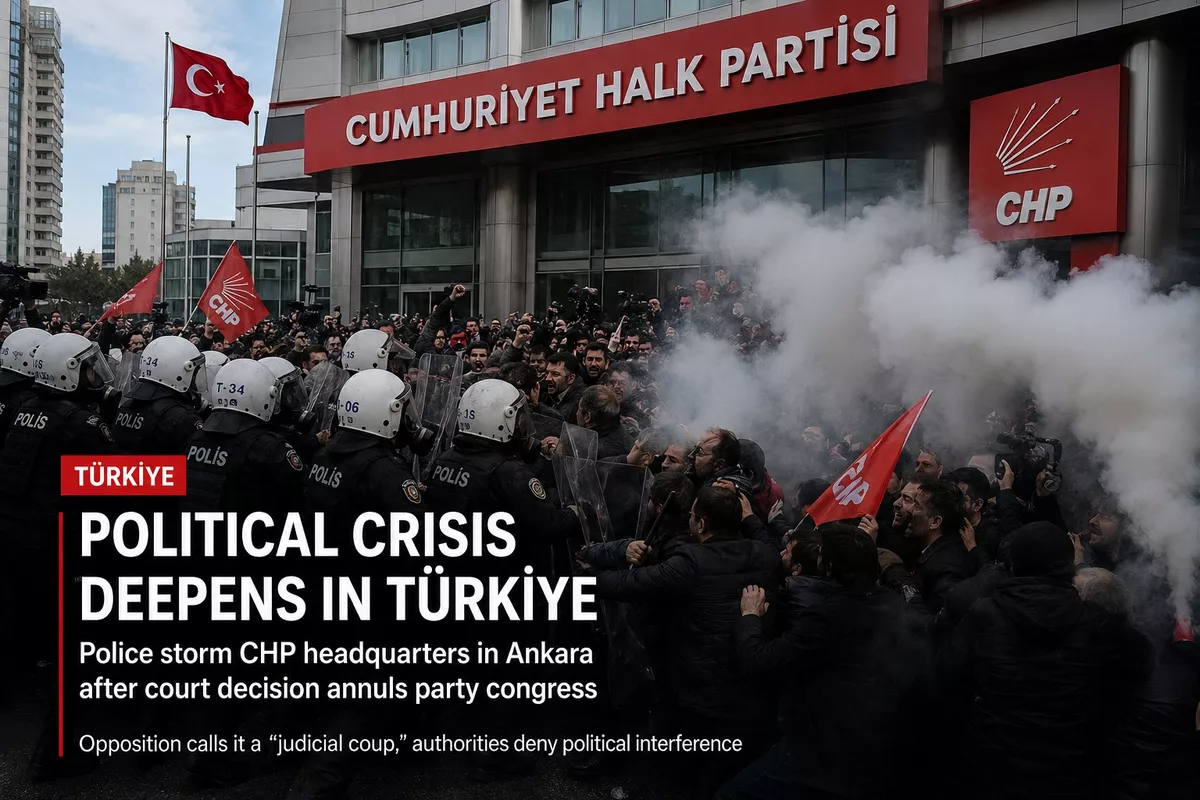
Türkiye has entered one of its most serious domestic political crises in recent years. At the center of the turmoil is the Republican People’s Party, or CHP, the country’s main opposition force and the historic party founded by Mustafa Kemal Atatürk. On May 24, Turkish police entered the CHP headquarters in Ankara, using tear gas to remove supporters of the party’s ousted leader, Özgür Özel. The episode was not merely a police operation inside a party building. It became a symbol of a deeper conflict over the future of the Turkish opposition, the judiciary and political competition in the country.
The immediate trigger was a decision by an Ankara appeals court on May 21 to annul the results of the CHP’s 2023 congress. It was at that congress that Özgür Özel was elected party chairman, replacing long-time leader Kemal Kılıçdaroğlu. Citing alleged procedural violations, the court effectively restored Kılıçdaroğlu as head of the party. Özel and his supporters described the ruling as a “judicial coup” and an attempt to weaken the opposition ahead of future elections. After the court decision, Özel called for protests and demanded that a new party congress be held as soon as possible.
The situation quickly turned into an open confrontation. Özel’s supporters barricaded themselves inside the CHP headquarters in Ankara, refusing to recognize the court ruling. The standoff reportedly lasted for three days before police entered the building, using tear gas and rubber bullets. Supporters of Özel tried to resist with improvised means, but security forces soon took control of the situation.
For Türkiye, this development matters far beyond one party. The CHP is not simply an opposition structure. It is the main political rival of President Recep Tayyip Erdoğan’s ruling Justice and Development Party, or AKP. After the 2024 municipal elections, in which the CHP achieved major gains, the party began to be seen as a real alternative to the current government. Under Özgür Özel, the CHP revived its campaign, mobilized voters and increased pressure on the ruling party.
That is why the current crisis is viewed by many observers as a blow to the most organized part of the Turkish opposition. Formally, the dispute concerns the party congress and the legal validity of the procedure that brought Özel to power. Politically, however, the consequences are much broader: the court has effectively changed the balance of power inside Türkiye’s main opposition party at a time when the country is already looking ahead to a future presidential campaign and possible early elections.
The factor of Ekrem İmamoğlu, the mayor of Istanbul and one of the most popular opposition politicians in the country, is especially important. He is widely viewed as a potentially strong candidate against Erdoğan. Pressure on the CHP, legal proceedings against its leadership and internal turmoil within the party could weaken the entire opposition infrastructure that would be needed to support a possible presidential campaign by İmamoğlu or another unified opposition candidate.
The Turkish authorities, for their part, reject accusations of political interference in the judiciary. Ankara’s official position is that the courts act independently and that political parties must comply with the law. However, for the opposition and parts of civil society, this argument is unconvincing. They believe that legal mechanisms are increasingly being used as a tool to pressure political competitors.
The crisis inside the CHP may also have serious economic consequences. Following the court ruling on May 21, Türkiye’s financial markets came under pressure, reflecting investor concerns over political instability. This shows that the business community sees domestic political tensions as a risk factor. For Türkiye, which is already dealing with high inflation, pressure on the lira and the need to attract capital, a new political confrontation could become another negative signal.
From a foreign policy perspective, developments in Türkiye will also be closely watched in Europe, the United States and the South Caucasus. Türkiye is a NATO member, a key regional power and an important player in the Black Sea, Syria, the Eastern Mediterranean and the South Caucasus. Domestic instability in such a country inevitably affects its foreign policy dynamics. Even if Ankara’s external course does not change immediately, the crisis around the CHP may raise further questions about democracy, the rule of law and the resilience of political institutions.
For the European Union, the situation is particularly sensitive. EU-Türkiye relations are already complicated by a number of issues, including migration, the customs union, human rights, the Eastern Mediterranean, Cyprus and security. If the crisis around the CHP deepens, European capitals may increase criticism of Ankara, although practical cooperation with Türkiye is likely to continue. The West still needs Türkiye as a NATO ally and as a partner on regional security and migration, which means the reaction may remain cautious.
The key question now is whether Özgür Özel and his supporters can preserve the party’s political momentum. After the police operation, Özel reportedly led his supporters toward parliament and declared that he would continue the struggle. At the same time, CHP lawmakers re-elected him as leader of the parliamentary group despite the court ruling affecting the party’s leadership structure. This suggests that the crisis has not ended; it has only entered a new phase.
For Kemal Kılıçdaroğlu, the situation is also far from simple. His return to the CHP leadership by court decision does not automatically mean political recognition within the party. For many supporters of renewal, he remains a figure of the past, associated with the opposition’s defeat in the 2023 presidential election. If a significant part of the party base refuses to accept his return, the CHP could face a deeper internal split.
Türkiye is therefore entering a period of acute political uncertainty. On the one hand, the authorities are demonstrating that court decisions will be enforced by the security apparatus. On the other, the opposition is showing that it is ready to resist and move the crisis into the streets and parliament. What is at stake is not only the fate of one party leader, but also the ability of the Turkish opposition to preserve unity ahead of future elections.
The storming of the CHP headquarters has become a symbol of a broader question: can Türkiye preserve space for genuine political competition, or will the struggle for power increasingly move from polling stations to courtrooms, police cordons and street protests? That is why the events in Ankara matter not only for the CHP, but for the entire political system of Türkiye.