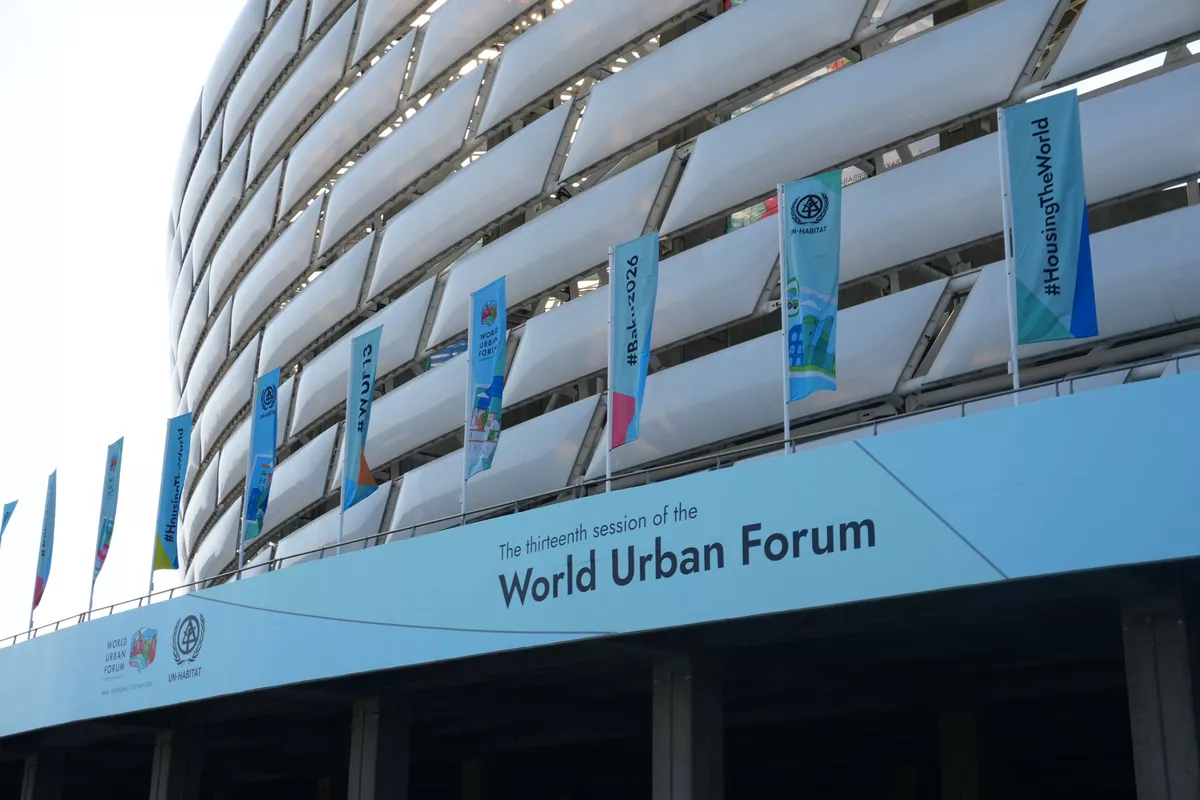
Housing has become a “systemic global challenge that shapes inequality, opportunity, resilience, and stability and peace in our cities and societies,” Executive Director of UN-Habitat Anacláudia Rossbach said at the conclusion of the World Urban Forum (WUF13) in Baku on Friday.
Affordability pressures, displacement and climate vulnerability are the main reasons for this major world issue, Rossbach explained.
Rossbach said the Forum’s concluding statement, called the Baku Call to Action, emphasised the complexity of finding housing solutions that integrate land, finance, infrastructure and governance to achieve climate-resilient, inclusive cities through urban transformation.
The World Urban Forum in Baku gathered more than 57,000 participants from over 176 countries, with Rossbach hailing the participation by stating that "never before has a forum of this nature brought together such as vast and diverse global audience”.
WUF13 National Coordinator Azerbaijan’s Anar Guliyev said that “the theme of WUF13 placed housing at the centre of the global urban agenda and reaffirmed that access to adequate, affordable, safe and resilient housing remains one of the defining challenges of our time.”
In an interview with Euronews at the WUF13, UN Deputy Secretary-General Amina Mohammed warned about the scale of this global challenge.
"We are going to see much more displacement from climate and from the conflicts that we are not able to solve,” Mohammed said, adding that the world must “design better the financial mechanisms to allow everyone access to a roof over their head.”
She warned against “just siloing the issue of housing, because this is not just about a house or a home, it’s about community and it’s about a life of dignity.”
“This is a wake-up call that over 70% of the human population is going to live in cities by 2050 and we have a chance to lay the foundations by 2030,” Mohammed said.
The world can find solutions “to be more resilient and more inclusive, so we could leapfrog if we could just get our ducks aligned,” she added.
In her interview with Euronews, the UN’s deputy secretary general issued a global call about what she called a probable “Super El Nino” this year, which will bring “incredible heat into many, many countries that already are suffering from it” as well as more floods for which the world is not prepared.
“You can see today that the international community is stepping back from a lot of the investments that they had put into development earlier, and that's just going to make it worse for our humanitarian crisis and response that we need to be there for people saving lives,” Mohammed told Euronews.
The global housing crisis is also about inequalities, which imply “that the social contract is breaking down, that democracy not working for people, that a life of dignity is disappearing in front of people's eyes, with no hope and no dignity,” the UN deputy secretary general added.
Another dimension of the global housing challenges is that “a lot of young people feel completely priced out of cities and we are seeing that on a daily basis”, that “what used to be let's rent a flat is now let's rent a tiny little room for vast amounts more money.”
“It must be very frightening for young people who thought with an education they had prospects and as more children are adults now, they are living with their parents longer,” she said.
“This is where policy needs to be thought through, again, in countries, because this cannot possibly go this way.”
“It's a huge contribution to anxieties and mental health that we see with young people today that don't know tomorrow," Mohammed said.
"And yet, we've given them an education. We think they can connect to the job market. And when they get a job, they can't afford the rent," she explained.
"There's something very wrong in the way we're structuring our economies and the inclusiveness, particularly for young people.”
In comments to Euronews on the conclusion of the forum, assistant to the president of Azerbaijan and head of the Foreign Policy Affairs Department of the Presidential Administration Hikmet Hajiyev said that Azerbaijan’s own post-conflict reconstruction experience has been a focus of WUF13, as part of the international discussion on urban development.
“Azerbaijan also has a unique experience, and we are trying to share our own experience with the international community,” Hajiyev said, describing how the country is rebuilding “nine cities and 300 settlements and villages from scratch”, in territories heavily contaminated with landmines following decades of conflict.
He said Azerbaijan was applying “all elements of the modern urbanism” to provide “safe and dignified conditions for the IDPs to return to their homes.”
“Unfortunately, at the global level, we see that cities are disappearing in front of our eyes,” Hajiyev said. “Cities are destroyed in Europe, in the Middle East, in Africa, and so many other places.”
Hajiyev argued that Azerbaijan’s own reconstruction efforts could provide valuable lessons for the international community. “We are ready and proudly ready to share it," he added.
“Azerbaijan also provides its own legacies, its own experience on urban development. Historically, Azerbaijan's people established ancient cities," Hajiyev said.
"From the four centuries before, one of the cities of Azerbaijan, for example, Gabala, was the capital of ancient Albania. And it was a leading trade and education and knowledge centre in our region and providing interaction between the many regions."
"And based on this culture of urbanism, we are carrying within a historical legacy and also applying modern city development. Baku is an exact illustration of that, where we provide it in harmony between culture, history, medieval architecture and modern architecture as well," Hajiyev told Euronews.
"And it shows that it can provide coexistence of those two concepts as possible,” he explained.
As WUF13 concluded, Mexico was officially welcomed into the World Urban Forum family, with Azerbaijan and Mexico expected to work closely together in preparation for WUF14.
Find the original article here