The submission to parliament of a framework bill as part of the process of building a "terror-free Türkiye" has become one of the central issues in Turkish domestic politics. The proposed legislation is expected to establish the legal framework for the disarmament of PKK members, their reintegration into civilian life, and the criminal liability of individuals involved in terrorist offences.
How realistic is this scenario? Could the PKK's abandonment of armed struggle eliminate the terrorist threat across the region? What political demands might be made in exchange for disarmament, and where does the Turkish state draw its red line?
Turkish political scientist Professor Hüsamettin İnaç shares his views on these questions in an interview with The Caspian Post.
- Professor, the submission of the framework bill to parliament has been described as a turning point in the process of building a "terror-free Türkiye". Are we really witnessing the beginning of the final stage of the struggle against the PKK?
- Türkiye has reached a point where its decades-long military, political and diplomatic struggle against terrorism may be transformed into a concrete legal framework.
The framework law must determine how weapons will be surrendered, who will be allowed to return to civilian life, what penalties will apply to those who have committed crimes, and how the state intends to monitor the disarmament process.
Until now, we have mainly seen political statements, appeals and isolated symbolic actions. The process must now move from the realm of political declarations to the realm of law.
At the same time, it is still too early to speak of the complete end of the struggle. The law may create the necessary conditions, but the final outcome will depend on the genuine surrender of weapons, the dismantling of command structures, the termination of foreign funding, and the abandonment of armed activity by all branches of the PKK.
- The concept of a "terror-free Türkiye" first gained broad political prominence following Devlet Bahçeli's initiative in October 2024. Why did the leader of the Nationalist Movement Party put forward such a proposal?
AA Photo
- This is one of the main political paradoxes of the process. The initiative came from a politician who cannot be accused of making concessions on Türkiye's territorial integrity, national unity or unitary state structure.
In doing so, the state sent two messages simultaneously. The first was directed at members of the terrorist organisation: there is an opportunity to lay down your arms. The second was addressed to Turkish society: this process does not involve bargaining over state sovereignty.
Bahçeli effectively proposed separating the problem of terrorism from the Kurdish question. This distinction is critically important.
Turkish citizens of Kurdish origin are part of Turkish society and the Turkish state, whereas the PKK is an armed organisation that has exploited ethnic grievances for decades to justify violence.
- However, contacts between government representatives and the DEM Party have caused concern. Part of society views the party as the political extension of the PKK. Can the state engage in dialogue with such a force without legitimising the terrorist organisation?
- A clear distinction must be made between parliamentary politics and armed activity.
A party represented in the Grand National Assembly of Türkiye operates within the political sphere and is accountable under the law. It is therefore entitled to participate in discussions on issues of public importance.
However, such dialogue must under no circumstances amount to recognising the PKK as a party to political negotiations. The state cannot place a terrorist organisation on the same level as its legitimate institutions.
If the DEM Party genuinely seeks to participate in democratic politics, it must unequivocally distance itself from armed violence.
It is impossible to keep one foot in parliament and the other in Qandil. Sooner or later, a choice will have to be made.
- What role did Abdullah Öcalan's call for the PKK to dissolve itself play in this process?
- Öcalan remains a symbolic figure for a significant number of the organisation's members. His call to end the armed struggle and dissolve the PKK carried considerable psychological and political significance.
However, today's PKK differs substantially from the organisation that Öcalan directly led several decades ago.
New centres of influence have emerged within the organisation, along with regional structures, financial networks and foreign patrons. For this reason, Öcalan's appeal alone cannot guarantee automatic disarmament.
The leadership based in Qandil may view the abandonment of armed struggle as a loss of power, resources and international relevance.
For an ordinary militant, carrying a weapon may be a means of survival. For the command structure, however, it is a source of political influence. This is precisely why the organisation's leadership resists disarmament far more strongly than its rank-and-file members.
- Does this mean that serious disagreements exist between Öcalan and the current PKK leadership?
- These differences are evident. Representatives of the leadership in Qandil have repeatedly indicated that the organisation's structure, international connections and regional role have changed.
AA Photo
In effect, they are saying that Öcalan may remain an ideological symbol, but decisions are now made by others.
This is, fundamentally, a struggle over the right to speak on behalf of the organisation.
If the Qandil leadership fully accepts Öcalan's appeal, it risks losing its own political agency. If it rejects the appeal, questions inevitably arise over whom Öcalan actually represents and whether he still retains any real influence over the armed units.
- Until now, the surrender of weapons has largely been viewed as a symbolic gesture. How can genuine disarmament be distinguished from a political spectacle?
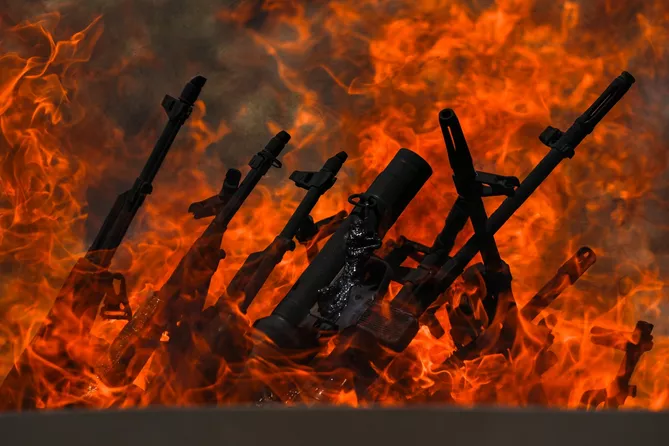
- Genuine disarmament cannot be measured by a few photographs showing a handful of rifles being burned.
It must include a complete inventory of weapons, the identification of their storage locations, the dismantling of training camps, the end of recruitment, the dissolution of command structures and the disruption of financial channels.
In addition, an internationally monitored verification mechanism must be established.
Türkiye must know exactly how many people have left the organisation, how many weapons have been surrendered, where the commanders are located, and whether regional units have ceased taking orders from a single command structure.
A symbolic gesture can be arranged in a single day. Genuine disarmament requires time, rigorous oversight and the ability to impose sanctions in the event of deception.
- Why have the conditions for the PKK's dissolution emerged now, despite the organisation having existed for decades?
- The international environment has changed.
For decades, the PKK remained viable because it skilfully exploited contradictions among regional and global powers.
Today, however, many of the external actors that supported or made use of the organisation are facing crises of their own.
The United States is simultaneously focused on several strategic fronts. Europe is preoccupied with its own security and the future of NATO. Israel is facing a difficult military and domestic political situation.
At the same time, Türkiye has significantly strengthened its defence industry, intelligence capabilities and capacity to conduct cross-border operations.
The organisation has lost much of its freedom of movement, a substantial part of its logistical infrastructure, and the ability to establish camps near Türkiye's borders without interference.
The PKK has not weakened because it has suddenly changed its ideology. It has weakened because maintaining its previous strategy has become increasingly costly and progressively less effective.