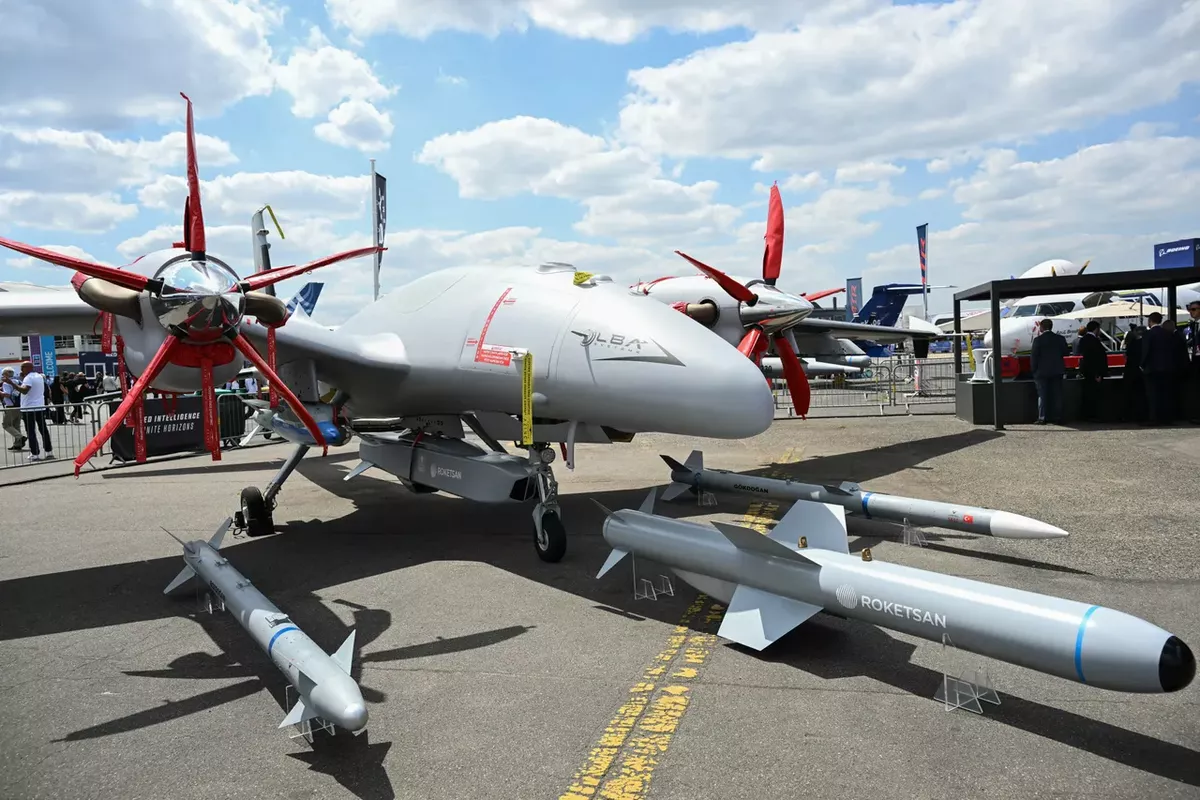
How Türkiye and Italy Are Advancing UAV Technology
The strategic partnership between Türkiye’s Baykar and Italy’s Leonardo marks a significant step in cross-border defense industrial collaboration, as the two companies move toward completing the first production milestone in their mid-class unmanned aerial vehicle (UAV) program.
The joint initiative reflects a broader trend in the global defense sector: countries and manufacturers are increasingly pooling technological expertise to accelerate innovation, reduce development timelines, and strengthen supply chain resilience.
Leonardo CEO Roberto Cingolani has described the UAV segment as an area of “extraordinary momentum” for the Italian aerospace group, emphasizing the rapid progress achieved in less than a year of close coordination with Baykar, according to the Turkish media.
What the Mid-Class UAV Program Includes
The collaboration covers a broad family of unmanned systems, spanning both fixed-wing and rotary-wing platforms. Mid-class UAVs typically bridge the operational gap between smaller tactical drones and larger high-altitude, long-endurance systems. They are widely used for:
-
Intelligence, surveillance and reconnaissance (ISR)
-
Border monitoring
-
Maritime patrol
-
Electronic warfare support
-
Precision-strike missions (depending on configuration)
Assembly of the first aircraft is being finalized at Leonardo’s facility in Ronchi dei Legionari in northern Italy. Before full-scale commercialization, the UAVs are expected to undergo roughly a year of testing and validation, including demonstrations of advanced operational capabilities such as complex landings and coordinated swarm missions.
The testing phase is critical not only for certification but also for attracting export clients in a highly competitive global drone market.
Why This Partnership Matters Strategically
1. Industrial Complementarity
Baykar has built a strong global reputation in unmanned systems development, while Leonardo brings extensive expertise in avionics, radar systems, sensors, and integrated defense electronics. The collaboration combines:
-
Turkish experience in UAV combat-proven platforms
-
Italian strengths in aerospace engineering and electronic systems
-
Shared access to European and global defense markets
This blend enhances both companies’ competitive positioning.
2. Acceleration of European Drone Capabilities
The initiative contributes to strengthening Europe’s domestic UAV production capacity at a time when many countries are seeking greater strategic autonomy in defense technologies.
Leonardo has also indicated that progress in the UAV program may generate spillover benefits for its electronics division, particularly in connection with the Global Combat Air Programme (GCAP). GCAP is a long-term multinational effort aimed at developing next-generation air combat systems, and UAV technologies are expected to play an increasing role in future airpower architectures.
How the Program Moves From Prototype to Market
Before reaching mass production - projected to potentially reach hundreds of units - the aircraft must complete a rigorous demonstration phase. During this period, the drones will showcase:
-
Performance in diverse operational environments
-
Integration of advanced sensors and communication systems
-
Swarm coordination capabilities
-
Reliability under demanding conditions
If the timeline remains on track, the program is slightly ahead of schedule, according to Leonardo’s leadership. Continued investment signals both firms’ confidence in long-term demand.
What It Signals for the Global UAV Market
The Baykar-Leonardo partnership reflects several wider shifts in the defense industry:
-
Growing demand for cost-effective, multi-role UAV platforms
-
Increasing reliance on autonomous and semi-autonomous systems
-
Expansion of drone integration into next-generation air combat ecosystems
-
Greater emphasis on joint ventures to share risk and accelerate innovation
As unmanned systems become central to modern military doctrine, partnerships that combine operational experience with advanced electronics expertise are likely to define the next phase of aerospace competition.