Türkiye Begins Development of Jet Trainer for Aircraft Carriers
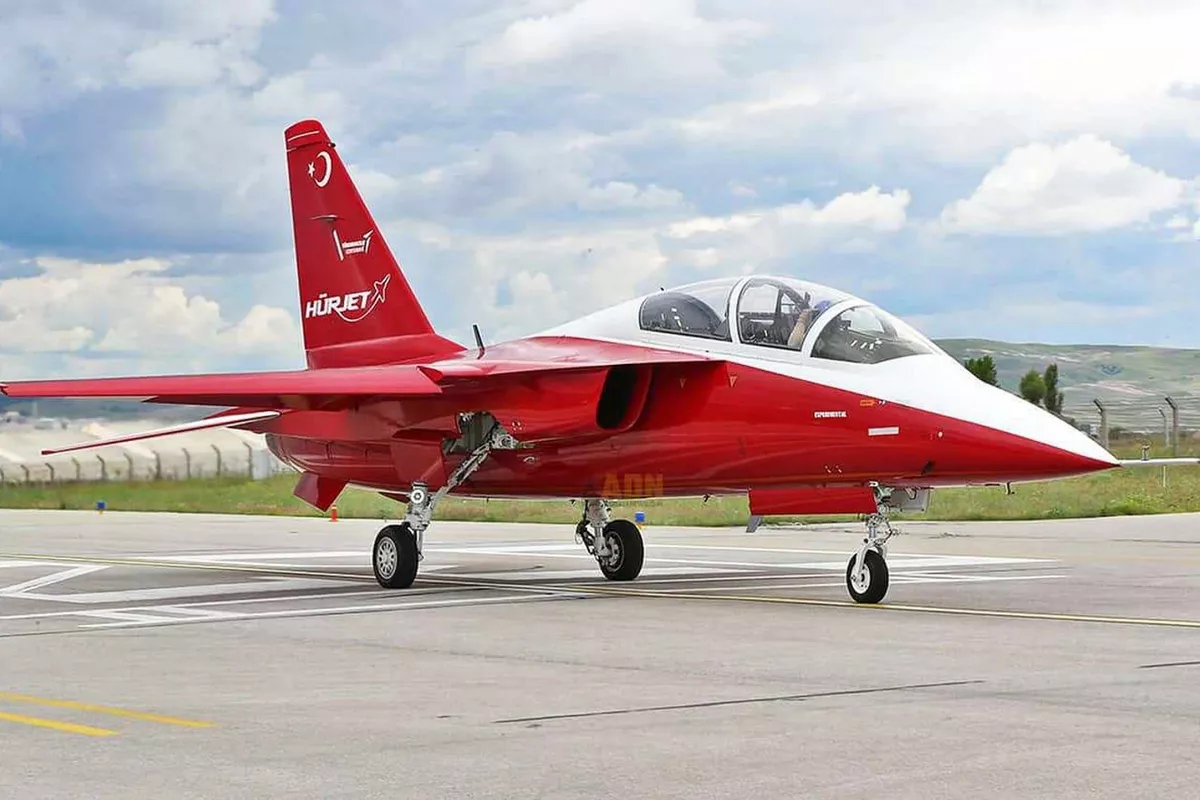
Türkiye has begun developing a carrier-based version of its HÜRJET supersonic jet trainer and light attack aircraft, the country’s defense industry directorate announced, signaling a major expansion of Ankara’s naval aviation plans as it advances its own aircraft carrier program.
The HÜRJET program, developed by Turkish Aerospace Industries, known by its Turkish acronym TUSAŞ, is an indigenous supersonic jet trainer and light attack aircraft designed to replace the aging T-38 Talon trainers currently used by the Turkish Air Force to prepare pilots for frontline fast jets, according to reporting by UlU Savunma, The Caspian Post reports, citing Defence Blog.
The baseline HÜRJET is a single-engine aircraft powered by a General Electric F404 turbofan engine, the same powerplant used by the F/A-18 Hornet, with a maximum speed exceeding Mach 1.4 and a design that bridges the gap between basic jet training and operational combat aircraft. Türkiye completed the HÜRJET’s maiden flight in April 2023, making it one of a small number of countries to have successfully developed an indigenous supersonic jet trainer.
The naval variant now entering development will require substantial modifications beyond what a land-based trainer demands, and the Turkish announcement is explicit about the scope of that engineering challenge. The aircraft will be adapted for both STOBAR and CATOBAR carrier operations, the two primary methods by which modern navies launch fixed-wing aircraft from ships. STOBAR, which stands for Short Take-Off But Arrested Recovery, relies on a ski-jump ramp to assist aircraft into the air and arresting wires to stop them on landing, the system used by Russia, India, and China on several of their carriers. CATOBAR, Short Take-Off Catapult Assisted Recovery, uses a steam or electromagnetic catapult to launch aircraft and arresting wires for recovery, the system employed on American supercarriers and the French Charles de Gaulle. Designing an aircraft compatible with both concepts gives Türkiye flexibility to operate the naval HÜRJET from different carrier configurations, including any future Turkish carrier design.
Carrier aviation imposes structural demands on aircraft that have no equivalent in land-based operations, and the Turkish development announcement details how the naval HÜRJET will address each of them. Arrested landings, where a tail hook catches a wire stretched across the flight deck and stops an aircraft traveling at landing speed within roughly 100 meters, subject the airframe and landing gear to impact forces many times greater than a conventional runway touchdown. The naval HÜRJET’s airframe and landing gear systems will be reinforced specifically to handle those repeated high-impact loads across a full service life.
The marine environment presents a separate category of threat to aircraft systems that is less dramatic but equally damaging over time. Salt air, humidity, and the constant exposure to seawater spray that carrier-based aircraft endure accelerate corrosion across every metal surface, every electronic connector, and every mechanical linkage in ways that can degrade a system’s reliability and lifespan far faster than land-based operation. The naval HÜRJET program will address that through corrosion-resistant materials and specialized coatings applied across the entire platform, from engine components and airframe alloys to precision avionics systems and electronic parts, according to the announcement.
Carrier operations require aircraft to fly and maneuver at lower speeds than land-based jets typically encounter, particularly during the approach to landing where precise low-speed control determines whether a pilot successfully catches a wire or is forced to go around for another attempt. Adapting the HÜRJET’s aerodynamic profile for reliable low-speed handling while preserving its supersonic performance envelope represents one of the more technically demanding aspects of the navalisation program. Additional modifications will address maintenance accessibility in the confined spaces of a carrier hangar deck and deck compatibility requirements for the specific carrier platforms Türkiye intends to operate.
Türkiye’s carrier ambitions provide the strategic context that makes a naval HÜRJET program meaningful rather than academic. The Turkish Navy has been developing the TCG Anadolu, an amphibious assault ship originally designed to operate F-35B short take-off and vertical landing aircraft. After the United States removed Türkiye from the F-35 program in 2019 following Ankara’s purchase of the Russian S-400 air defense system, the Anadolu’s aviation complement became an open question. Türkiye has been exploring alternatives ever since, including the development of indigenous unmanned combat aircraft for carrier operations. A navalised HÜRJET capable of operating from the Anadolu or a future Turkish carrier would give Ankara a domestically produced fixed-wing carrier strike option that does not depend on American approval or allied cooperation to field.