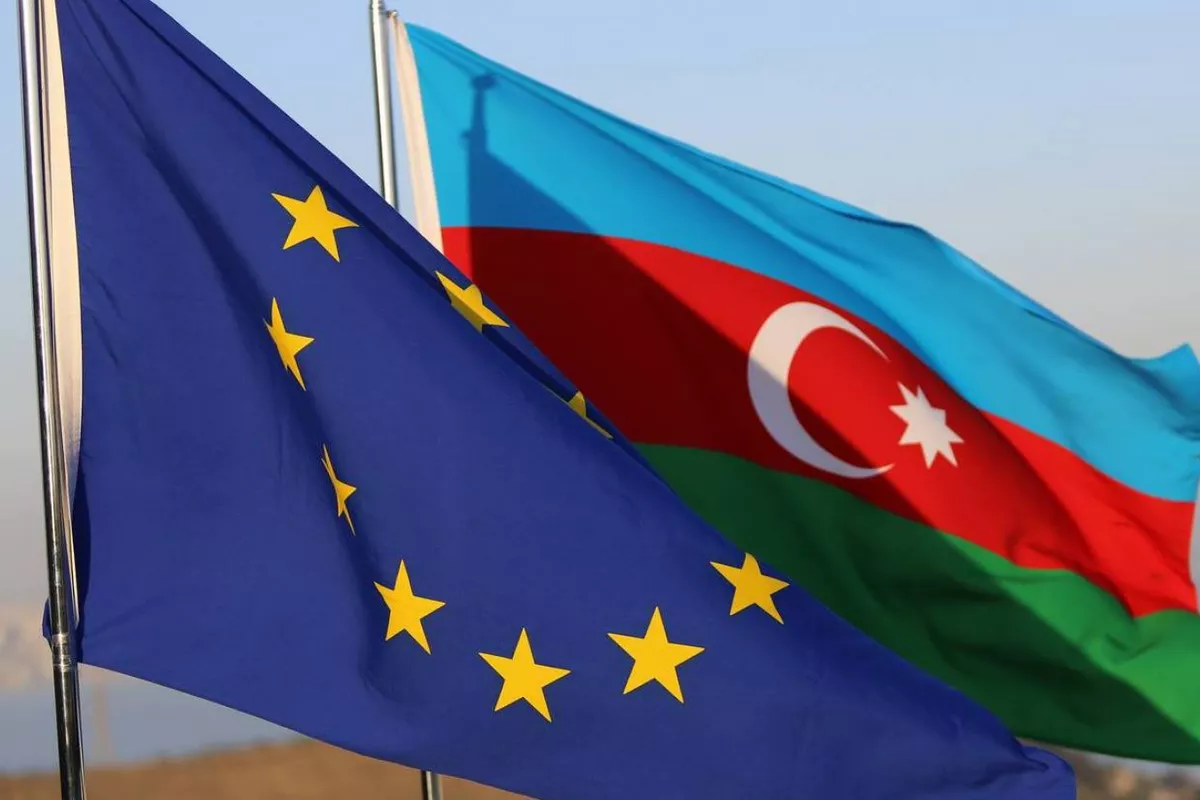
Relations between Azerbaijan and European institutions have entered one of their most complex phases in recent years. Interestingly, this complexity stems from the absence of a unified European approach towards Azerbaijan. On the one hand, European Union institutions regard Azerbaijan as a strategic partner in terms of Europe's energy security, the Middle Corridor, green energy and regional stability. On the other, bodies such as the Parliamentary Assembly of the Council of Europe (PACE) and the European Parliament continue to adopt political resolutions, issue criticism and promote sanction initiatives targeting Azerbaijan. This dual-track approach has further deepened the crisis of confidence between Baku and Brussels.
According to Zaur Mammadov, Associate Professor at the Academy of Public Administration under the President of the Republic of Azerbaijan, President Ilham Aliyev's remarks at the Shusha Global Media Forum on 13 July once again demonstrated that Azerbaijan's foreign policy course remains unchanged.
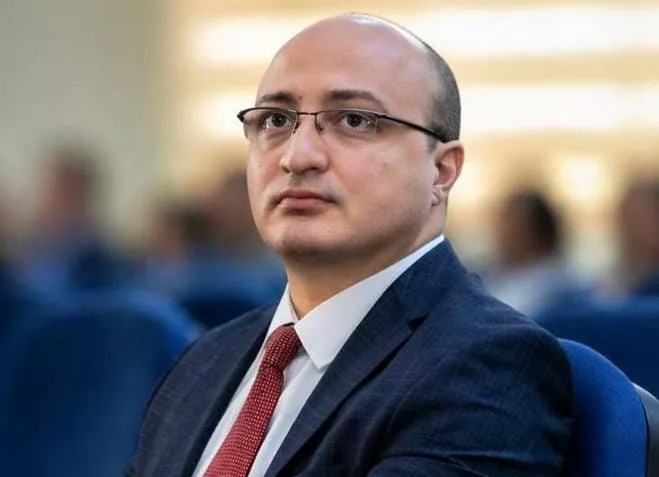
Photo: Zaur Mammadov, Associate Professor at the Academy of Public Administration under the President of the Republic of Azerbaijan
"President Ilham Aliyev's remarks regarding European institutions at the 4th Shusha Global Media Forum once again demonstrated that Azerbaijan's foreign policy course remains unchanged," he said.
He noted that official Baku has repeatedly stated that it is interested in developing relations with European countries and institutions on the basis of mutual respect, respect for sovereignty and equality.
"This approach is driven not by political considerations but by pragmatic interests," Mammadov said, adding that Azerbaijan's contribution to Europe's energy security, the Southern Gas Corridor, the Middle Corridor, plans to export green energy from the Caspian Sea to Europe and its role in maintaining regional stability have made cooperation between the two sides a strategic necessity.
According to the expert, these principles form the foundation of Azerbaijan's foreign policy.
"Azerbaijan's foreign policy is based on the principles of mutual respect, respect for the sovereignty of states and equal cooperation. Official Baku expects both international organisations and individual states to adopt an objective and fair approach towards our country based on these principles," he said.
"President Ilham Aliyev's remarks on European institutions at the 4th Shusha Global Media Forum should also be viewed in this context."
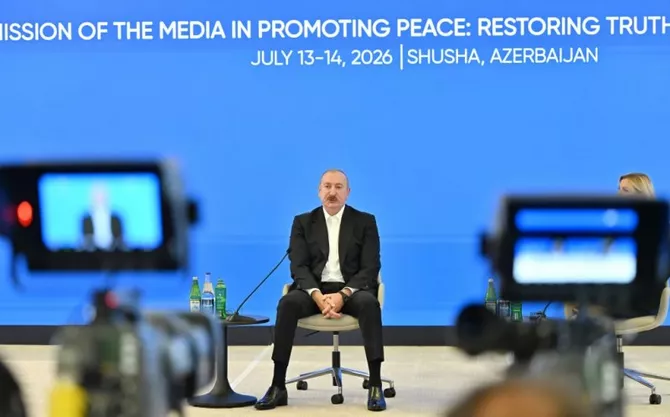
Source: Azertag / President of the Republic of Azerbaijan Ilham Aliyev
According to Mammadov, President Aliyev highlighted the difference between relations with the previous and current European Commission, describing the role of the former EU High Representative for Foreign Affairs and Security Policy, Josep Borrell, as "destructive". The president said Borrell had effectively destroyed relations between the European Commission and Azerbaijan.
The expert also referred to President Aliyev's remarks that Borrell had colluded with certain corrupt individuals, including Luis Moreno Ocampo, the former Prosecutor of the International Criminal Court. According to the President, Ocampo had openly admitted financing Borrell and had himself received money from a Russian-Armenian oligarch who is currently under house arrest in Armenia, Mammadov said.
Mammadov said that, according to President Aliyev, one of the main factors negatively affecting relations during that period was the activity of an anti-Azerbaijani political group within the European Commission.
The expert believes this assessment indicates that official Baku associates the problems experienced during the previous Commission with the actions of certain individuals and political groups.
"At the same time, Azerbaijan believes that relations with the new European Commission have entered a different political atmosphere," he added.
Mammadov also quoted President Aliyev as saying that high-level reciprocal visits in recent months "demonstrate the beginning of a new phase in bilateral relations". He highlighted Aliyev's remarks that relations with the new Commission began to improve after both sides recognised a strong mutual interest in resetting ties. President Aliyev noted that within several months this year Baku had been visited by European Council President António Costa, EU High Representative for Foreign Affairs and Security Policy Kaja Kallas, and European Commission President Ursula von der Leyen.
Mammadov described the visits as carrying important political and economic significance.
"Energy security, transport corridors, green energy, digital transformation and regional stability remain priorities on the European Union's cooperation agenda with Azerbaijan."
He also highlighted President Aliyev's remarks that both sides had openly expressed satisfaction with the current level of cooperation.
However, according to the expert, this positive momentum in relations with the European Commission has not extended to PACE or the European Parliament.
"Azerbaijan maintains that these platforms have for years conducted coordinated political campaigns against the country and that their resolutions are based more on political considerations than on objective legal assessments," he said.
Source: commonspace.eu
Commenting on this approach, Mammadov argued that despite Azerbaijan's strategic contribution to Europe's energy security, the position of certain European institutions has remained unchanged.
"Although Azerbaijan is one of the European Union's key partners in ensuring energy security today, certain European institutions, particularly the Council of Europe and the Parliamentary Assembly of the Council of Europe (PACE), continue to demonstrate a biased attitude towards the country," he said.
In his view, this approach stems not from objective criteria but from political motivations.
The expert said that, according to Azerbaijan's position, the sanctions imposed by PACE were unrelated to human rights but instead reflected the new geopolitical reality that emerged after Azerbaijan fully restored its territorial integrity and sovereignty in 2023.
He referred to President Aliyev's remarks that PACE questioned the credentials of the Azerbaijani delegation and suspended its voting rights in January 2024 after Azerbaijan eliminated the remnants of separatist forces from its territory. According to the president, this had nothing to do with human rights but instead amounted to punishment for Azerbaijan's restoration of its sovereignty.
According to the political analyst, the approach adopted by PACE and certain other European institutions serves neither the long-term interests of those organisations nor those of Europe as a whole.
"The attitude towards Azerbaijan displayed within PACE and certain European institutions serves neither the long-term interests of those organisations nor Europe as a whole. On the contrary, such steps correspond to the political interests of third parties and negatively affect the atmosphere of trust in Azerbaijan-Europe relations," he said.
He added that this reflects Azerbaijan's view that PACE's decisions are politically motivated.
"It was for this reason that the Azerbaijani delegation suspended its participation in the Assembly's activities," Mammadov said.
The expert added that Azerbaijan has subsequently begun questioning whether it is appropriate to remain a member of the Council of Europe. According to President Aliyev, this issue is being seriously considered by the government.
Mammadov believes the first step towards normalising relations should be the abandonment of biased approaches.
"To normalise relations, biased approaches must first come to an end. Otherwise, the Azerbaijani state and parliament may adopt decisions regarding PACE that correspond to the country's national interests."
In his opinion, the first steps that led to the current tensions were taken by the other side.
At the same time, Baku has demonstrated that it has not completely closed the door to dialogue. Azerbaijan's position is that normalisation remains possible, but the first step must come from PACE.
Source: Trend
According to the expert, President Aliyev also emphasised that Azerbaijan's objective is not confrontation with European institutions but the establishment of normal and mutually beneficial relations.
"The concluding message of President Ilham Aliyev's speech clearly outlined Azerbaijan's future approach," Mammadov noted, adding that the president had made it clear that Baku was ready for normalisation and that the other side must take the first step.
Summarising this approach, Mammadov argued that Azerbaijan's foreign policy remains firmly based on protecting national interests.
"Azerbaijan builds its cooperation with all states and international organisations on the principles of justice, mutual respect and equality. If these principles are not observed, official Baku reserves the right to take appropriate measures to protect its national interests," he said.
He added that the future of Azerbaijan-Europe relations largely depends on which of the two trajectories prevails.
"On the one hand, there are shared strategic interests, including energy security, the Middle Corridor, green energy and regional stability. On the other, there is political mistrust, continued confrontation within PACE and the European Parliament, and mutual accusations."
He added that the current geopolitical reality demonstrates that Europe cannot ignore Azerbaijan as a key partner in the South Caucasus, just as Azerbaijan has no intention of abandoning cooperation with Europe.
"However, for this partnership to remain sustainable, political dialogue will need to be rebuilt on the principles of mutual respect, respect for sovereignty and equal partnership," the expert concluded.