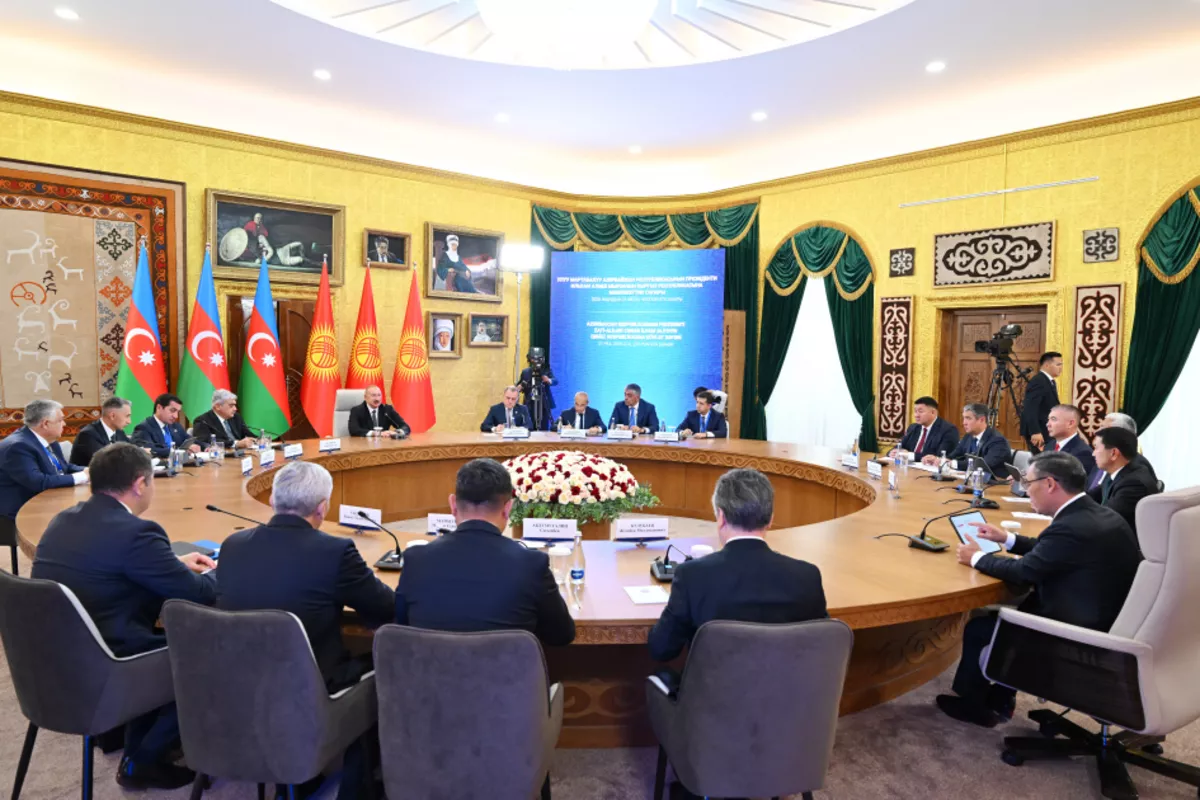
President Ilham Aliyev’s participation in the informal meeting of the heads of state of Azerbaijan and Central Asia, being held in the Kyrgyz city of Cholpon-Ata on July 31, should be viewed as far more than a routine diplomatic event. In practical terms, the gathering reflects the emergence of a new trans-Caspian cooperation space that is gradually bringing Central Asia, the South Caucasus and European markets into a single transport, energy and economic system.
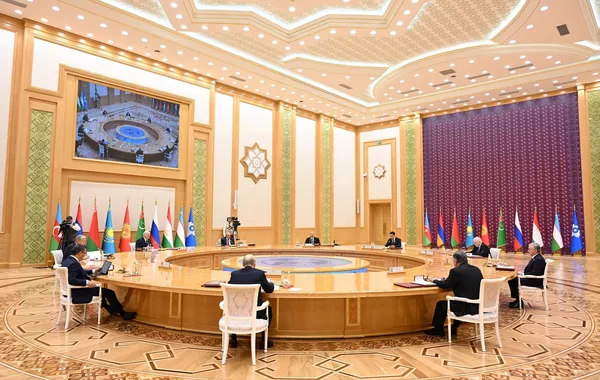
The meeting in Cholpon-Ata brings together the leaders of Azerbaijan, Kazakhstan, Kyrgyzstan, Tajikistan, Turkmenistan and Uzbekistan. Its agenda includes trade, energy, transport corridors, tourism, humanitarian cooperation and regional security. It is also the first informal summit of this kind since Azerbaijan joined the Central Asian consultative format as a full participant.
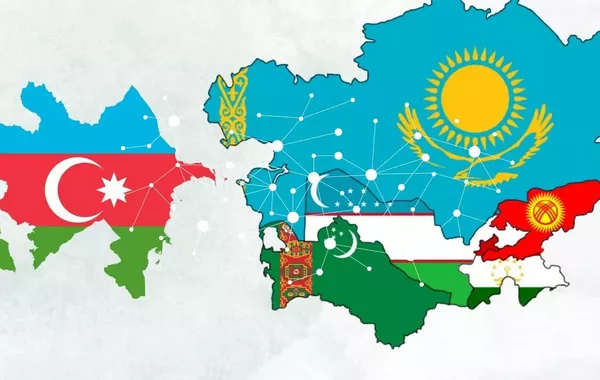
Against this backdrop, the traditional “C5” designation, referring to the five Central Asian states, is gradually evolving into a “C6” format. Yet the significance of this transformation lies not merely in the addition of another country. Azerbaijan’s participation extends the political and economic geography of the platform to the western shore of the Caspian Sea and gives it the potential to become a mechanism connecting Central Asia with the South Caucasus.
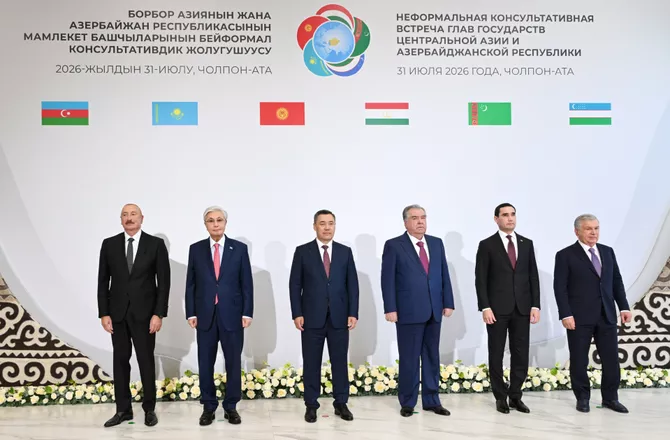
Photo: AZERTAC
From regional dialogue to an independent center of influence
The Consultative Meetings of the Heads of State of Central Asia were launched in 2018. Initially, the format was conceived as a relatively informal mechanism for direct dialogue among Kazakhstan, Kyrgyzstan, Tajikistan, Turkmenistan and Uzbekistan. Its emergence reflected the regional states’ willingness to discuss shared challenges independently rather than leaving the initiative entirely to outside powers.
Over the past several years, the mechanism has become increasingly institutionalized. In 2022, the Treaty on Friendship, Good-Neighborliness and Cooperation for the Development of Central Asia in the 21st Century was signed, while the Central Asia 2040 regional cooperation concept was approved in 2024. The format has therefore gradually moved beyond political consultations toward long-term strategic planning.
Azerbaijan took its first major step toward participation in September 2023, when President Ilham Aliyev attended the fifth Consultative Meeting in Dushanbe as an honorary guest. In November 2025, at the seventh meeting in Tashkent, the leaders of the Central Asian states decided to admit Azerbaijan as a full participant.
Azerbaijan thus became the first country not geographically located in Central Asia to be incorporated into the region’s internal consultative framework. This development demonstrates that contemporary regional integration is being shaped less by geography alone and increasingly by transport connectivity, economic interdependence and converging strategic interests.
For the Central Asian states, Azerbaijan is valuable not as an outside observer but as a natural gateway to the South Caucasus, Türkiye, the Black Sea and European markets. For Baku, closer engagement with Central Asia strengthens its own status as one of Eurasia’s key transport and logistics hubs.
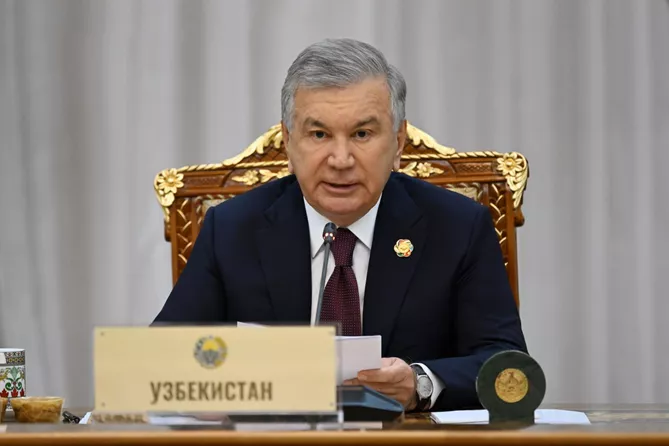
Photo: Uzbek president's office
The economic foundation of a new regional architecture
Central Asia’s economic potential has expanded considerably in recent years. According to figures presented by Uzbek President Shavkat Mirziyoyev, the combined GDP of the five Central Asian states has increased almost 2.5-fold over the past eight years, reaching approximately $520 billion. Their total foreign trade turnover has surpassed $253 billion.
Trade among the Central Asian states themselves has doubled to about $11 billion, while mutual investment has increased 5.6-fold. Industrial growth in the region is running at approximately 6% annually, roughly twice the global average.
Economic ties between Azerbaijan and Central Asia are also growing rapidly. In 2025, Azerbaijan’s trade turnover with the five Central Asian countries increased by 53% to reach $1.8 billion. Kazakhstan and Uzbekistan accounted for the largest shares of Azerbaijan’s exports to the region.
Nevertheless, the absolute volume of trade remains modest compared with the combined size of the economies involved and the high level of political relations. A trade turnover of $1.8 billion is relatively limited when measured against Central Asia’s $520 billion economy. This suggests that current growth is starting from a low base and that much of the cooperation potential remains untapped.
The principal task of the C6 format is therefore to convert political rapprochement into sustainable production, investment and trade chains. Increasing the export of individual commodities will not be enough. The participating states require joint industrial enterprises, logistics centers, agricultural projects, digital platforms and investment mechanisms.
Some of the necessary financial infrastructure is already being developed. The Azerbaijan-Uzbekistan Investment Company has capital of $500 million and can finance projects both in the two countries and in third markets. The authorized capital of the Azerbaijan-Kyrgyz Development Fund has been increased from $25 million to $100 million. During the current visit to Kyrgyzstan, President Ilham Aliyev noted that the fund is already financing several projects and is expected to expand its activities.
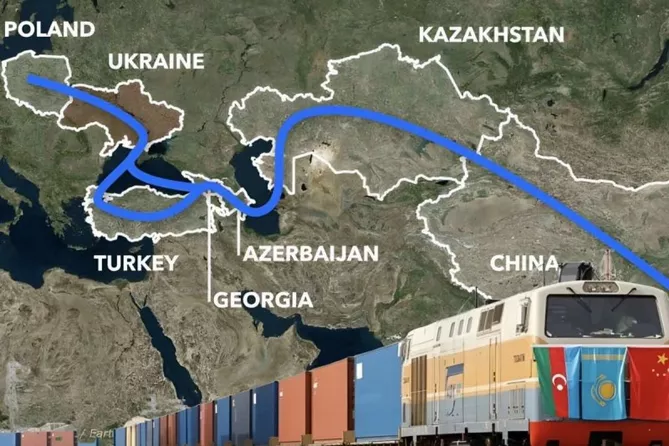
photo: getty images
The Middle Corridor as the economic backbone of C6
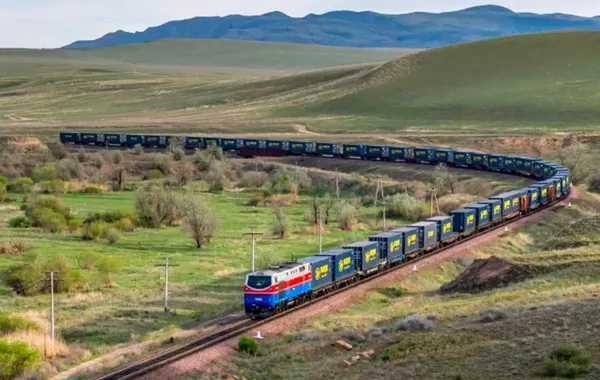
The main material foundation for the rapprochement between Azerbaijan and Central Asia remains the Trans-Caspian International Transport Route, widely known as the Middle Corridor.
The route connects China and Central Asia with Europe through Kazakhstan, the Caspian Sea, Azerbaijan, Georgia and Türkiye. Its importance has grown significantly following disruptions to traditional logistics chains and the rise of geopolitical risks along alternative routes.
In 2024, freight traffic along the Trans-Caspian route increased by approximately 62% to reach 4.5 million tons. Over a three-year period, the volume of cargo transported through Azerbaijan along the Middle Corridor rose by around 90%.
The World Bank estimates that, with the necessary reforms and infrastructure investment, freight volumes along the Middle Corridor could triple by 2030, while transit times could be cut by half. However, this will require more than the construction of ports and railways. Tariff coordination, the digitalization of customs procedures, greater transparency in freight operations and the elimination of delays during transfers between different modes of transport will be equally important.
Azerbaijan has already invested heavily in increasing the corridor’s capacity. Following modernization completed in 2024, the annual capacity of the Baku-Tbilisi-Kars railway increased to 5 million tons. The capacity of the Baku International Sea Trade Port in Alat is expected to rise from the current 15 million tons to 25 million tons per year.
Azerbaijan is therefore functioning as Central Asia’s western transport gateway. Kazakhstan, Uzbekistan, Kyrgyzstan, Tajikistan and Turkmenistan are interested in diversifying their foreign trade routes and reducing their dependence on one or two directions. Baku, for its part, is seeking to ensure that a significant share of the expanding Asia-Europe freight flow passes through Azerbaijani ports, railways and logistics centers.
This is where the interests of the two sides complement one another. Central Asia possesses the cargo base, raw materials and expanding industrial capacity, while Azerbaijan provides the infrastructure and access needed to move those goods westward.
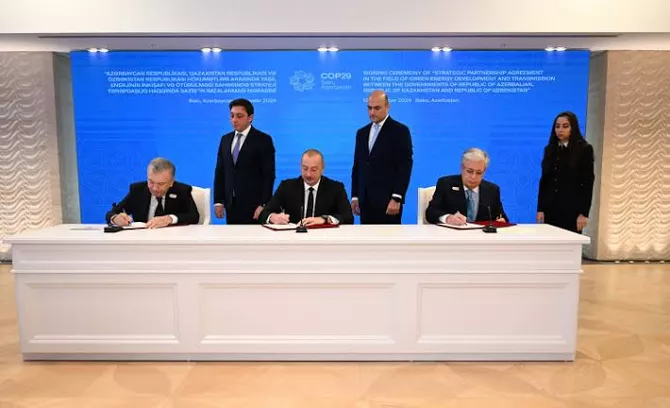
photo: The Astana Times
From oil and gas routes to a green energy corridor
Cooperation is also moving beyond the traditional transportation of oil and gas.
In November 2024, Azerbaijan, Kazakhstan and Uzbekistan signed an agreement on strategic partnership in the development and transmission of green energy. The project envisages the creation of an energy connection across the Caspian Sea, followed by integration into Azerbaijan’s infrastructure and, in the longer term, access to European markets through the Black Sea.
Should the project be implemented, the Middle Corridor would effectively become not only a transport route but also an energy corridor. The Caspian Sea could carry not only containers, oil and petroleum products, but also electricity and digital data. Plans are also being considered for laying a fiber-optic cable across the seabed.
This would fundamentally change the nature of regional integration. Azerbaijan and the Central Asian states would no longer be developing a single route, but an interconnected system of transport, energy and digital corridors.
Such an approach also increases the strategic significance of the Caspian Sea. Once viewed largely as a natural barrier separating Central Asia from the South Caucasus, it is increasingly becoming a bridge between the two regions.
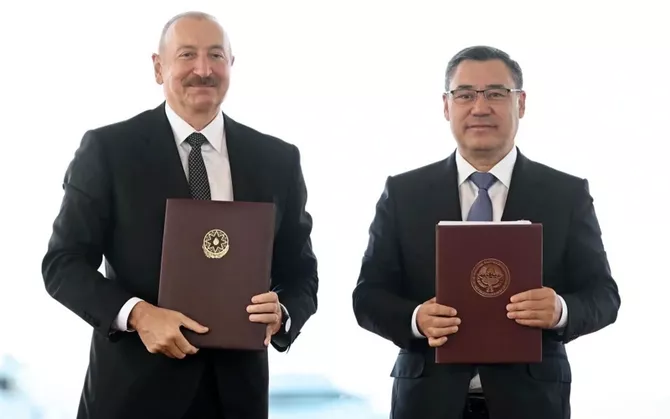
photo: Kazinform
Why the Kyrgyzstan meeting matters
President Ilham Aliyev’s current visit to Kyrgyzstan combines two levels of engagement: bilateral and regional.
On July 31, the presidents of Azerbaijan and Kyrgyzstan signed a Treaty on Allied Relations. This represents the highest level of interstate cooperation and provides for closer coordination in political affairs, security, the economy and humanitarian ties.
Azerbaijan’s participation in the regional format is therefore being reinforced by a network of strong bilateral partnerships. Baku already maintains allied or strategic relations with several Central Asian states and is developing joint investment funds, transport projects and humanitarian initiatives with them.
It is precisely this combination of bilateral mechanisms and the broader C6 platform that can make the new format effective. Multilateral declarations will have limited value unless they are supported by concrete projects between individual states.
The remaining obstacles
Despite the positive momentum, it would be premature to speak of a fully developed common economic space.
The Middle Corridor continues to face constraints related to the capacity of Caspian ports, dependence on ferry services, differences in tariffs, insufficient synchronization of railway schedules and complex customs procedures.
Every additional border crossing, container transfer or ferry delay increases transportation costs. The corridor’s competitiveness therefore depends not only on the length and quality of railways, but also on the speed and efficiency of administrative procedures.
There is also an institutional challenge. The regional states already participate in the Organization of Turkic States, the Commonwealth of Independent States, the Shanghai Cooperation Organization and the Economic Cooperation Organization, while several are also members of the Eurasian Economic Union. The new format should avoid duplicating the functions of existing organizations.
Its principal value could lie in practical specialization: coordinating transport policy, developing the Caspian route, attracting investment and forming common approaches to water, food, energy and climate security.
Central Asia’s western gateway
Azerbaijan’s accession to the consultative format does not amount to a geographical enlargement of Central Asia. Rather, it signals the emergence of a wider trans-Caspian system of cooperation based on economic logic.
For the countries of the region, Azerbaijan is becoming a link to the South Caucasus, Türkiye and Europe. Central Asia, in turn, offers Azerbaijan access to a growing market, new freight flows, energy resources and industrial projects.
The transition from C5 to C6 therefore carries strategic rather than merely symbolic significance. With successful coordination, the new format could develop into one of Eurasia’s most promising centers of economic growth and transport connectivity.
The Cholpon-Ata meeting demonstrates that the Central Asian states no longer view Azerbaijan as an external partner. It is becoming part of the region’s decision-making architecture.
The key question is no longer whether political rapprochement will take place - that has already happened. The real issue is whether the six countries can translate their high level of political trust into coordinated tariffs, faster customs procedures, joint investment and resilient transport and energy chains.
The answer will determine whether C6 develops into an influential new Eurasian format or remains primarily a platform for political consultations.