In April this year, the French Parliament approved a bill simplifying the procedure for the return (restitution) of cultural property and works of art removed from former colonies during the colonial period. President Emmanuel Macron has also addressed this issue.
Although Azerbaijan was never a French colony, the question raised by France is relevant to Azerbaijan as well. The cultural heritage of the Azerbaijani people has been looted during invasions throughout different historical periods and from different directions. Examples of our people’s cultural and artistic legacy can be found today in museums and private collections across many countries.
Azerbaijan, too, hopes that friendly states will consider following Macron’s example and returning to our country the cultural property that was taken from it.
One such case concerns the Ganja Gates.
The Ganja Gates were made in 1063 by the master Ibrahim Osmanoglu (Ibrahim ibn Osman), on the orders of Abul-Aswar Shavur, a ruler of the Shaddadid dynasty. They are a rare example of Azerbaijani metalworking art from the 11th century.
In 1139, a devastating earthquake almost completely destroyed Ganja. Thousands of people were killed, and the city’s defensive system was rendered inoperative. Taking advantage of the city’s helplessness, Georgian King Demetre I attacked Ganja, looted it and took the fortress gates to Georgia as a military trophy. Apparently, little besides the gates remained in the devastated city.
More precisely, however, describing the gates as a military trophy is inaccurate. Demetre entered a city that had effectively been destroyed and was incapable of organising resistance. Therefore, this artefact cannot reasonably serve as an object of military pride or hold such symbolic value for the Georgian side.
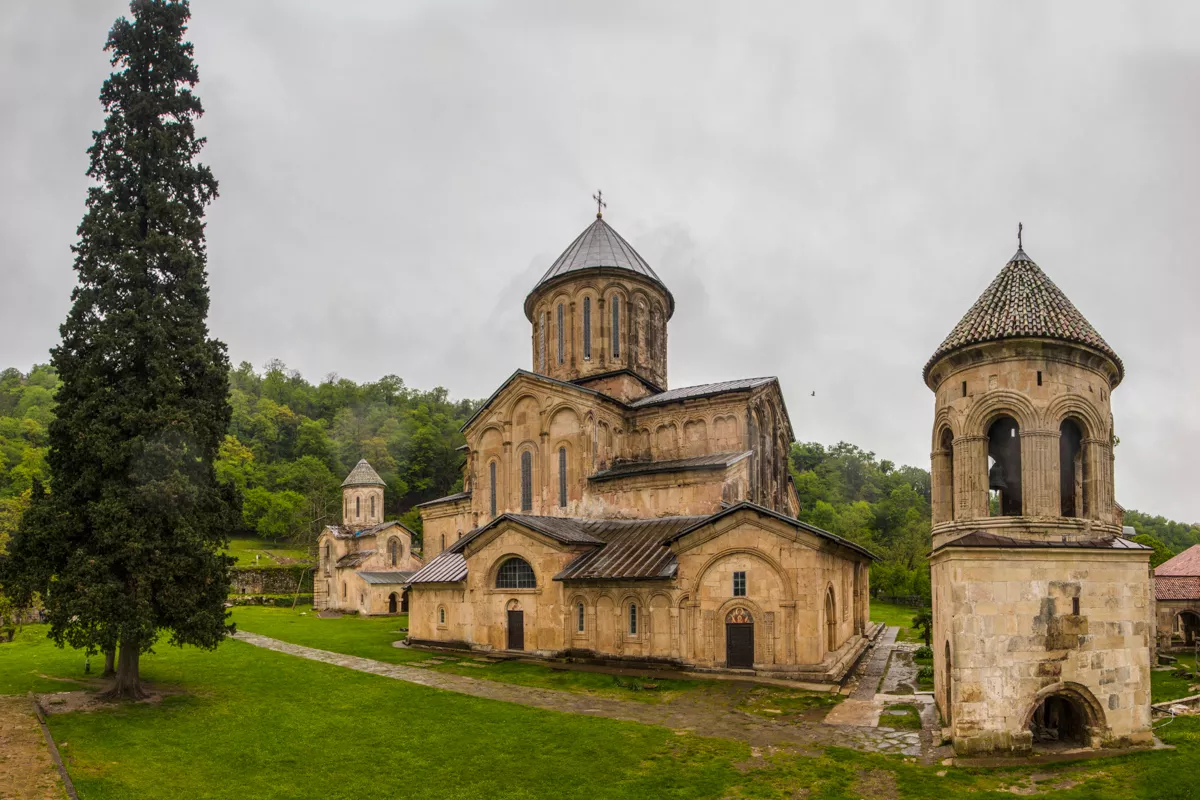
The gates were taken to the Gelati Monastery in Kutaisi. Today, only one leaf of the gates has survived. It is embedded in the wall of the Gelati Monastery opposite the grave of King David IV. According to the Azerbaijan Soviet Encyclopedia, during the monastery’s restoration in the 18th century, the second half of the Ganja Gates was used as roofing material. Other sources state that it was destroyed by corrosion. The gates were covered with tightly fitted iron sheets. There is also a version according to which the gates were taken to Derbent and melted down.
Whatever the case, only one leaf of these gates has survived. It can rightly be regarded as part of the historical and cultural heritage of the Azerbaijani people, since it was a genuine work of art. The Ganja Gates are an inseparable part of Azerbaijan’s cultural heritage.
Baku has repeatedly raised the issue of returning the Ganja Gates, but has not met with understanding.
Some sources claim that the Ganja Gates were discovered during archaeological excavations in Ganja, restored and returned to their original location. However, those are not the gates in question.
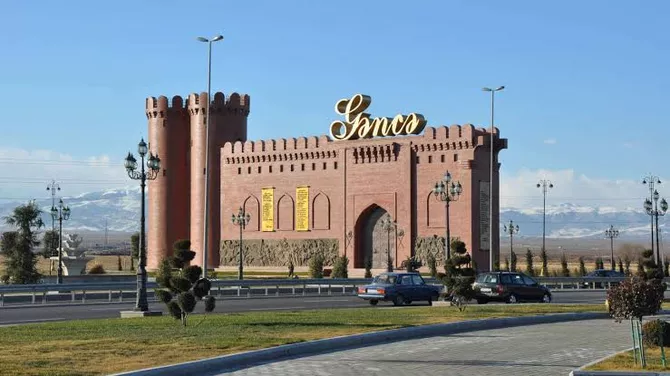
photo: visitsilkroad
As can be learned from publicly available information, archaeological excavations in the ruins of ancient Ganja in 2000 uncovered fragments of the so-called Mausoleum Gates, one of the five gates of the Ganja fortress. Based on these archaeological materials, Ganja’s ancient gates were reconstructed for the first time in 2007 by the Heydar Aliyev Foundation and installed at their original location, at the entrance to the city, as part of a museum building.
In February 2022, then-Culture Minister Anar Karimov stated that Azerbaijan intended to recover the Ganja Gates, which have been kept in Georgia since the 12th century. Baku was holding talks with Tbilisi on the transfer of the historical artefact. As was noted at the time, the negotiations were “difficult and complicated.” The fate of the Ganja Gates was included in the agenda of the bilateral intergovernmental commission between Azerbaijan and Georgia.
However, there has still been no result. Moreover, Georgian media reported that after the Azerbaijani minister’s statement, the leaf of the Ganja Gates kept at the Gelati Monastery was placed under protection at the initiative of the National Agency for Cultural Heritage Preservation. For some reason, the issue of returning the Ganja Gates provoked a strange reaction among Georgian experts. Many saw political undertones in it and began comparing it with the situation surrounding the border church of Kurmukhi, although these are entirely different matters.
Let us repeat: returning the artefact would cause Georgia no harm. It is not a question of borders or territory.
The Ganja Gates are not the only artefacts removed from Azerbaijan. During the Russian imperial period, under the unified administrative system of the Caucasus, numerous historical objects, manuscripts, artefacts and cultural valuables were taken from the territory of Azerbaijan, including in the direction of Georgia. Azerbaijan is not making broad claims or advancing demands. The return of the Ganja Gates would be a logical step within the framework of friendship and good-neighbourly relations between the two countries.
If this artefact had strategic importance or were in any way connected to the territorial integrity or sovereignty of the neighbouring state, Baku would not raise the issue. Azerbaijan has consistently acted in the interests of preserving good-neighbourly relations.
Friendship between Azerbaijan and Georgia is of strategic importance to both countries. Azerbaijan has repeatedly helped Georgia in its most difficult times, providing support even when it could itself have faced problems, including geopolitical ones. This support was not merely moral; it was economic, financial and energy-related. Baku has never refused assistance and has always sought to resolve disagreements diplomatically, even when it had to maintain a delicate balance.
We are linked by common interests, common projects, the present day and plans for the future. Why cling to episodes of the past and attempt to build relations upon them?
There could have been no question of military resistance or defence by that Ganja against an external enemy. The Georgian king arrived at the ruins of a city and “conquered” them. These historical facts should clarify both the notion of a “military trophy” and the narrative of a victory of Georgian arms.
If the Georgian side decides to return the surviving leaf of the Ganja Gates, it would be a highly positive step in bilateral relations and proof of mutual understanding. If even the French Parliament voted unanimously to return cultural property to former colonies, then such a matter between two friendly states could be resolved without the need for any parliamentary intervention.