Bridging the Middle Corridor: How Azerbaijan and the EU Are Reshaping Eurasian Connectivity
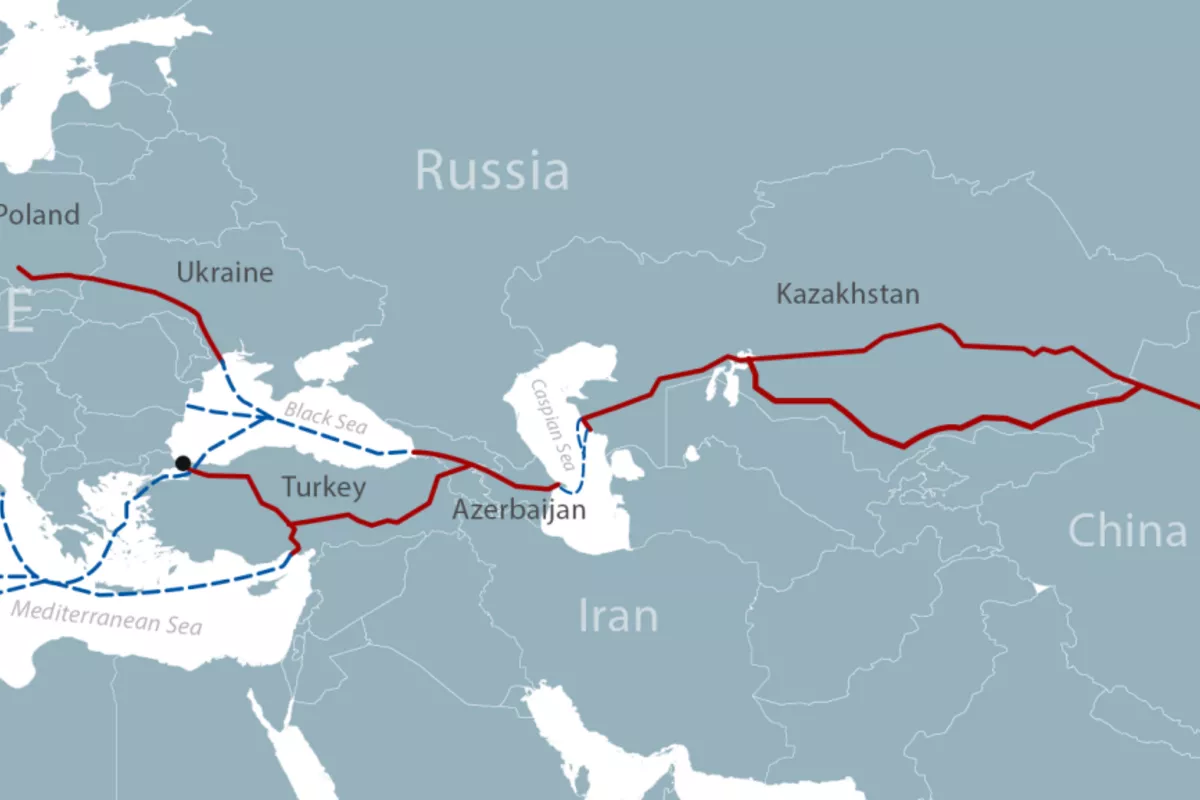
Trade volumes along the Middle Corridor - the rail and sea route linking China to Europe via Central Asia and the South Caucasus - have roughly quadrupled since 2022. Transit times have been reduced from 53 days to between 18 and 23 days, as shippers are being forced to reroute their products around a sanctioned Russia and a volatile Red Sea, where up to 90 percent of shipping has been diverted since 2024.
Beijing and Brussels are now competing openly for a stake in that realignment. China committed some $23 billion to Kazakhstan’s side of the route in 2025 alone, while the EU has answered with €12 billion ($13.94 billion) in the form of the Global Gateway package and a dedicated coordination platform meant to keep European financing in the race.
Azerbaijan is currently routing nearly all of that corridor traffic through Georgia. The Baku-Tbilisi-Kars railway, which entered full-scale operation in June following years of upgrades, remains the corridor’s only functioning rail link to Türkiye and the Black Sea coast, bypassing Armenia entirely while a parallel line through Armenian territory has remained dormant since 1993.
A second route is taking shape further south, functioning as an alternative rather than a substitute to the Georgian passage: the Zangezur corridor. Framed under TRIPP-the Trump Route for International Peace and Prosperity, a U.S.-brokered initiative designed to restore transport links between mainland Azerbaijan to Türkiye via Armenia and the Nakhchivan exclave. Ongoing railway reconstruction in Nakhchivan will effectively extend TRIPP onto Azerbaijani soil as corridor construction transitions from a declaration to project physical implementation.
Narrowing the Rail Gap in Zangezur
The clearest recent progress report on that project came from President Ilham Aliyev himself. Speaking in Tashkent on August 23, at the third meeting of the Azerbaijani-Uzbek Supreme Interstate Council, he gave a clear public accounting of where the Zangezur Corridor stands: on the Azerbaijani mainland side, the 110-kilometer Horadiz-Aghband railroad is already roughly three-quarters complete and due for full completion next year. Across Armenia, under that same TRIPP framework, only 42 kilometers of track are required, with construction expected to begin by early next year. Meanwhile, inside Azerbaijan’s own Nakhchivan exclave, reconstruction covers 194 kilometers of main line - 264 kilometers counting sidings, where the sections nearest the border are already under construction.
While in Tashkent, Aliyev noted that Baku is now assembling an international consortium of companies and states willing to invest in the Nakhchivan section in exchange for guaranteed transport volumes and returns. He also noted that work on the Armenian side is proceeding as well, as American partners are keeping Baku regularly informed about progress on the project. Once joined, the three sections are projected to carry 5.5 million passengers and 15 million tons of cargo a year, threading together east-west and north-south transport routes in a way that has not been physically possible since the railways of the South Caucasus suspended operating in the early 1990s.
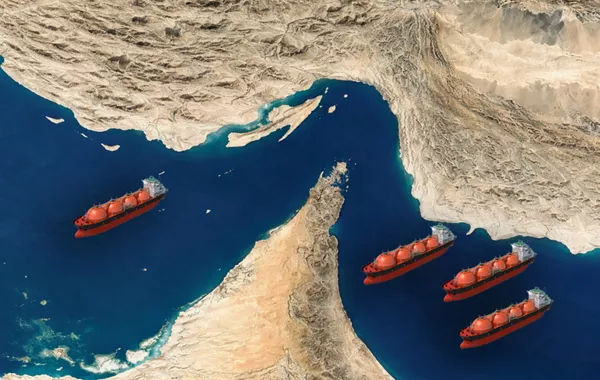
The Zangezur corridor sits inside a much larger contest for the Middle Corridor’s future capacity, and disruption elsewhere has done as much as construction crews to raise its standing. For example, the near-collapse of tanker traffic through the Strait of Hormuz this past March turned a route once seen as a niche alternative into what one recent assessment described as “a vital insurance policy for the European economy.” Against that backdrop, the EU’s recent outreach to Baku appears less like Brussels conferring a favor and more like a deliberate move to secure a footprint in a corridor defined by Azerbaijan and its partners.
Earlier this year the EU and the EBRD agreed to fund a feasibility study for the Nakhchivan railway, a step that followed a January visit to Baku by the European Commission’s Gert Jan Koopman and reflects the Commission’s own stated goal of reducing transit times between Europe and Central Asia to roughly 15 days - a target that depends on exactly the link Baku is building. European Commission President Ursula von der Leyen, applied that same logic during her July 1-2 visit to Baku and Yerevan, unveiling a €200 million ($232 million) Global Gateway package to establish greater South Caucasus connectivity. While modest relative to the total capital the corridor demands, the commitment signals Brussels’ determination to claim a seat at a table it did not build.
German engagement follows the same pattern, and came just weeks after the EU visits. President Aliyev traveled to Berlin on July 20-21, producing the most institutionalized bilateral step in the relationship to date which included a Joint Declaration on a Strategic Partnership Agenda and the creation of a new German-Azerbaijani Economic Council. Moreover, Chancellor Friedrich Merz described the South Caucasus as an increasingly vital connective hub between Europe and Asia, framing emerging transport and trade corridors as a shared source of economic potential. This wording positioned Berlin less as a patron granting Baku access to European markets and more as an equal partner seeking to integrate German capital, engineering, and manufacturing expertise into a corridor strategy Azerbaijan has already set in motion. It also comes at a crucial time for Germany, whose export-dependent economy-accounting for roughly 41 percent of GDP-requires precisely the type of supply-chain diversification promised by the Middle Corridor.
The same capital gap runs through Azerbaijan’s energy relationship with the EU, where the need for investment has grown considerably more urgent. Under a 2022 memorandum with the European Commission, Azerbaijan committed to doubling gas exports to the bloc to 20 billion cubic meters a year by 2027. Azerbaijan’s total exports reached 25.2 billion cubic meters in 2025, with more than half flowing into the EU and gas now reaching sixteen countries, up from twelve the year before. Meeting the 2027 target, however, depends on projects still working their way through construction and financing - the second stage of the BP-operated Shah Deniz field, full-scale development of Absheron, the Umid Phase 2 and Babek gas projects targeted for the end of the decade, and an expansion of Trans-Adriatic Pipeline capacity beyond its current 11.2 bcm/year.
Aliyev Calls for Europe to Back Words with Action
President Aliyev has grown increasingly blunt about where the constraint lies. At the World Economic Forum in Davos in January, he told business representatives that Europe is showing little investment interest in either of Azerbaijan’s energy sectors, noting that the country’s main partners in fossil fuels and renewables alike are American, British, Gulf and Chinese firms rather than European ones. In Berlin six months later, he was even more specific: with TANAP and TAP already running at full capacity, any increase in gas deliveries to Germany and the rest of Europe depends on new interconnectors - and financing for them that European banks, chief among them the European Investment Bank, have largely withdrawn from oil and gas projects under their green-transition mandates.
Azerbaijan brings real assets to that conversation. It is the only post-Soviet nation in the South Caucasus with no Russian military presence on its soil. Moscow completed the withdrawal of its peacekeeping contingent from the Karabakh region in June 2024, some seventeen months ahead of the original November 2025 mandate. Azerbaijani gas began flowing directly into Germany and Austria via the Trans-Adriatic Pipeline for the first time this past January, and its transit relevance has only grown as both the Red Sea and the northern route through Russia have become less reliable. It is also spreading its bets well beyond Europe by extending its activities to Central Asia. SOCAR recently signed an exploration agreement with Uzbekistan’s state energy company and an offshore cooperation deal with Israel’s NewMed Energy near the Leviathan field in March 2025.
Outlook
Taken together, these developments suggest that Azerbaijan is increasingly positioning itself not simply as a transit country or energy supplier, but as a strategic platform linking Europe with the wider Eurasian space. If the EU wants the Middle Corridor and Azerbaijani energy to deliver their full potential, Baku’s message is clear: political recognition must now be matched by more tangible European investment, financing and long-term commercial engagement in the region.
Find the original article here