The US-Israeli attack on Iran has been ongoing for nearly a week and increasingly no longer resembles a short-term operation.
In recent decades, a key factor often cited behind many wars involving the US has been Washington’s strategic interest in the natural resources of the countries involved, The Caspian Post reports via Kazakh media.
This narrative has often included countries rich in natural resources - from lithium- and copper-rich Afghanistan to the oil-producing states of Iraq, Libya, Syria, and Venezuela.
Iran also holds some of the world’s largest oil reserves, yet its response to the current escalation could bring more risks than benefits for the US.
The situation places Donald Trump before a difficult choice: prioritize the interests of voters who hope for cheaper gasoline, or those of oil companies that now see an opportunity to profit from a potential global supply shortage.
This article highlights the dilemma facing the US president, exploring his possible motivations and the potential global consequences of his decisions.
What’s Happening to Oil During the War
Following the first reports of attacks by US and Israel on Iran, economists quickly urged investors to watch oil prices closely.
The conflict began on a Saturday (February 28), meaning markets had to wait two days for the first trading reactions, highlighting the immediate impact of geopolitical tensions on global energy markets.
By Sunday evening (March 1), attention had turned to data from spot market traders-those conducting non-public, immediate-delivery deals at specialized hubs.
According to preliminary reports, oil prices surged by around 10%, a noticeable jump, yet seemingly disproportionate to the scale of the unfolding conflict. Surprisingly, when formal trading opened, prices slipped back down to $78 per barrel, highlighting the volatile and unpredictable nature of energy markets during wartime.
Later, May futures climbed steadily, reaching $87 per barrel by the end of the trading week.
The much-discussed $100 mark predicted by some analysts has yet to materialize, and talk of revisiting the $140 levels seen during the 2008 global financial crisis remains far off for now.
Part of the explanation lies in Iran’s unique role in the global oil industry. The country is a member of OPEC (though not OPEC+) and ranks fourth out of the 12 members in production volume.
However, due to international sanctions, most Iranian crude doesn’t reach global markets under normal conditions. Over 90% is purchased by China through a complex shadow network of tankers transferring shipments between each other, bypassing conventional trade channels.
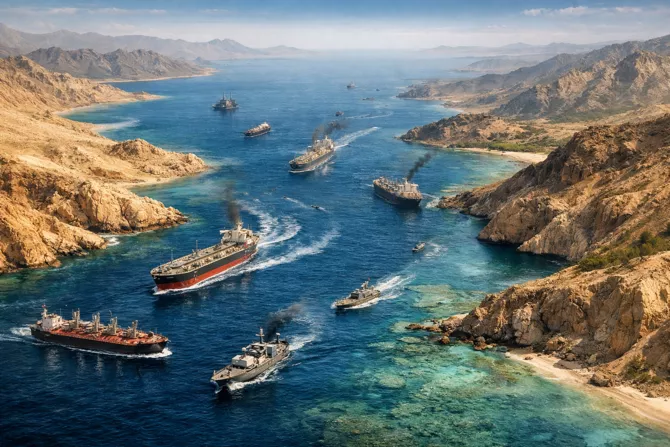
photo: Orda.kz
International sanctions and China’s near-monopoly force Tehran to accept steep discounts on its oil.
In 2025, the Islamic Republic earned approximately $42 billion from oil exports-slightly more than Kazakhstan, which brought in around $40 billion.
What This Means for the World
In this way, Iran’s impact on global oil supply is largely indirect-similar to Venezuela until recently. Before President Nicolás Maduro was effectively sidelined, Venezuela also exported significant volumes of oil to China, meeting roughly 15% of Beijing’s total demand.
With these supplies removed from the market, buyers must seek alternatives, with Russia emerging as the primary candidate. Should Russia face any production or export issues, the global market would need to rely on other sources, further reducing the oil available to other buyers worldwide.
Even more crucial is that Iran holds another powerful lever over the global oil industry and world economy - the Strait of Hormuz, which borders both the Islamic Republic and the Arabian Peninsula.
Roughly 20% of all global oil shipments and 90% of the region’s crude production pass through this strategic waterway, giving Iran significant influence over energy flows worldwide.
Iran has repeatedly threatened to close the Strait of Hormuz in response to any perceived threat - from international sanctions to last year’s airstrikes on its nuclear facilities.
For the first time, these threats have become reality: the strait is now completely blocked for all vessels, leaving hundreds of ships stranded at its entrance with thousands of crew members on board.
Trump has pledged US naval escorts for commercial ships and even ordered low-cost insurance for cargo passing through the strait, but so far, these measures have had little effect.
Meanwhile, Iran is attacking the oil and gas infrastructure of Gulf countries. In Saudi Arabia, the largest oil refinery has been forced to halt operations, while in Qatar, liquefied natural gas exports - including shipments to Europe - have been temporarily suspended.
Experts warn that these disruptions could significantly impact global markets. Calculations show that Saudi Arabia’s oil storage will last only about two weeks. After that, one of the world’s largest oil producers, cut off from much of its exports due to the Strait of Hormuz blockade, may be forced to reduce production.
Alternative shipping routes are limited in capacity and cannot fully replace the strait, raising the risk of global supply shortages and price spikes.
What Does This Mean for the U.S.?
Thus, the main risks could materialize with a slight delay, over the course of a few weeks. If that happens, oil prices are likely to react much more sharply, creating potential headaches for Trump.
Historically, American presidents prioritize cheap gasoline at home. US residents, due to sprawling cities and limited public transit, rely heavily on cars for daily life. During his first term, Trump even called Saudi Arabia’s crown prince, demanding an increase in oil production to lower global prices.
Ahead of his campaign to return to the White House, the Republican made one of his slogans “Drill, baby, drill”, reflecting his hope for higher supply and lower gas prices.
Only recently, in February 2026, Trump addressed Congress, touting the cheaper gasoline prices he claimed credit for. At the time, the national average at the pump was $2.92 per gallon (3.78 liters), down from $3.11 in January 2025, when the current president took office.
Since then, gasoline prices have risen by 11.3%, signaling renewed pressure on US drivers and potential political challenges.
On March 5, 2026, the average gasoline price in the US reached $3.25 per gallon, ranging from $2.80 in Oklahoma-home to the main trading hub for American WTI crude-to $4.81 in California.
The current spike lags only behind the surge in March 2022, shortly after the outbreak of the war in Ukraine, when prices hit $5 per gallon. Analysts warn that if the conflict continues over the coming weeks, US gas prices could rise to $3.35 per gallon.
Should oil prices climb to $100 per barrel, gasoline at American pumps could reach $4 per gallon, intensifying pressure on consumers and policymakers alike.
Despite being one of the world’s largest oil producers, the US cannot fully meet its own crude and fuel needs, and several factors explain why.
The pipeline network is imperfect, making it difficult to transport oil from production regions-mostly in the south-to all parts of the country. In some states, it is easier and cheaper to import oil by sea.
American crude is very light, making it ideal for producing gasoline but less suitable for other fuels such as diesel, kerosene, jet fuel, and fuel oil. These products must also be sourced from abroad, or US crude must be blended with heavier imported oils before refining.
Another factor is that producing oil domestically is expensive. The early-2000s shale revolution dramatically transformed America’s oil industry. Today, shale fields account for roughly three billion barrels per year, or about 64% of total US production.
Extracting oil from shale is technologically far more complex than from conventional reservoirs. The process requires pumping large volumes of water mixed with chemicals to fracture the rock, a method known as hydraulic fracturing, or fracking.
This process significantly increases production costs. Currently, extracting shale oil costs about $65-70 per barrel, depending on the field, and forecasts suggest it could rise to $95 per barrel over the next decade. When global oil prices fail to cover these costs, production is often halted or scaled back.
photо: Envato
Additionally, because US crude-primarily Texas WTI-is traded domestically, its price must remain below Brent crude to offset higher transportation costs and stay competitive on the global market.
All of this makes the US heavily dependent on imports, which account for about one-third of domestic consumption. Any spike in global oil prices, including those driven by the war in Iran, inevitably affects US pump prices.
There’s a nuance, though. After the export ban was lifted a decade ago, roughly one-third of domestic production is shipped abroad. While the ban could theoretically be reinstated, there are no plans to do so.
Even if import dependence declines in the foreseeable future, it won’t automatically lower gas prices. In an open global market, sellers can simply export crude for higher profits, shrinking domestic supply and keeping US prices elevated.
A new export ban, if implemented, could help stabilize domestic oil supply, but it would expose another challenge. Oil companies are a major pillar of the US economy, and Trump cannot ignore their interests.
Major firms like Chevron, ExxonMobil, Devon Energy, ConocoPhillips, and Phillips 66 are all part of the S&P 500 index. Lower domestic prices would hit their profitability and affect returns for countless investors, including banks, insurers, pension funds, and investment funds across multiple countries.
Additionally, American oil companies are involved in numerous international projects, meaning any domestic policy changes can have global ripple effects.
In Kazakhstan alone, American oil companies are heavily involved in the development of major fields such as Tengiz, Kashagan, and Karachaganak, earning the bulk of revenues from these operations-so much so that it sparked a multi-billion-dollar lawsuit from the government.
These firms also operate in Canada, Brazil, Guyana, Argentina, Venezuela, Australia, and Middle Eastern countries, profiting wherever oil prices are high.
This highlights the dual challenge facing Trump. While he must consider domestic voters, who favor cheap gasoline, he also cannot ignore the interests of oil giants, including shale producers, who rely critically on high prices.
Historically, every US president faced similar tensions. The dilemma becomes especially acute during military conflicts in oil-rich regions, as seen in Iraq, Syria, and Libya.
Buying crude from Tehran-even at favorable prices under a Tehran government more aligned with Washington-is not a vital necessity for the US The country already produces enough resources domestically to meet its needs.
While American oil companies could theoretically participate in Iranian projects, decades of US-imposed sanctions, some reinforced during Trump’s first term, make such involvement impractical.
photo: orda.kz
Recent events in Venezuela, where Trump openly spoke about reintroducing American companies and claiming the country’s oil, fueled a wave of speculation and even conspiracy theories.
One theory suggests that Washington uses wars to clear the global oil market of competitors, reserving resources for itself and its allies. Another claims that oil-rich countries often turn into corrupt authoritarian regimes, and the US acts out of a genuine desire to improve governance and local living conditions-with oil being a mere side factor.
A third perspective argues that by targeting Iran, the US aims to weaken China’s global position, as Beijing currently depends on multiple sources. Losing two major suppliers since the start of the year forces China to buy more oil from the US, limiting its strategic options-from trade policy to potential actions regarding Taiwan.
For Washington, the most critical goal is to make China more flexible in semiconductor supplies. Currently, China is nearly the sole global supplier, and the US has long feared manipulation or sudden loss of access to this crucial resource.
This theory has both strengths and weaknesses. On one hand, experts point out that Russia is the main alternative to replace Iranian and Venezuelan oil, but it remains under sanctions and cannot sell freely-an advantage that China and India have long exploited.
On the other hand, as reported by The Wall Street Journal, the White House is seriously considering urging China to abandon Russian and Iranian oil in favor of US supplies. This is a difficult task, especially since Beijing values its relationship with Moscow.
Either way, Trump finds himself in a precarious position. The decisions of the impulsive US president now carry major consequences for the global economy and multiple industries worldwide.