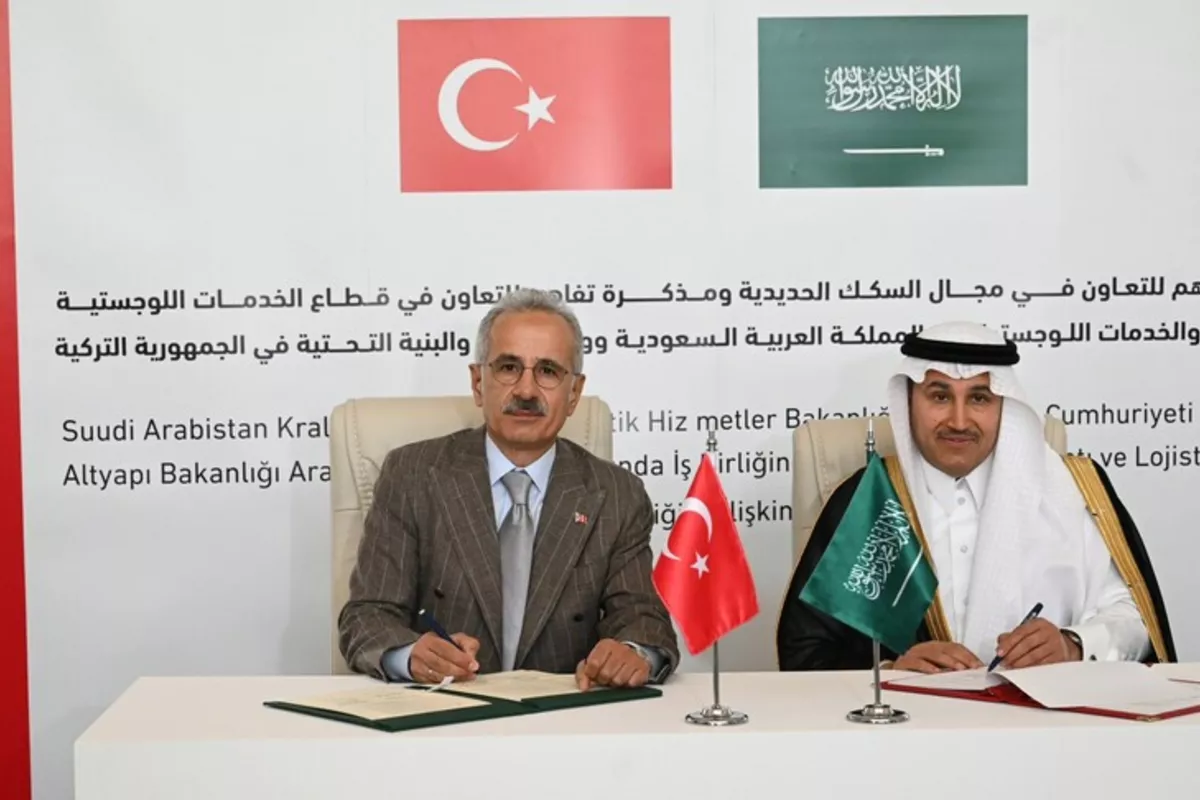
The signing of two memorandums of understanding (MoUs) between Türkiye and Saudi Arabia in the fields of logistics services and railway cooperation marks a significant development in the evolving strategic relationship between the two regional powers. While the agreements focus on transportation infrastructure and technical cooperation, their broader implications extend far beyond logistics. They reflect a growing convergence of economic interests, regional connectivity ambitions, and efforts to reshape trade routes across the Middle East at a time of profound geopolitical and economic transformation.
The agreements, signed by Turkish Minister of Transport and Infrastructure Abdulkadir Uraloglu and Saudi Minister of Transport and Logistics Services Saleh bin Nasser Al-Jasser, represent a major step toward integrating transportation networks across the region, according to Anadolu Agency. They also demonstrate how both countries are positioning themselves to benefit from changing global supply chains and emerging transit corridors.
Strategic Transport Cooperation Beyond Bilateral Relations
The newly signed agreements are not merely technical arrangements. They represent an attempt to establish a long-term framework for cooperation between two countries that occupy pivotal geographic positions linking Europe, Asia, and Africa.
Türkiye has long sought to leverage its location as a bridge between continents, investing heavily in highways, ports, railways, and logistics hubs. Saudi Arabia, meanwhile, has placed transportation and logistics at the center of its Vision 2030 economic diversification strategy. The kingdom aims to become a global logistics hub capable of connecting major international markets while reducing dependence on oil revenues.
The logistics services memorandum focuses on cooperation in logistics center construction, operational management, expertise sharing, and joint activities. Such cooperation can facilitate the harmonization of standards and improve efficiency in cargo movement between the two countries.
At the same time, the railway cooperation agreement seeks to strengthen collaboration in technology, infrastructure development, training, and human resources. This reflects recognition that modern transportation systems require not only physical infrastructure but also institutional and technical integration.
By combining Türkiye's transportation expertise with Saudi Arabia's large-scale infrastructure investments, both sides are creating the foundations for deeper regional economic integration.
The Revival of Regional Land Corridors
One of the most significant aspects of the announcement is the emphasis on land transportation routes connecting Türkiye, Iraq, and Saudi Arabia.
According to Uraloglu, two successful test runs from Türkiye through Iraq and onward to Saudi Arabia have already demonstrated the feasibility of the route. This is particularly important because regional trade patterns have been heavily affected by geopolitical instability, conflicts, and disruptions in traditional transit pathways.
The proposed corridor offers several advantages. It could shorten transportation times, reduce logistics costs, and provide businesses with alternatives to maritime shipping routes. As global supply chains increasingly prioritize resilience and diversification, land-based transport corridors are gaining strategic importance.
The route through Iraq also aligns with broader regional infrastructure initiatives aimed at reconnecting Middle Eastern economies after years of conflict and fragmentation. If successfully developed, the corridor could serve as a critical link connecting Turkish manufacturing centers with Gulf markets while also facilitating trade flows in the opposite direction.
The fact that Ankara and Riyadh are jointly monitoring developments along the Syria-Jordan-Iraq transportation routes indicates that both governments view regional stabilization as increasingly connected to economic and infrastructure cooperation.
The Hejaz Railway Vision and a New Trade Geography
Perhaps the most ambitious aspect of Türkiye's transportation strategy is its proposal to modernize and expand the historic Hejaz Railway.
Originally built during the Ottoman era in the early twentieth century, the railway once connected Damascus with Medina and served as a major transportation artery for pilgrims and commerce. Reviving this historic route carries both symbolic and practical significance.
Türkiye's plan to extend the railway network eventually toward Oman would create a vast transportation corridor stretching across much of the Middle East. Such a project could fundamentally alter regional trade geography by establishing an alternative route to maritime passages such as the Strait of Hormuz.
The strategic importance of this vision should not be underestimated. The Strait of Hormuz remains one of the world's most critical energy and trade chokepoints. Any disruptions in the area can have global economic consequences. Developing complementary land transportation networks could reduce vulnerability to maritime disruptions while increasing trade flexibility.
The project would also strengthen economic interdependence among countries across the region. Improved rail connectivity could stimulate investment, tourism, industrial development, and cross-border trade. For landlocked areas and regions recovering from conflict, enhanced railway infrastructure could provide new opportunities for economic growth and integration.
However, realizing such an ambitious vision will require extensive investment, political coordination, and long-term stability. Infrastructure projects spanning multiple countries often face challenges related to financing, regulations, security concerns, and technical compatibility. Nevertheless, the renewed interest in regional railway connectivity reflects a broader shift toward infrastructure-driven diplomacy.
Economic and Geopolitical Implications
The Türkiye-Saudi transportation partnership must also be viewed within the broader context of changing regional dynamics.
In recent years, Ankara and Riyadh have worked to normalize and strengthen bilateral relations following periods of political tension. Economic cooperation has become a central pillar of this rapprochement. Transportation and logistics provide a practical area where both countries' interests strongly align.
The agreements also coincide with increasing competition among global and regional powers to shape future trade corridors. Initiatives such as China's Belt and Road Initiative, India's connectivity projects, and various Gulf-led infrastructure programs have intensified interest in transportation networks as instruments of economic influence.
For Türkiye, stronger transportation links with Saudi Arabia enhance its role as a transit hub connecting Europe with the Middle East and beyond. For Saudi Arabia, improved connectivity supports its ambition to become a global logistics center and a key player in international trade networks.
The potential revival of transport volumes is another notable aspect. Uraloglu highlighted that annual bilateral transport activity had reached 20,000 movements before 2012. Although regional developments reduced those numbers, both countries now appear determined to not only restore but surpass previous levels of cooperation.
This objective reflects confidence in the long-term economic potential of the partnership. Growing trade, expanding investment flows, and increasing regional connectivity could generate substantial benefits for both economies.
A Foundation for Future Regional Integration
The newly signed memorandums represent more than bilateral agreements between Türkiye and Saudi Arabia. They are part of a broader effort to redefine how goods, services, and people move across the Middle East.
As regional governments increasingly focus on economic diversification, infrastructure modernization, and connectivity projects, transportation cooperation is emerging as a critical tool for fostering growth and stability. The agreements signed this week indicate that Ankara and Riyadh are seeking to position themselves at the center of this transformation.
While many challenges remain before ambitious projects such as the expanded Hejaz Railway become reality, the direction is clear. Both countries are investing in a future where regional integration is driven not only by diplomacy but also by physical infrastructure linking economies together.
If successfully implemented, the Türkiye-Saudi transportation partnership could become a cornerstone of a new regional logistics architecture, enhancing trade flows, strengthening economic resilience, and contributing to greater connectivity across one of the world's most strategically important regions.