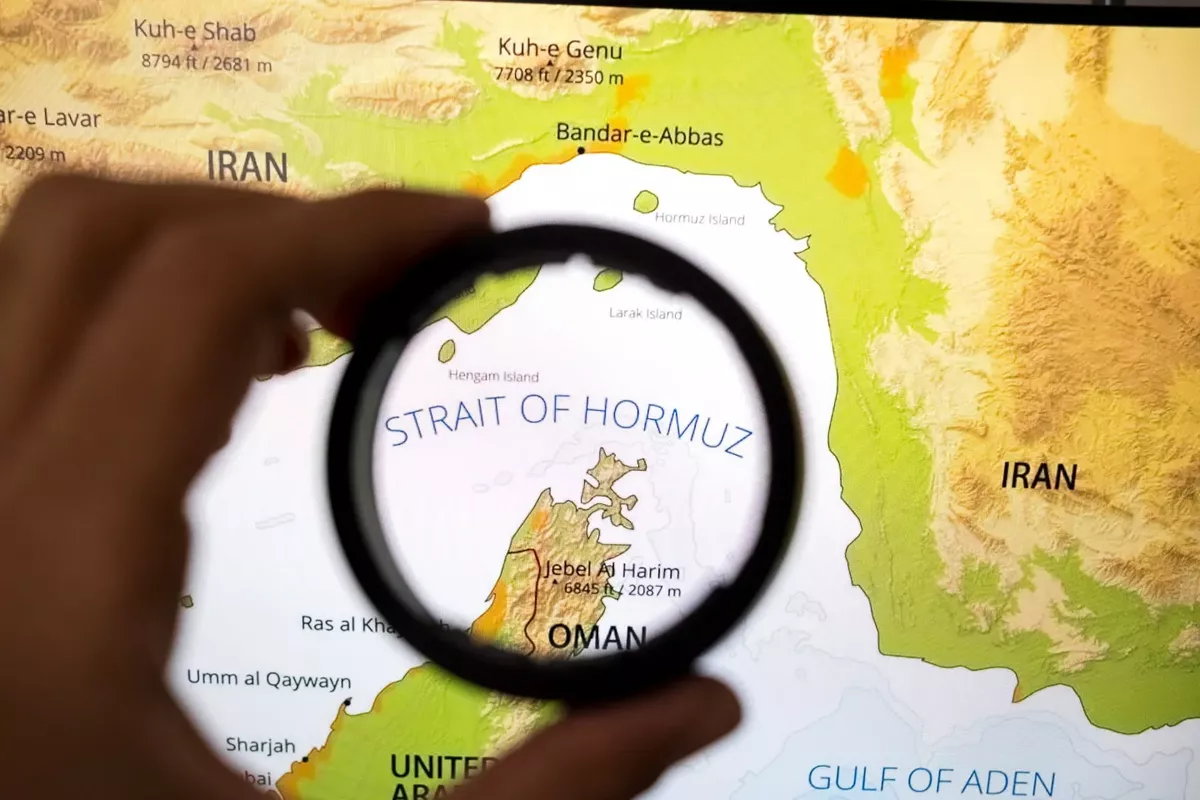
The negotiations between Iran and Oman over a new navigation regime in the Strait of Hormuz may prove to be far more significant than a temporary arrangement designed to restore commercial shipping. What is being discussed could ultimately affect the balance of power in the Gulf, the legal principles governing international waterways and, perhaps most importantly, the way Middle Eastern energy reaches global markets.
In early August, Tehran and Muscat moved closer to an agreement establishing new shipping lanes through the Strait of Hormuz. The negotiations have not yet produced a final settlement, and Iran has linked the full reopening of the waterway to broader demands on the United States. Nevertheless, the emerging framework already reveals Tehran’s strategic objective: Iran wants a much greater role in determining how one of the world’s most important maritime chokepoints operates.
The importance of Hormuz is difficult to overstate. Before the current conflict, roughly one-fifth of the world’s oil passed through the strait, making any disruption there an immediate concern for energy markets from Asia to Europe. Recent uncertainty surrounding its reopening has already contributed to renewed volatility in crude prices.
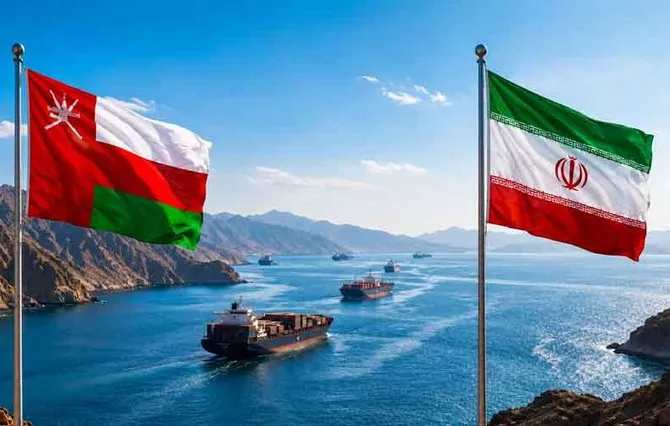
Under the arrangement being discussed by Iran and Oman, vessels entering the Persian Gulf would use a route subject to Iranian control, while outbound traffic would follow a route managed from the Omani side. Iran has also pushed for commercial ships to pass through Iranian waters in both directions under certain versions of the proposal. The precise architecture is therefore still being negotiated.
Credit: samaa.tv
This is not simply a technical question of maritime traffic management. If implemented on Tehran’s terms, the arrangement would give Iran something it has sought for years: a degree of internationally recognized operational influence over shipping through Hormuz.
That would represent an important strategic gain.
There is also a financial dimension. No transit charge is expected during the initial temporary phase, but the parties have discussed introducing so-called service fees intended to cover maritime security, environmental protection and related services. Iran has reportedly proposed charges equivalent to 5-7% of cargo value, while Oman has suggested a figure closer to 3%. Washington, by contrast, has insisted that commercial transit through Hormuz should remain free of such charges.
The terminology matters. Tehran prefers to frame the proposed payments not as tolls for passage, but as fees for services provided to vessels. Yet from the perspective of shipping companies, insurers and governments, the distinction may be difficult to sustain if payment effectively becomes a condition for safe transit.
This is where the Hormuz dispute becomes much larger than Iran itself.
International shipping has long depended on the assumption that strategically important natural straits cannot simply be transformed into geopolitical toll gates by whichever coastal state possesses the military capability to dominate them. The United Nations Convention on the Law of the Sea codifies the principle of transit passage through straits used for international navigation. Article 44 states that states bordering such straits should not hamper transit passage.
The legal picture is not entirely straightforward. Iran signed UNCLOS but never ratified it and has historically disputed the idea that the convention’s transit-passage regime automatically binds it as customary international law. Nevertheless, Tehran’s attempt to condition navigation on payments and political concessions has already generated serious opposition within the international shipping community.
The precedent is potentially dangerous.
If Hormuz can be subjected to compulsory charges justified by security or environmental services, other states bordering major maritime chokepoints may eventually be tempted to formulate similar arguments. The Strait of Malacca between Malaysia, Indonesia and Singapore, the English Channel between Britain and continental Europe, Gibraltar between the Mediterranean and Atlantic, and the Turkish Straits are all essential arteries of international commerce.
The historical circumstances and legal regimes governing these waterways differ considerably, so direct comparisons should be made cautiously. But the fundamental question is the same: how much control should coastal states be allowed to exercise over international navigation?
That is why Washington’s objections go beyond the amount of any proposed Iranian fee.
For the United States, accepting a system under which Tehran effectively determines the conditions for access to Hormuz would amount to acknowledging a new regional reality. Washington has publicly emphasized freedom of navigation while simultaneously negotiating, directly or indirectly, over the conditions necessary to restore stable commercial traffic. Iran, meanwhile, has tied a permanent reopening of the strait to wider demands, including sanctions relief, compensation, access to frozen assets and changes in the U.S. military posture.
Hormuz has therefore ceased to be merely a shipping route. Tehran has transformed it into negotiating leverage.
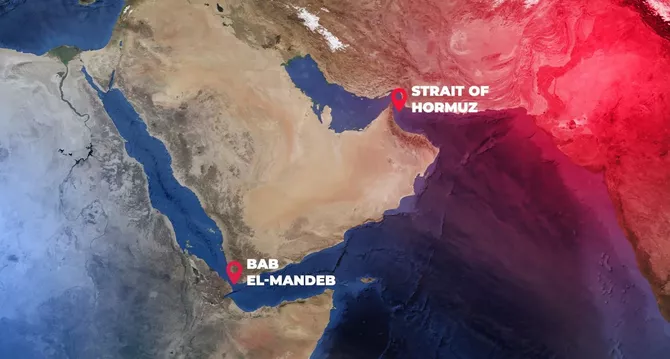
The same strategic logic can be seen farther south.
Credit: niice.org.np
The Bab el-Mandeb Strait, connecting the Red Sea with the Gulf of Aden, is another vital artery of world trade. Shipping through this area has repeatedly been disrupted by attacks carried out by Yemen’s Iran-aligned Houthis. Tehran does not directly control Bab el-Mandeb, but its relationship with the Houthis gives Iran an important source of indirect regional leverage precisely where shipping headed toward the Suez Canal is most vulnerable. Recent Houthi attacks have again highlighted the connection between Gulf security, Red Sea security and global energy transportation.
The political consequences of this pressure are now becoming visible.
On August 7, Saudi Arabia, Türkiye and Pakistan signed the Mecca Joint Defense Agreement. Its central principle is clear: an armed attack against one of the three states will be regarded as an attack against all. The agreement also calls for deeper defense cooperation and stronger collective deterrence.
Officials from all three countries have stressed that the pact is defensive and is not directed against Iran or any other particular state. That distinction should be taken seriously. It would therefore be premature to describe the agreement formally as an anti-Iranian alliance or a “Sunni NATO.”
Yet geopolitical agreements do not emerge in a vacuum.
The timing of the pact, following months of regional conflict, pressure on Gulf infrastructure and uncertainty surrounding Hormuz, makes it difficult to separate the new security architecture from the broader challenge posed by Iran and its regional partners. Even if Tehran is not mentioned in the document, Iranian military pressure has undoubtedly become one of the factors encouraging Saudi Arabia and other regional powers to diversify their security partnerships.
In that sense, Iran may have achieved the opposite of what it intended.
By demonstrating how vulnerable its neighbors remain to pressure through Hormuz, missile attacks and proxy networks, Tehran is giving them additional incentives to coordinate militarily and economically.
Egypt could eventually have its own reasons to move closer to such regional security arrangements. Cairo has a particularly strong interest in restoring secure navigation in the Red Sea because disruptions to shipping directly affect traffic through the Suez Canal. But any Egyptian participation in the Mecca pact remains a matter of speculation unless Cairo itself decides to move in that direction.
An even more profound transformation is taking place in the energy sector.
Gulf governments have concluded that they cannot simply wait for another diplomatic settlement and assume that Hormuz will never again be used as geopolitical leverage. They are accelerating efforts to create export routes that bypass the strait altogether.
The United Arab Emirates is already in the strongest position. Its existing Abu Dhabi Crude Oil Pipeline carries oil from inland fields to Fujairah on the Gulf of Oman, outside the Strait of Hormuz. ADNOC is now accelerating another pipeline project that is expected to substantially increase export capacity through Fujairah. Reuters reported in May that the new project was already about 50% complete and was targeted for operation in 2027.
Saudi Arabia has its own strategic alternative: the East-West Pipeline connecting its eastern oil-producing regions with the Red Sea port of Yanbu. Riyadh is considering increasing the system’s capacity by as much as 1-2 million barrels per day, potentially allowing not only Saudi crude but also oil from neighboring Gulf producers to avoid Hormuz.
Yanbu, however, does not eliminate every geopolitical risk. Cargoes heading south toward Asian markets must still navigate the Red Sea and Bab el-Mandeb, where Houthi attacks have created another security problem. For exports moving north toward Europe through the Suez Canal, Yanbu offers a much more attractive route because vessels can avoid Hormuz altogether.
Iraq is also examining alternatives, including possible pipeline connections from Basra toward Oman’s Duqm port and a long-discussed route through Jordan to the Red Sea port of Aqaba. These projects are less advanced and face substantial financial, political and engineering obstacles, but their strategic logic has become much more compelling since the Hormuz crisis began.
The UAE is simultaneously expanding logistics infrastructure on its eastern coast. DP World announced plans in July to develop new terminals in Fujairah, further strengthening the country’s ability to operate outside the Strait of Hormuz.
The direction of travel is therefore unmistakable.
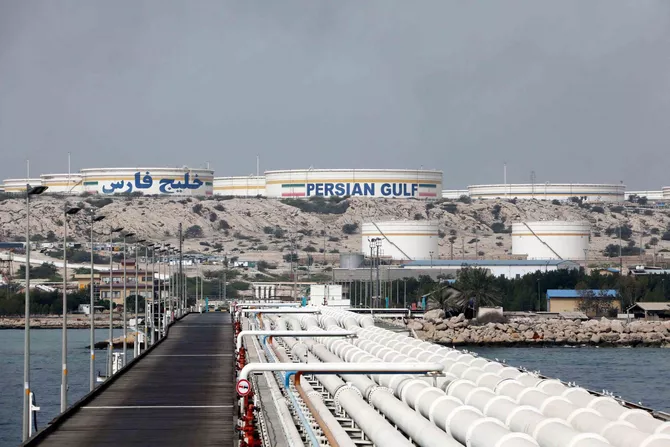
Goldman Sachs analysts estimate that additional Middle Eastern pipeline capacity could insulate more than 45% of pre-war Persian Gulf oil exports from future Hormuz disruptions by the end of 2027, with the share rising above 60% by the end of 2028.
Credit: middle-east-online.com
This may ultimately prove to be the most important long-term consequence of the crisis.
Iran has traditionally regarded geography as one of its greatest strategic advantages. The Strait of Hormuz gave Tehran extraordinary leverage because so much of the Gulf’s energy wealth had to pass within reach of the Iranian coastline.
But leverage works only as long as the other side has no alternative.
Every new pipeline to Fujairah, every additional barrel that can reach Yanbu, every new port on the Gulf of Oman and every serious discussion of overland energy corridors weakens the strategic value of Iran’s position.
Tehran may therefore win an important tactical victory if the emerging agreement with Oman gives it greater authority over traffic through Hormuz. It may even succeed in forcing the international community to negotiate over arrangements that would have appeared unacceptable only a few years ago.
But strategically, Iran is taking a much larger gamble.
By repeatedly demonstrating its ability and willingness to use maritime chokepoints as instruments of pressure, Tehran is encouraging its neighbors to build an energy system that depends less on those chokepoints, while simultaneously pushing powerful regional states toward deeper defense cooperation.
The paradox is striking. Iran is trying to convert geography into permanent political leverage. Yet the more aggressively it uses that leverage, the stronger the incentive for the rest of the region to make Iranian geography less important.
If the current trend continues, the lasting legacy of the Hormuz crisis may not be Iranian control over the Gulf’s principal gateway. It may instead be the emergence of a new Middle East in which pipelines, ports, military partnerships and alternative trade corridors are deliberately designed to ensure that no single country can hold that gateway hostage again.