Who Controls the Strait of Hormuz and Can Countries Charge Ships for Protection?
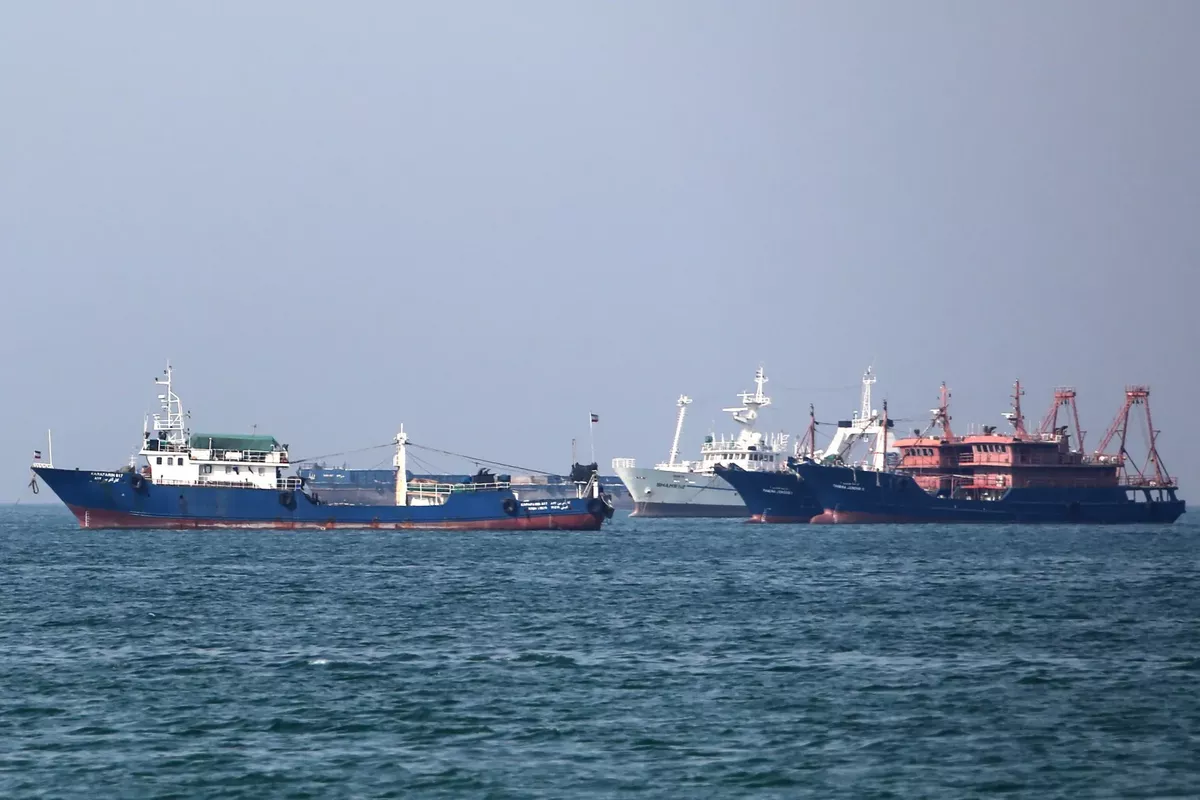
Renewed tensions between the US and Iran have once again placed the Strait of Hormuz at the center of a security crisis, reviving questions over who controls the strategic waterway and how disruptions could affect energy markets worldwide.
On Monday, US President Donald Trump said Washington was reinstating what he called an "Iranian blockade" and proposed charging a 20% fee on cargo passing through the Strait of Hormuz in exchange for US protection of the strategic waterway.
In an earlier interview with Fox News, Trump said: "We're going to guard it. We're going to get paid for guarding it - a lot of money. We want to be reimbursed for putting our people in danger."
Iran rejected the proposal, insisting it has long been responsible for safeguarding navigation in the strait and accusing the US of attempting to assert authority over an international waterway.
Following the Feb. 28 strikes on Iran, tensions disrupted shipping through the Strait of Hormuz as Iran imposed restrictions and threatened vessels linked to its adversaries. Traffic gradually resumed after a June US-Iran Memorandum of Understanding (MoU) but faced renewed disruption.
On July 11, the Islamic Revolutionary Guard Corps (IRGC) Navy said the Strait of Hormuz had been closed "until further notice," according to IRIB. Washington rejected the claim and said navigation remained open.
The competing claims have renewed debate over who controls the strait, what international law says about passage through it and whether any country can charge ships for using one of the world's busiest maritime chokepoints.
What is the Strait of Hormuz?
The Strait of Hormuz is a narrow waterway linking the Persian Gulf with the Gulf of Oman and the Arabian Sea.
At its narrowest point, it is about 33 kilometers (21 miles) wide, while the designated shipping lanes in each direction are only about 3 kilometers wide, making it one of the world's most sensitive maritime chokepoints.
It serves as the only sea route for oil exports from Kuwait, Iraq, Bahrain and Qatar, and for much of the exports from Saudi Arabia, the UAE and Iran.
Why is it so important?
The strait carries roughly one-fifth of the world's oil consumption and a significant share of global liquefied natural gas (LNG) exports.
According to energy analysts, about 20 million barrels of crude oil and petroleum products pass through the waterway every day.
Qatar, one of the world's largest LNG exporters, ships nearly all of its gas through the strait.
Any disruption immediately raises concerns over global energy supplies, shipping costs and inflation, often pushing oil prices higher.
Who controls the strait?
No single country controls the Strait of Hormuz.
The northern coastline belongs to Iran, while the southern coastline is shared by Oman and the UAE.
The internationally recognized shipping lanes pass through the territorial waters of both Iran and Oman.
Although coastal states exercise sovereignty over their territorial waters, international maritime law guarantees the right of "transit passage" through straits used for international navigation.
This means commercial and military vessels from all countries generally have the legal right to pass continuously and without unnecessary delay.
Can countries charge ships for protection?
Under international law, countries cannot unilaterally impose fees on foreign vessels simply for exercising the right of transit passage through an international strait.
Coastal states may collect charges only for specific services they provide, such as pilotage, port facilities or other optional maritime assistance.
A blanket fee for allowing ships to transit through the Strait of Hormuz has no clear basis under the UN Convention on the Law of the Sea (UNCLOS), although interpretations differ because neither the US nor Iran is a party to the convention.
Tehran disputes that all foreign military vessels enjoy unrestricted transit passage because it is not a party to UNCLOS and has domestic legislation requiring prior authorization for some warships.
Article 42 of UNCLOS allows only charges connected with specific services. A general protection fee would almost certainly be challenged under international law.
Why do Iran and the US both claim to protect shipping?
Iran has long argued that it is primarily responsible for maintaining security in the Persian Gulf and the Strait of Hormuz because much of the waterway borders its coastline.
The United States, meanwhile, has maintained a major naval presence in the Gulf for decades, arguing that it protects freedom of navigation and ensures global energy supplies remain uninterrupted.
The US Navy's Fifth Fleet, headquartered in Bahrain, regularly patrols the region alongside allied naval forces.
Find the original article here