Iran’s role in the transport and logistics architecture of the South Caucasus cannot be assessed solely through economic indicators or the length of railway routes. For Tehran, transport corridors have long been more than infrastructure projects. They are instruments of geopolitics, used to preserve regional influence, overcome international isolation and contain strategic competitors.
Iran has traditionally viewed the South Caucasus both as a vital buffer zone and as a northern gateway to Russia, the Black Sea region and European markets. Consequently, any changes to the region’s transport map are viewed in Tehran primarily through the prism of national security.
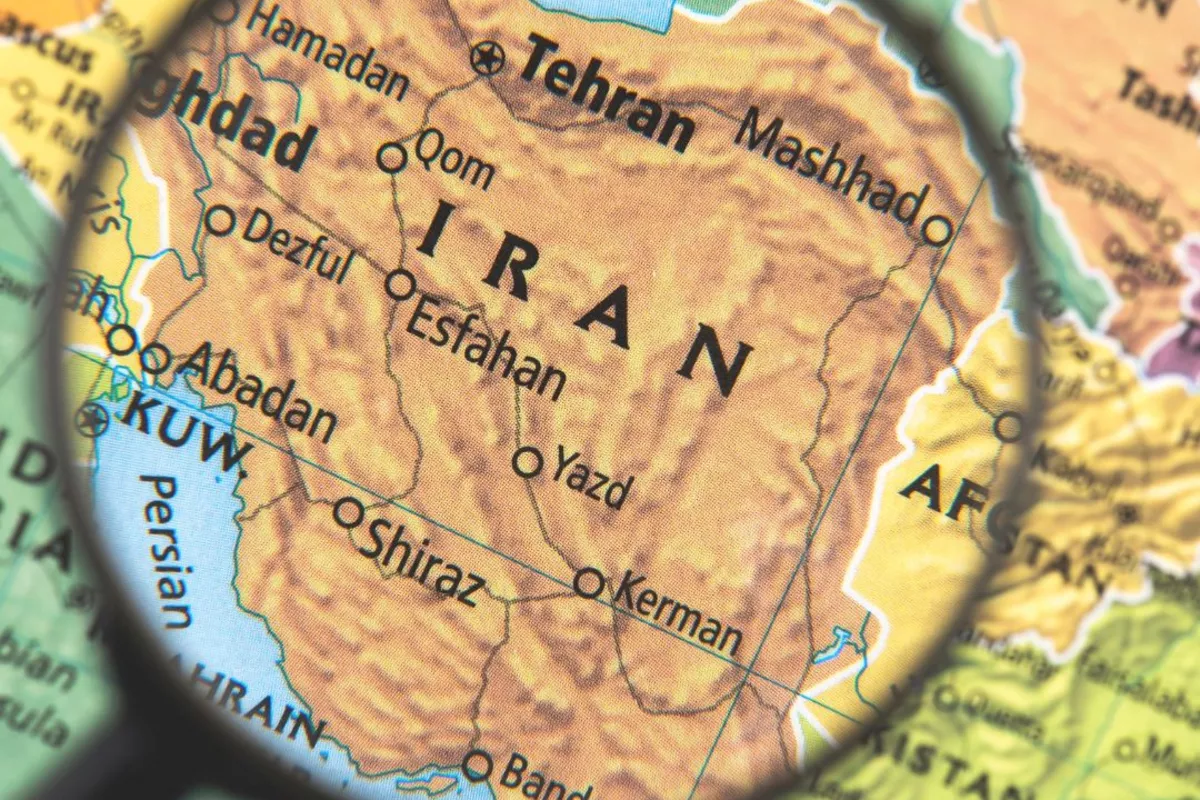
Iran’s principal advantage remains its geographical location. The country lies at the crossroads of the South Caucasus, Central Asia, the Caspian basin and the Persian Gulf, making it a natural participant in several major logistics projects.
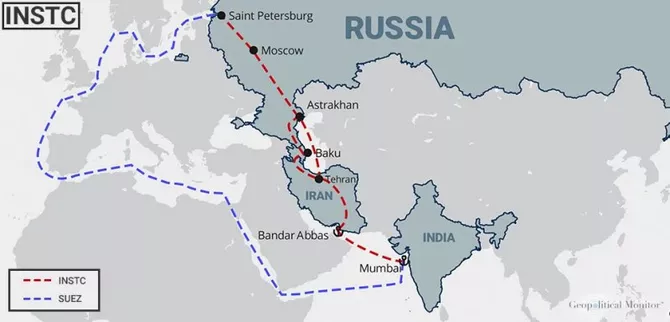
Credit: Geopolitical Monitor
The International North-South Transport Corridor occupies a central place among them. It is intended to connect India and the Persian Gulf states with Azerbaijan, Russia and, ultimately, European markets via Iranian territory. The use of Iranian ports, particularly Bandar Abbas and Chabahar, could significantly reduce both delivery times and transport costs compared with the traditional maritime route through the Suez Canal.
Geography alone, however, is not enough. Without modern infrastructure, it remains merely a potential advantage. This is why the development of the Caspian port of Astara and the completion of the Rasht-Astara railway have become particularly important for Iran. The railway is expected to close one of the key missing links in the western branch of the North-South corridor.
For many years, the project faced financial difficulties, sanctions-related restrictions and a lack of investment. Under the current geopolitical circumstances, however, its significance for Iran has grown considerably. For Tehran, it is no longer simply a commercial project but also a means of avoiding further exclusion from Eurasian trade.
Azerbaijan occupies a special place in this system. Baku supports the development of the North-South corridor because it strengthens the country's position as a major transit hub linking Russia, Iran, Central Asia and global markets. At the same time, Iran remains an important partner for Azerbaijan in maintaining transport links with the Nakhchivan exclave.
Baku's official position is that transport and logistics cooperation with Tehran should develop on a mutually beneficial basis and should not be directed against the interests of third countries. Behind this diplomatic language, however, lies intense competition over routes, transit flows and strategically important infrastructure.
A clear example is the so-called Araz Corridor through Iranian territory. For Tehran, it is more than simply an alternative route between mainland Azerbaijan and Nakhchivan. It enables Iran to retain its strategic importance for Baku, secure additional transit opportunities and prevent regional logistics from shifting entirely away from Iranian territory.
Energy cooperation, including swap deliveries of Turkmen gas, further enhances relations between Baku and Tehran. Thus, despite periodic political tensions, practical interests continue to encourage cooperation between the two sides.
A different dynamic characterises Iran's relations with Armenia. For Yerevan, the border with Iran in the Syunik region remains its only reliable overland route to the south. For Tehran, this border is equally significant.
Iran has repeatedly stated that any alteration of internationally recognised borders in the South Caucasus constitutes a "red line". This position reflects not only Tehran's support for Armenia. Losing direct access to Armenian territory would also significantly weaken Iran's own strategic position while further strengthening the Turkish-Azerbaijani partnership.
Through Armenia, Iran potentially gains access to Georgia and the Black Sea. The two countries also maintain an energy exchange arrangement under which Iran supplies gas in return for electricity. These links create a durable economic interdependence that both sides have a strong interest in preserving.
This largely explains Tehran's opposition to the concept of the Zangezur Corridor. Iran fears that the proposed route could diminish the importance of its own territory, alter the existing regional balance of power and weaken its connection with Armenia.
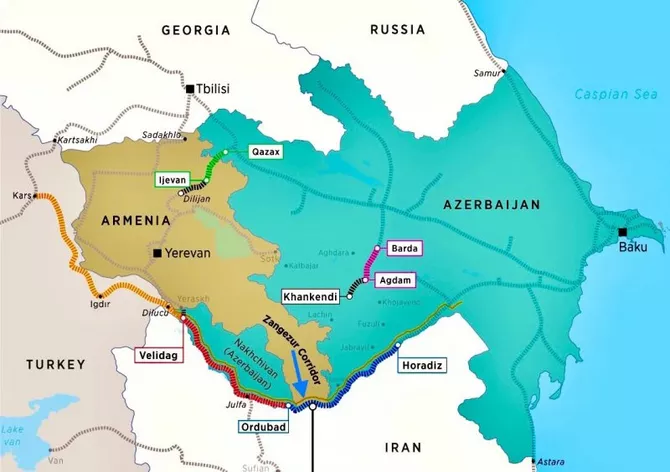
Credit: caspianpolicy.org
Azerbaijan, meanwhile, argues that transport links through Zangezur would not entail any revision of internationally recognised borders and pose no threat to Iran. Baku maintains that reopening communications would benefit the entire region, strengthen cross-border connectivity and even create additional opportunities for the North-South corridor.
The dispute over the Zangezur route is therefore less about the infrastructure itself than about who will shape the future geo-economic landscape of the South Caucasus.
Another major challenge for Tehran is the rapid development of the Middle Corridor. The Trans-Caspian route connects Central Asia with Europe via the Caspian Sea, Azerbaijan, Georgia and Türkiye. Its principal political advantage for Western and regional actors is that it bypasses both Russia and Iran.
The development of the Middle Corridor strengthens Azerbaijan and Georgia as transit hubs while increasing their importance within international supply chains. For Iran, this creates the risk of being marginalised in emerging Eurasian trade networks.
Tehran reacts sensitively to initiatives that could exclude it from regional logistics. In response, Iran has sought to diversify its options by becoming more active in projects associated with the Shanghai Cooperation Organisation and BRICS, while also promoting the Persian Gulf-Black Sea corridor through Armenia and Georgia.
The project is intended to provide Iran with an additional route to European markets and reduce its dependence on transport networks dominated by Türkiye and Azerbaijan. Its implementation, however, would require substantial investment, political stability and close coordination among all participating countries - conditions that are not yet fully in place.
Iran's policy in the South Caucasus is generally aimed at preventing the excessive strengthening of external actors, particularly Türkiye, Israel, the United States and the European Union.
Tehran regards its close ties with Armenia as an important element of the regional balance capable of limiting the expansion of Turkish and Azerbaijani influence. At the same time, it seeks to preserve pragmatic relations with Baku despite persistent disagreements.
Sources of tension include Azerbaijan's close defence cooperation with Israel, mutual security suspicions and the politically sensitive issue of Iran's large ethnic Azerbaijani population. Nevertheless, a complete breakdown in relations would serve neither side's interests.
Iran also participates in the regional "3+3" consultative format, which brings together Russia, Türkiye, Iran and the three South Caucasus states. For Tehran, this mechanism reflects the principle that regional problems should be resolved by regional countries themselves.
In practice, Iran seeks to promote a regional security and transport architecture in which the role of the United States and the European Union is kept to a minimum. Yet the interests of the regional states do not always align with Tehran's vision. Armenia, Azerbaijan and Georgia continue to pursue multi-vector foreign policies and are unwilling to limit their cooperation exclusively to neighbouring powers.
In recent years, logistics has become one of Iran's principal instruments of foreign policy. Through transport projects, Tehran is seeking to mitigate the impact of sanctions, preserve transit revenues and avoid international isolation.
Iran's capabilities, however, remain constrained. Domestic economic difficulties, limited foreign investment, ageing infrastructure and sanctions-related risks continue to delay even strategically important projects. As a result, neighbouring countries often favour more predictable and better-funded alternatives.
Nevertheless, excluding Iran entirely from the South Caucasus transport system is virtually impossible. Its geographical position, access to the Persian Gulf, links with Russia, Armenia and Central Asia, and participation in the North-South corridor ensure that Tehran remains a major regional actor.
The key question is whether Iran can translate its geographical advantage into modern, competitive infrastructure.
Credit: dobetter.esade.edu
Iranian policy in the South Caucasus is gradually evolving. Whereas it was once driven primarily by the desire to preserve the regional balance of power, Tehran is now increasingly compelled to reconcile security considerations with the economic viability of transport projects.
The future of Iranian influence will largely depend on the success of the North-South corridor, completion of the Rasht-Astara railway and the country's ability to integrate into new regional supply chains. Otherwise, Tehran risks losing ground to the more dynamic Middle Corridor and the expanding Turkish-Azerbaijani partnership.
In modern Eurasia, transport routes are no longer merely channels for moving goods. They shape political alliances, redistribute influence and create new forms of interdependence between states.
Iran's position is therefore paradoxical. On the one hand, its policy is constrained by sanctions, domestic economic difficulties and competition from alternative routes. On the other, geography continues to make Iran a strategically important and, in many respects, indispensable regional actor.
In the medium term, Tehran is likely to retain its ability to influence trade, energy and the political balance of the South Caucasus. Geography alone, however, will no longer be enough. Iran will have to demonstrate that it can be not only an unavoidable neighbour but also a reliable, modern and economically attractive transport partner.