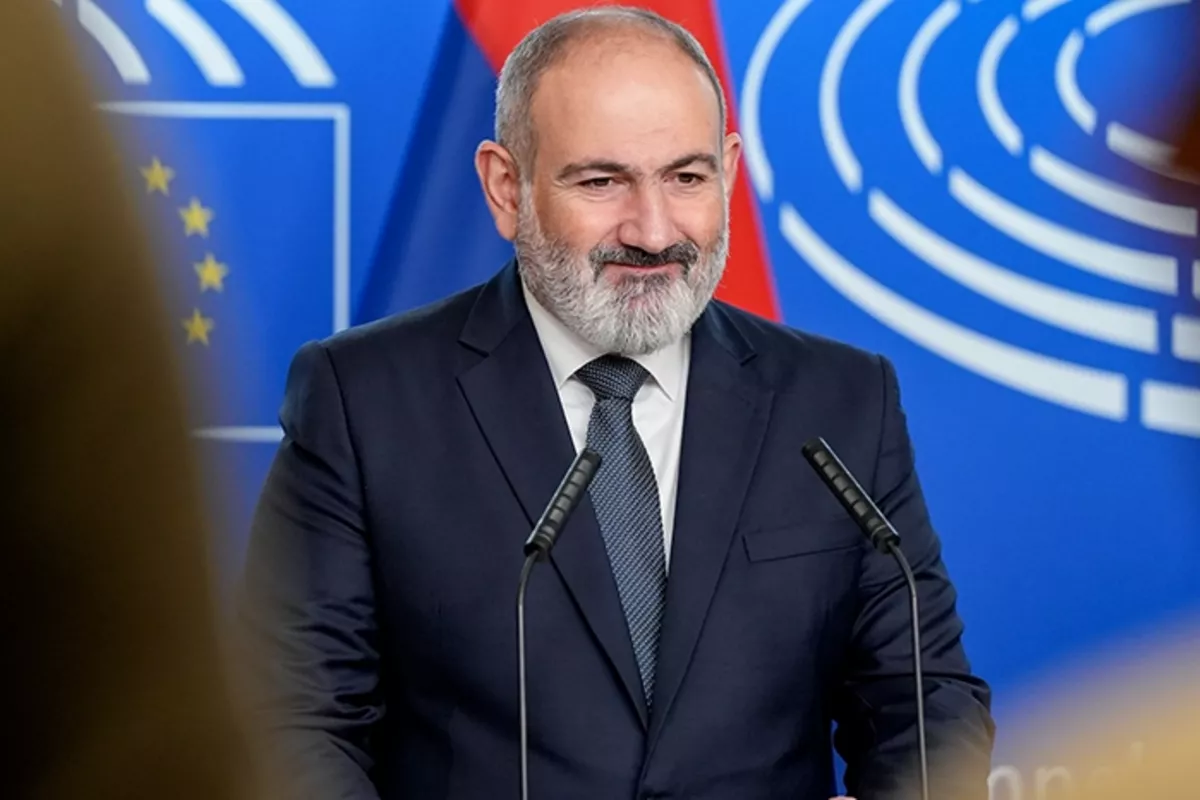
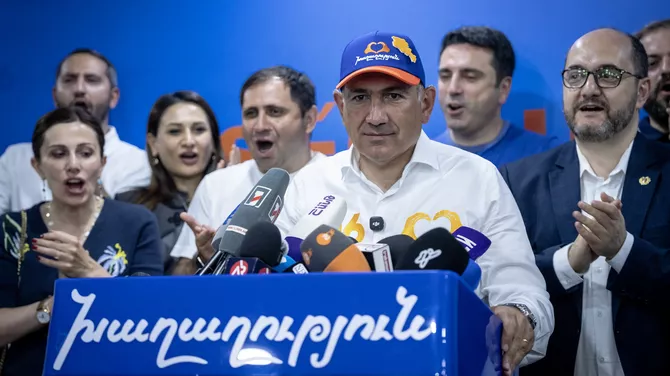
The resignation of Armenia’s government after the newly elected National Assembly convened was procedural rather than political. Under Article 158 of the Armenian Constitution, the cabinet is required to step down following the first sitting of a new parliament. President Vahagn Khachaturyan’s subsequent decision to reappoint Nikol Pashinyan as prime minister therefore confirmed continuity rather than signalling a crisis of power.
Yet behind this constitutional formality lies a far more consequential political reality. Pashinyan is beginning a new term at a moment when Armenia faces fundamental decisions about its constitutional order, relations with Azerbaijan and Türkiye, security partnership with Russia, and place in the emerging geopolitical architecture of the South Caucasus.
The government’s resignation marked neither the collapse of the existing political system nor the end of a political cycle. It effectively reset the institutional clock while preserving the balance of power created by the 7 June parliamentary election. With the ruling Civil Contract Party retaining its majority, Pashinyan received another opportunity to pursue a strategic course centred on regional normalisation, economic connectivity and gradual diversification away from Armenia’s traditional dependence on Russia.
The election was therefore more than a competition between political parties. It became an indirect referendum on Armenia’s future direction.
Pashinyan presented peace with Azerbaijan, normalisation with Türkiye and deeper engagement with Western partners as essential components of Armenia’s long-term security. His opponents, many of whom are associated with the former political establishment, promoted a more traditional approach based on close strategic relations with Russia and a more confrontational interpretation of Armenia’s regional disputes.
The result suggests that a substantial part of Armenian society prioritised stability, economic development and the prospect of open borders over a return to permanent confrontation. However, electoral approval is only the beginning of the process. Negotiating peace, securing public acceptance of painful compromises and translating diplomatic commitments into legally binding arrangements will be considerably more difficult than winning an election.
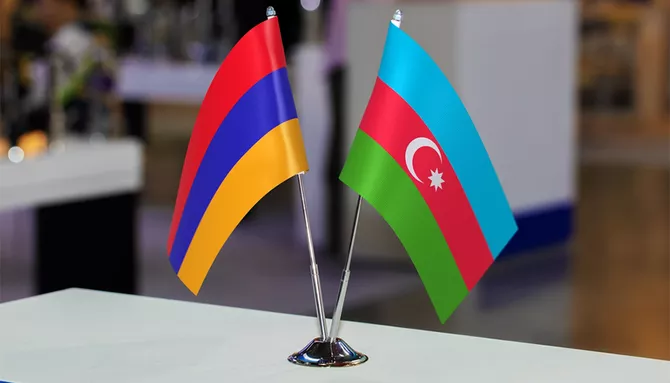
The greatest test of Pashinyan’s new mandate will remain the peace process with Azerbaijan.
Credit: consultancy.eu
Although Baku and Yerevan have narrowed their differences on several elements of a potential agreement, the remaining disputes involve politically and legally sensitive questions. These include border delimitation, constitutional reform, regional transport connections and the mechanisms through which the two countries would guarantee the absence of territorial claims against one another.
Among these issues, the Armenian Constitution has assumed particular importance.
Azerbaijan argues that references contained in the preamble of Armenia’s Constitution, through its connection to the 1990 Declaration of Independence, preserve an indirect territorial claim against Azerbaijan. Baku therefore considers the removal of such language essential to ensuring that a future peace agreement cannot later be challenged or undermined through Armenia’s domestic legal framework.
From Azerbaijan’s perspective, the matter is not merely symbolic. A peace treaty can provide lasting stability only when the constitutional and legal systems of both states are consistent with their formal recognition of each other’s sovereignty and territorial integrity. Baku consequently views constitutional clarification as a safeguard against the revival of territorial claims under a future Armenian government.
Pashinyan has acknowledged the need to reconsider Armenia’s constitutional framework. He has spoken both about amending the existing Constitution and about drafting an entirely new one. However, either option would expose the government to serious political risks.
Civil Contract does not possess the parliamentary supermajority required to resolve the issue through the legislature alone. Pashinyan may therefore have to seek opposition support or submit constitutional changes to a nationwide referendum. In practice, such a vote would become much more than a legal procedure. It would amount to a public verdict on Armenia’s post-conflict identity, the legacy of the Karabakh issue and the political legitimacy of Pashinyan’s peace strategy.
The referendum campaign would almost certainly be used by the opposition, former governing elites, nationalist organisations and groups associated with the Karabakh Armenian community to accuse the government of abandoning national interests. The Armenian Apostolic Church could also emerge as an influential centre of resistance, particularly if constitutional reform is presented as part of a wider break with traditional political and historical narratives.
Pashinyan must therefore resolve a difficult contradiction. Azerbaijan expects legally durable guarantees before signing a comprehensive peace settlement, while significant sections of Armenian society may regard the constitutional changes required for such guarantees as an unacceptable concession.
This tension makes constitutional reform one of the most decisive and potentially destabilising elements of the peace process.
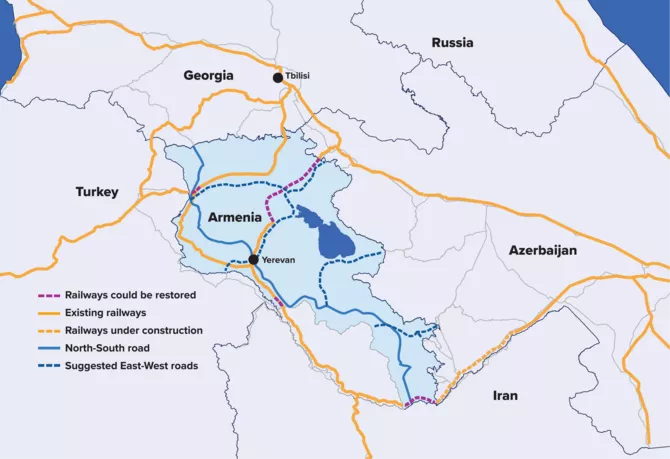
The future transport connection between mainland Azerbaijan and the Nakhchivan Autonomous Republic presents another complex challenge.
Azerbaijan advocates a secure and uninterrupted route across Armenian territory. Armenia, however, insists that all transport links must operate under its sovereignty, customs regulations, border procedures and security jurisdiction.
Yerevan places this position within its “Crossroads of Peace” initiative, which envisages the reopening of regional communications on the basis of reciprocity and respect for the jurisdiction of the countries through which the routes pass.
The disagreement is not simply about railway lines, roads or customs posts. It reflects a deeper dispute over how the post-conflict regional order should function.
Source: Government of Armenia
For Azerbaijan, the connection to Nakhchivan must be reliable and protected from arbitrary political disruption. For Armenia, accepting any exceptional legal regime could be interpreted domestically as weakening its sovereignty over the southern Syunik region. The language used to describe the route has consequently become almost as controversial as the practical arrangements themselves.
A compromise will require a model that provides Azerbaijan with predictable and unhindered transit while formally preserving Armenia’s territorial sovereignty. Possible solutions could involve international guarantees, technological customs controls, simplified procedures or third-party monitoring. Nevertheless, unless the two governments bridge their competing interpretations, the transport question may remain one of the final obstacles to a comprehensive settlement.
Progress with Azerbaijan would also create the conditions for a major transformation in Armenia’s relations with Türkiye.
The initial stage of Armenian-Turkish normalisation is expected to include opening the land border to third-country nationals and holders of diplomatic passports. This could later be followed by broader commercial and passenger access. However, Ankara has consistently linked full normalisation with developments in the Armenian-Azerbaijani peace process, making a breakthrough between Baku and Yerevan essential for wider regional integration.
For Armenia, the reopening of the Turkish border would have consequences extending far beyond diplomacy.
Access to Türkiye could diversify Armenia’s trade routes, reduce transport costs and provide new connections to European and Middle Eastern markets. It could also weaken Armenia’s dependence on routes passing through Georgia and reduce its reliance on Russian-controlled economic infrastructure. Over time, open borders with both Azerbaijan and Türkiye could transform Armenia from a geographically isolated state into a participant in regional trade and transit networks.
This explains why Pashinyan increasingly presents peace not merely as a security arrangement, but as an economic development strategy.
His government appears to believe that Armenia can no longer base its national security on closed borders, unresolved conflicts and dependence on a single external patron. Instead, Yerevan is attempting to create a more flexible model in which normal relations with neighbouring countries provide economic opportunities and reduce Armenia’s structural vulnerabilities.
Such a transformation would inevitably affect Armenia’s relationship with Russia.
Yerevan has frozen its participation in the Collective Security Treaty Organisation, expanded cooperation with the European Union and strengthened political and security dialogue with the United States. Armenia has also welcomed a larger EU monitoring presence and increasingly questioned the reliability of Russia as its principal security partner.
These developments have caused growing unease in Moscow, which views the South Caucasus as part of its traditional strategic sphere of influence.
Nevertheless, an abrupt Armenian withdrawal from Russia’s orbit remains unlikely. Armenia’s economy is still deeply connected to the Russian market. Russia remains a major source of energy, investment, remittances and trade. Russian companies retain important positions in Armenia’s infrastructure, while a large Armenian diaspora continues to live and work in Russia.
Moscow therefore possesses numerous instruments of pressure that fall below the threshold of military confrontation. These include energy pricing, trade restrictions, regulatory measures affecting Armenian exports, pressure on migrant workers, information campaigns and political support for pro-Russian forces inside Armenia.
The Kremlin may seek to demonstrate that distancing Armenia from Russia carries significant economic and political costs. Its response will probably depend on the speed and scale of Yerevan’s Western reorientation.
Pashinyan does not appear to be pursuing an immediate geopolitical rupture. His strategy is better understood as an attempt to diversify Armenia’s partnerships after decades of excessive dependence on Moscow. He wants closer relations with the European Union and the United States without triggering an uncontrollable confrontation with Russia.
Maintaining that balance will be increasingly difficult. Western governments may expect faster reforms and clearer political alignment, while Russia may interpret even gradual diversification as a strategic loss. Pashinyan must therefore expand Armenia’s room for manoeuvre without creating economic shocks that could undermine public support for his government.
Domestic resistance may prove no less serious than external pressure.
The opposition remains fragmented and has repeatedly failed to convert street protests into a credible alternative government. Pashinyan’s parliamentary majority gives him significant institutional protection, making the immediate collapse of his administration improbable.
However, the absence of a unified opposition does not eliminate the risk of prolonged instability.
Constitutional reform, the formal renunciation of territorial claims, border delimitation and compromises concerning regional transport could provide different opposition groups with a common cause. The Armenian Apostolic Church, former officials, nationalist organisations, Karabakh-linked political networks and pro-Russian forces may not share an identical political agenda, but they could unite temporarily against Pashinyan’s peace programme.
The central danger is therefore not necessarily a sudden transfer of power. It is the possibility of sustained domestic confrontation that delays implementation, weakens negotiating flexibility and makes Armenia’s commitments appear reversible.
A peace agreement can succeed only if it survives changes of government. Azerbaijan will therefore seek assurances that any settlement with Pashinyan reflects a durable transformation of Armenian state policy rather than the temporary position of one administration.
Armenia now faces two competing strategic scenarios.
Under the first, Pashinyan completes a peace agreement with Azerbaijan, resolves the constitutional dispute, advances border delimitation and reaches a workable arrangement on transport connections. This would facilitate the gradual reopening of the border with Türkiye and allow Armenia to participate more actively in regional trade corridors.
Such an outcome could transform the entire South Caucasus.
Azerbaijan would gain secure regional communications, Armenia would reduce its isolation, and Türkiye would become more deeply involved in the region’s economic integration. New railway and road connections could strengthen links between the Caspian basin, Central Asia and European markets. At the same time, Russia’s traditional monopoly over Armenia’s external relations would gradually weaken.
The second scenario is less favourable.
Failure to resolve constitutional and transport disputes could delay the peace treaty indefinitely. Armenian-Turkish normalisation would remain limited, regional projects would stall, and the risk of renewed tension with Azerbaijan would persist. Russia could then exploit Armenia’s economic vulnerabilities and domestic divisions to obstruct Yerevan’s geopolitical diversification.
Credit: iiss.org
Under such circumstances, Pashinyan’s electoral victory could prove politically significant but strategically inconclusive. He would retain power without achieving the transformation on which his political legacy increasingly depends.
The resignation and reappointment of Armenia’s government should therefore be understood as the beginning of a decisive political phase rather than a routine institutional transition.
Pashinyan has secured another mandate, but the fundamental questions confronting Armenia remain unresolved. He must reconcile peace commitments with domestic political realities, rebuild relations with neighbouring states, manage pressure from Russia and persuade Armenian society that regional normalisation does not represent capitulation.
His most difficult task will be turning a general public preference for peace into acceptance of the specific legal and political compromises that peace requires.
For Azerbaijan, the decisive issue remains whether Armenia is prepared to eliminate constitutional ambiguity and formally establish that it has no territorial claims against Azerbaijani territory, including Karabakh. For Armenia, the challenge is to make this legal transition without provoking a domestic crisis capable of reversing the wider normalisation process.
Pashinyan’s new term may therefore become the most consequential period of his political career. His legacy will not be determined simply by how long he remains prime minister. It will depend on whether he can transform electoral legitimacy into sustainable agreements that redefine Armenia’s borders, regional relationships and geopolitical orientation.
The opportunity for such a transformation exists, but so do the risks. Armenia has reached a point at which delaying fundamental decisions may become more dangerous than making them.