The latest disruptions surrounding the Caspian Pipeline Consortium have once again exposed one of the central vulnerabilities of Kazakhstan’s energy sector: the country is a major oil producer, but its access to international markets remains heavily dependent on a single export corridor.
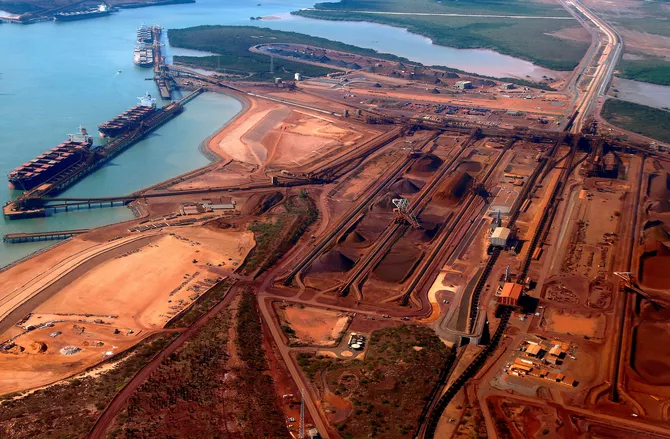
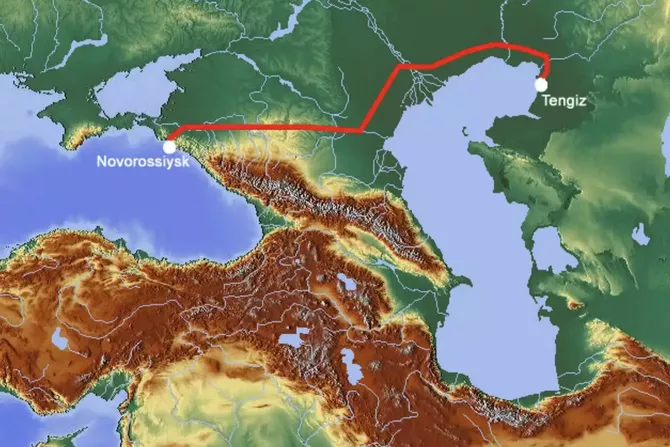
Drone attacks in the Black Sea in July forced repeated suspensions of tanker loadings at the CPC marine terminal near Novorossiysk. The consequences were immediate. The CPC route handles more than 80% of Kazakhstan’s oil exports and accounts for roughly 2% of global crude supply. When exports were interrupted, producers had little choice but to reduce output because storage capacity could not absorb the accumulating crude.
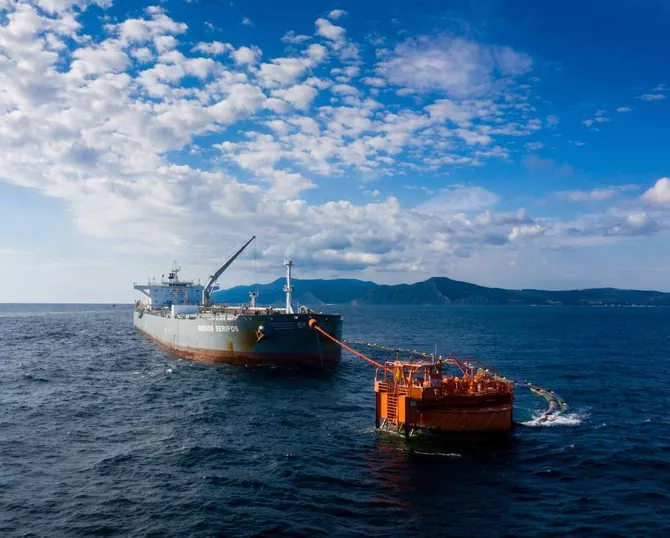
Photo: Caspian Pipeline Consortium official telegram account
The impact was particularly visible at Tengiz, Kazakhstan’s largest oil field and one of the world’s most important upstream projects. Tengizchevroil, in which Chevron holds a 50% stake, cut production from around 925,000 barrels per day to approximately 406,000 barrels per day during one of the most serious phases of the disruption. Kazakhstan’s overall daily oil and gas condensate production also fell sharply as the CPC terminal struggled to maintain regular operations.
The disruption continued into August. Although loading operations resumed, CPC shipments remained intermittent because of security concerns and a shortage of tankers willing to call at the terminal. Reuters reported that CPC operations had been sporadic since mid-July and that tanker availability had become an increasingly serious constraint.
This illustrates a broader problem. Even a temporary interruption does not affect Kazakhstan only through lost barrels. Persistent instability around the terminal raises freight costs, increases insurance premiums, reduces the attractiveness of CPC crude to traders and ultimately forces producers to reconsider both production and export schedules. The Black Sea has increasingly become a geopolitical risk zone for commodities as attacks on ships, ports and energy infrastructure have expanded.
A potentially important development came on August 8, when Bloomberg reported that, following discussions with Washington, Ukraine had agreed to refrain from targeting certain non-Russian tankers and infrastructure used to export Kazakh crude through the Black Sea. According to reports on the U.S.-brokered understanding, protection would apply to vessels that are not carrying Russian cargo, are not Russian-owned and are not subject to Ukrainian sanctions.
If implemented consistently, such an arrangement could significantly reduce immediate risks surrounding CPC operations.
It would not, however, remove the strategic problem facing Astana.
The events of July demonstrated that Kazakhstan’s principal export artery can be disrupted by a military conflict in which Kazakhstan itself is not a participant. CPC predominantly transports Kazakh-origin crude, something even the U.S. Treasury explicitly recognizes when applying sanctions regulations, yet much of the pipeline crosses Russian territory and terminates on Russia’s Black Sea coast.
For Astana, that is the real lesson of the latest crisis.
The issue is no longer simply how quickly the CPC can return to normal operations. It is how Kazakhstan can reduce the systemic risk created by excessive reliance on one route.
This explains why the Trans-Caspian direction through Azerbaijan is receiving renewed attention.
On August 7, KazMunayGas Chairman Askhat Khassenov acknowledged the economic reality with unusual clarity. Kazakhstan currently has no genuine alternative to the CPC “in terms of economics” or volumes, he said. But, importantly, he added that this did not mean other options were not being developed.
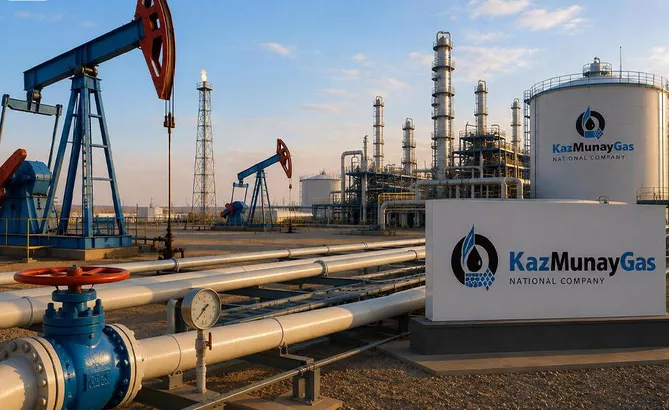
Credit: Kazakhstan Today
Among them, Khassenov specifically identified the Atyrau-Aktau route and further transportation through Azerbaijan, noting that a feasibility study was under preparation. Kazakhstan is simultaneously examining the expansion of the Kazakhstan-China pipeline system.
This is an important distinction.
The Baku-Tbilisi-Ceyhan pipeline should not be portrayed as an immediate replacement for the CPC. At present, the difference in scale is simply too large. But diversification does not require replacing the CPC barrel for barrel. It requires creating enough alternative capacity to give Kazakhstan strategic flexibility when its principal route becomes unreliable.
In this context, Azerbaijan’s importance is growing.
Kazakh crude can be transported from western Kazakhstan to the port of Aktau, shipped across the Caspian Sea to Azerbaijan and then fed into the BTC system, which delivers oil through Georgia to the Turkish Mediterranean port of Ceyhan.
This route has already moved well beyond the experimental stage.
KazMunayGas and SOCAR signed a general transit agreement in November 2022 providing for the transportation of 1.5 million tonnes of Kazakh oil annually through Aktau and onward via BTC. Commercial shipments began in 2023. A subsequent agreement provided for a gradual increase in volumes to 2.2 million tonnes per year.
In 2024, transportation along the Aktau-Baku-Ceyhan corridor increased by 34% to 1.419 million tonnes. Kazakhstan exported around 1.2 million tonnes through BTC in 2025, while 704,000 tonnes had already been transported during the first half of 2026. Astana has indicated that shipments could reach between 1.5 million and 2.2 million tonnes this year, with the possibility of further increases.
The ambitions go considerably further. Azerbaijan and Kazakhstan have previously discussed raising Kazakh transit through Azerbaijan to 5-7 million tonnes annually, and Azerbaijani Energy Minister Parviz Shahbazov said in October 2025 that volumes could potentially reach 7 million tonnes per year by 2027.
Such figures would still not eliminate Kazakhstan’s dependence on CPC, but they would fundamentally change the strategic significance of the Trans-Caspian route.
Credit: Reuters
Azerbaijan’s own transport and energy policy is moving in the same direction.
During his July 21 talks in Berlin with German Chancellor Friedrich Merz, President Ilham Aliyev described Azerbaijan as an increasingly important bridge between Central Asia and Europe. He pointed to the continuing modernization of Azerbaijan’s transport infrastructure and argued that the country’s role in connecting the two regions would gradually expand.
The energy dimension of that role is equally important.
Asked by Reuters how much oil Azerbaijan could supply to Germany, Aliyev said Azerbaijan was already exporting crude worth several hundred million dollars and could supply as much as required, both from domestic resources and through SOCAR’s trading operations. He placed these possibilities in the wider context of disruption to traditional energy supply chains caused by crises in the Middle East and problems affecting Russian refining and petroleum-product exports.
This does not mean that all additional crude reaching Europe through Azerbaijani infrastructure would necessarily be Azerbaijani-produced oil. Increasingly, Azerbaijan’s value lies not only in its own energy resources but also in its ability to function as a transit and trading hub for resources originating further east.
Kazakhstan fits naturally into that equation.
For Astana, the strategic attraction of Azerbaijan is obvious. The Trans-Caspian route provides access to European and Mediterranean markets without passing through Russian territory. For Baku, growing Kazakh volumes strengthen the commercial role of its ports, shipping infrastructure and pipelines while consolidating Azerbaijan’s position as the principal physical connection between Central Asian producers and European markets.
There is therefore a convergence of interests.
Kazakhstan wants redundancy in its export system. Azerbaijan wants to increase its role as an energy and transportation hub. Europe, meanwhile, continues to seek diversified and politically resilient sources and routes for energy imports.
This does not make BTC a perfect solution.
Trans-Caspian transportation involves additional stages: crude must reach Aktau, be loaded onto tankers, cross the Caspian, be unloaded in Azerbaijan and then enter the BTC system. That makes the route more complex and, in many circumstances, more expensive than pumping oil directly through the CPC to the Black Sea.
Capacity must also be expanded in ports, tanker fleets, connecting pipelines and terminal infrastructure if Kazakhstan is to increase shipments from today's relatively modest levels to several million tonnes per year.
But strategic infrastructure cannot be evaluated only by comparing the cheapest transportation cost under normal conditions.
The events surrounding CPC demonstrate that reliability itself has an economic value.
A route that appears more expensive in peacetime may become indispensable when the cheaper route is temporarily unavailable, when insurance costs explode or when tankers refuse to approach an export terminal.
This is precisely why Kazakhstan’s approach to BTC appears to be changing.
What began several years ago as an alternative route is gradually becoming an element of national energy strategy. Kazakhstan’s Energy Minister Yerlan Akkenzhenov has described cooperation between KazMunayGas and SOCAR as an effort to create a sustainable model for oil transit through the Baku-Tbilisi-Ceyhan corridor and stressed that guaranteeing uninterrupted exports and maintaining Kazakhstan’s reputation as a reliable supplier remain key objectives for Astana.
The July crisis has made that argument considerably stronger.
The U.S.-Ukraine understanding may help stabilize CPC operations in the short term. Tankers may return, production at Tengiz may recover and the immediate pressure on Kazakhstan’s export system may ease.
But none of that changes the fundamental conclusion.
For Kazakhstan, the CPC will remain indispensable for the foreseeable future. Economically and in terms of sheer capacity, no existing route can replace it. Yet precisely because CPC is indispensable, dependence on it has become a strategic vulnerability.
Caspian Pipeline Consortium/Photo credit: Wikipedia
That is why Azerbaijan matters.
The real significance of the Aktau-Baku-BTC route is not that it can suddenly take over 80% of Kazakhstan’s oil exports. It cannot. Its importance lies in giving Astana something it has historically lacked: a meaningful western export corridor that does not depend on Russian territory.
In energy policy, diversification rarely means abandoning the principal route. It means ensuring that the principal route is no longer the only one that matters.
The disruptions in the Black Sea may therefore have an impact extending far beyond the current crisis. They are accelerating Kazakhstan’s search for a more resilient export architecture - and in that emerging architecture, Azerbaijan and the Baku-Tbilisi-Ceyhan pipeline are increasingly moving from the category of an alternative to that of a strategic necessity.