Azerbaijan’s decision to uphold secular dress standards in public schools has prompted criticism from some religious activists. But the debate should be placed in its proper context: this is not a question of denying personal faith. It is a question of protecting the neutral, inclusive character of state education, and ensuring that children can learn before they are asked to carry the weight of ideological or religious expectations.
A secular school system is not hostile to religion. On the contrary, it creates a common civic space in which pupils from different religious, ethnic and social backgrounds can study on equal terms. In a country as diverse as Azerbaijan, that principle matters.
Azerbaijan is home to Muslims, Christians, Jews and people of other beliefs, as well as those with no religious affiliation. Its social stability has long rested on a balance between respect for faith and the primacy of a secular state. Public schools are central to preserving that balance.
The state has a legitimate responsibility to ensure that classrooms remain places of education, not arenas for religious competition or social pressure. Schoolchildren are still developing intellectually and emotionally. They should be encouraged to ask questions, acquire knowledge and form their own views - not be placed under expectations that they may not yet be mature enough to understand or challenge.
This is especially important when it comes to visible religious symbols imposed on children. Adult women who freely choose religious dress deserve respect. But the situation is different for a six-, seven- or eight-year-old girl. At that age, it is difficult to speak meaningfully about a fully independent decision. Family influence, social pressure and religious instruction inevitably shape such choices.
A school uniform policy does not prevent anyone from practising their religion outside the classroom. It simply establishes common rules within a public institution. Such rules exist in many countries with strong democratic traditions. France, for example, has long defended the principle of laïcité in public education, while other European states have adopted restrictions on conspicuous religious symbols in schools or public institutions. The details differ from country to country, but the underlying principle is widely understood: the state must retain the ability to keep public education neutral.
Azerbaijan’s approach should be viewed through the same lens.
The country does not ban religion. Mosques operate freely, religious communities function openly, and citizens are free to observe their beliefs. But freedom of religion cannot mean that public institutions abandon their secular character. Nor can it mean that religious norms override the rules designed to serve all citizens equally.
Schools have a specific mission. They are meant to teach science, languages, history, civic responsibility and critical thinking. They prepare young people for adult life in a modern society. This mission becomes harder when children are divided into visible religious categories or when religious identity is allowed to define the classroom environment.
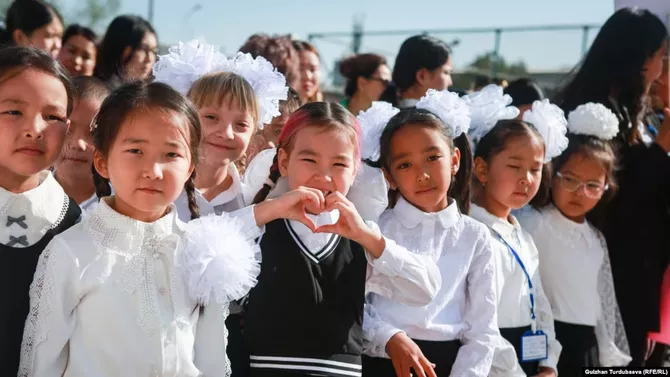
photo: getty images
The experience of Central Asia offers a relevant warning. Since the collapse of the Soviet Union, several countries in the region have faced a rapid expansion of religious influence in public life. Foreign-funded religious networks, informal clerical authority and ideological movements have sometimes filled social and political spaces that should belong to state institutions and civil society.
This does not mean that faith itself is a threat. It does mean that governments must distinguish between private belief and attempts to turn religion into a tool of social control or political mobilisation.
History shows that this distinction matters. In Uzbekistan during the 1990s, radical religious groups openly challenged the country’s secular order and called for a state governed by Sharia law. The authorities responded firmly, often controversially, but the broader lesson remains clear: when secular institutions are weak, ideological actors are quick to occupy the space.
Türkiye’s history also illustrates the importance of secular state-building. Mustafa Kemal Atatürk understood that modernisation required strong public institutions, universal education and the emancipation of women. The Turkish republic’s secular foundations helped create a state capable of becoming a major regional power, with a large economy, a globally connected society and NATO’s second-largest military.
Azerbaijan has its own path and should not copy any country blindly. Yet it should be confident in defending the principles that have supported its stability: secular governance, national identity, multiculturalism and modern education.
There is also a cultural dimension to this issue. Azerbaijanis, like other Turkic peoples, possess rich traditions of clothing, art and social customs. Traditional headscarves and national dress are part of that heritage. But imported forms of religious dress should not be confused with the entirety of national culture, nor should they become a standard imposed on children in public schools.
The real challenge is not to choose between faith and modernity. A healthy society can accommodate both. The challenge is to ensure that religion remains a personal conviction rather than a source of coercion, exclusion or pressure, particularly in institutions responsible for educating the next generation.
Azerbaijan’s secular school policy is therefore not a rejection of religious freedom. It is a defence of equal citizenship, educational neutrality and the right of children to grow up with open minds.
The country is right to protect that space.