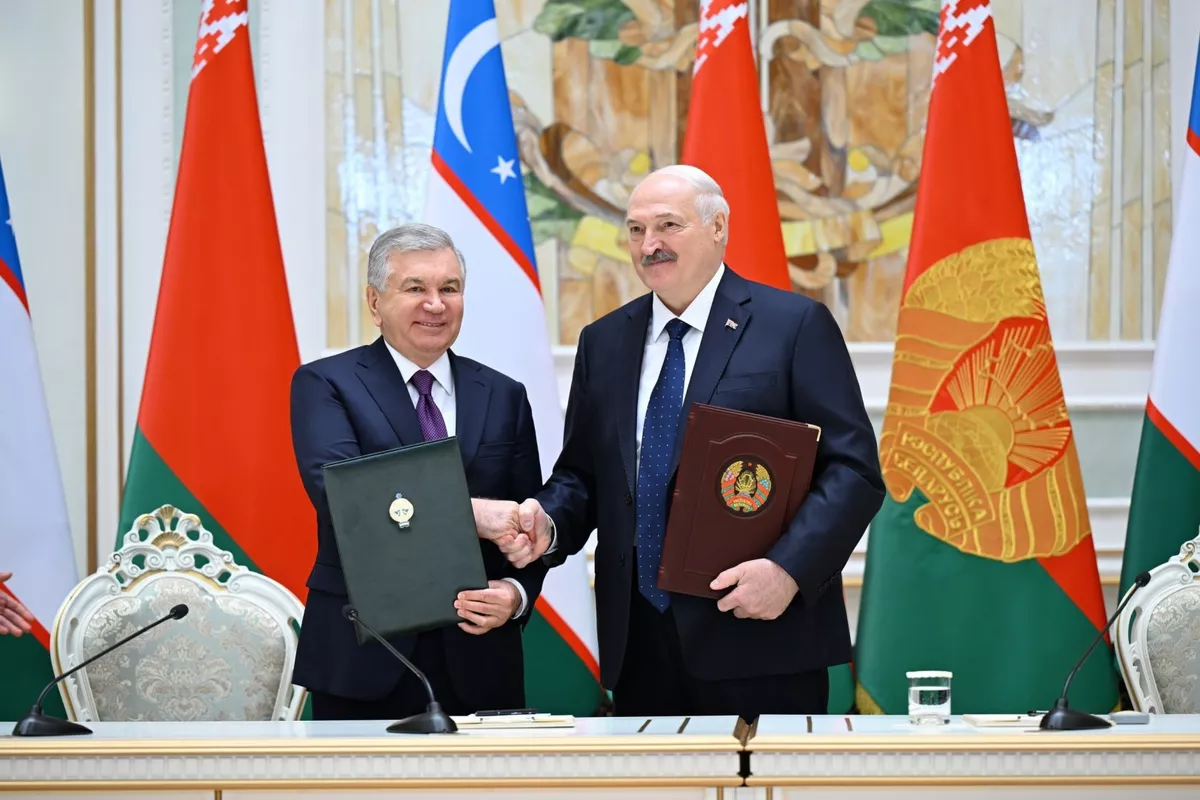
Uzbek President Shavkat Mirziyoyev's official visit to Belarus on 8-9 July 2026 concluded with the signing of a Declaration on the Establishment of a Strategic Partnership. While the elevation of bilateral relations is significant in itself, the broader pattern of Tashkent's recent diplomatic activity is even more noteworthy. Shortly before the visit to Minsk, Uzbekistan established a strategic partnership with Georgia, while its relationship with Kazakhstan had already advanced to the higher level of a strategic partnership and alliance.
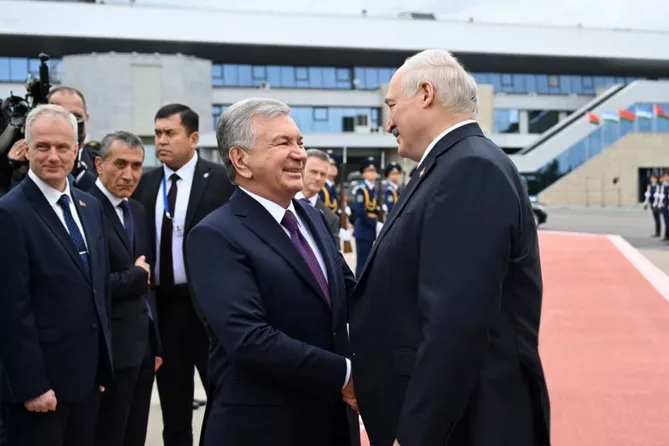
Credit: president.uz
The decision to elevate ties with Belarus should therefore be viewed not as an isolated diplomatic gesture, but as part of Uzbekistan's broader effort to build a diversified network of economic, industrial and transport partnerships across Eurasia.
It would, however, be inaccurate to describe Belarus as only the third country with which Uzbekistan has established a strategic partnership. Tashkent already maintains such relations with Russia, Azerbaijan, Türkiye, Turkmenistan, Pakistan, France, Italy, Hungary and several other states. Nevertheless, the Kazakhstan-Georgia-Belarus sequence reflects one of the defining features of Uzbekistan's diplomacy in 2026: strengthening its position in Central Asia, securing access to western transport routes and expanding its industrial footprint across the post-Soviet space.
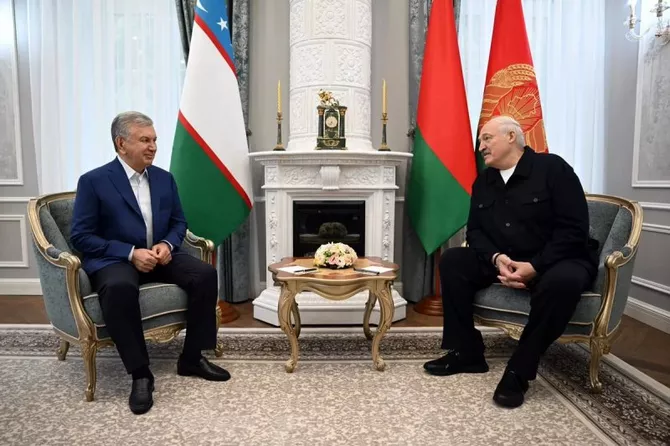
Credit: president.uz
Kazakhstan occupies a special place in this framework. It is Uzbekistan's closest major neighbour, the largest economy in Central Asia and one of Tashkent's most important transit partners. Relations between the two countries have already progressed beyond a conventional strategic partnership to the level of an alliance.
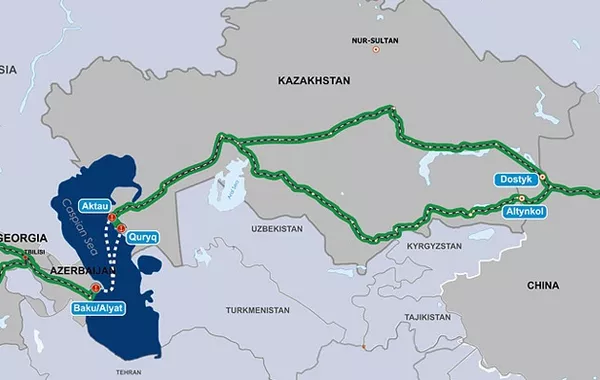
Kazakhstan is indispensable to Uzbekistan as the backbone of a broader Central Asian economic space. Key rail and road corridors crossing Kazakh territory connect Uzbekistan with Russia, China, the Caspian Sea and European markets. Relations with Astana therefore provide Tashkent with an essential regional platform.
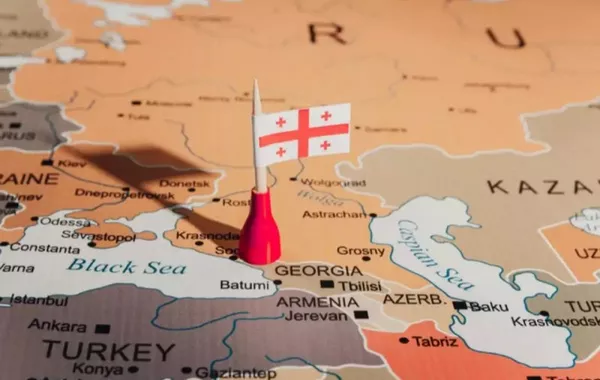
Georgia serves a different purpose. For landlocked Uzbekistan, it is one of the most important links in the transport corridor running across the Caspian Sea, Azerbaijan and the South Caucasus to the Black Sea and Europe. The signing of a strategic partnership declaration with Georgia institutionalised the transport dimension of Uzbekistan's foreign policy.
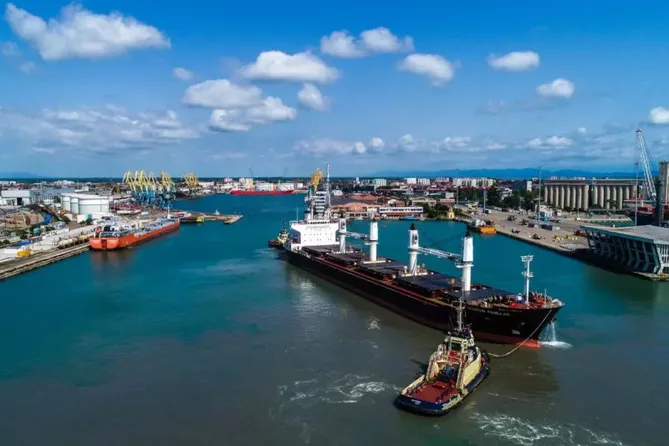
Credit: Caliber
Georgia's importance extends well beyond bilateral trade. The ports of Poti and Batumi are regarded by Tashkent as gateways to international markets. Cooperation with Tbilisi is closely linked to the development of the Trans-Caspian International Transport Route (TITR), also known as the Middle Corridor, which offers Uzbekistan an alternative route to Europe.
If Kazakhstan provides regional depth and Georgia access to the Black Sea, Belarus is expected to become the industrial and technological pillar of this emerging framework.
Economic ties between Uzbekistan and Belarus have expanded more rapidly in recent years than their previous political status might have suggested. Bilateral trade has nearly tripled over the past five years, approaching the US$1 billion mark. The number of joint ventures has risen to around 360, while cooperation has expanded across mechanical engineering, agriculture, food processing, pharmaceuticals and textiles.
Belarus is particularly attractive to Uzbekistan because it has retained a substantial industrial base. Belarusian enterprises manufacture mining trucks, tractors, municipal and agricultural machinery, food-processing equipment, pharmaceuticals and timber products. For Uzbekistan, which is seeking to accelerate industrialisation and increase the share of higher value-added products in its economy, such cooperation has clear practical value.
Tashkent is interested not only in importing Belarusian machinery but also in localising its production. This explains why joint manufacturing, assembly, technology transfer and the expansion of industrial supply chains featured prominently in the negotiations.
Increasing tractor production to several thousand units a year, deepening cooperation with BelAZ and establishing new manufacturing facilities would help Uzbekistan modernise its economy, create jobs and reduce its dependence on imported finished products.
For Belarus, the partnership is equally important. With access to Western markets remaining restricted, Minsk is increasingly seeking to expand its presence in Central Asia. Uzbekistan, with a population of more than 37 million, represents a large and rapidly growing market.
In addition, establishing joint production facilities in Uzbekistan would give Belarusian companies access not only to the domestic Uzbek market but also to neighbouring countries across Central and South Asia.
The composition of the Uzbek delegation was particularly revealing. Around 230 Uzbek companies and business organisations accompanied Mirziyoyev to Belarus, together with the governors of the Tashkent, Fergana and Andijan regions, each of which has a population of around four million.
This demonstrated that the visit extended well beyond political symbolism. It was intended to establish direct links between regions, businesses and manufacturing centres.
Rather than signing a single ceremonial declaration, the two sides concluded a broad package of agreements. These included an action plan for trade, economic, social and humanitarian cooperation for 2026-2030, a programme of consultations between the foreign ministries, an agreement on the organised employment of Uzbek citizens in Belarus, a roadmap for deeper agricultural cooperation, and documents covering light industry, tourism, forestry, social protection, science and finance.
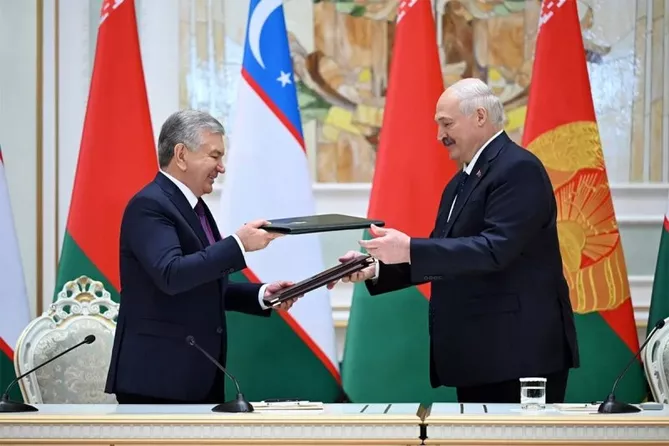
Credit: uzdaily.uz
The two countries also agreed to establish an Uzbekistan-Belarus Expert Council.
The scope of the agreements demonstrates that the strategic partnership is intended to operate on several levels simultaneously. These include large-scale industrial cooperation; agriculture and food security; labour mobility and social protection; education, science and vocational training; and interregional and business cooperation.
Belarus was therefore chosen not because Uzbekistan is aligning itself with a particular geopolitical bloc, but because it offers capabilities that complement Tashkent's development priorities.
Uzbekistan continues to pursue a multi-vector foreign policy while avoiding excessive dependence on any single centre of power. Its approach remains firmly grounded in economic pragmatism.
Tashkent is building a system in which different partners perform distinct but complementary roles. Kazakhstan provides regional integration, transit capacity and access to the largest neighbouring market. Georgia offers a Black Sea outlet and a bridge to European transport networks. Belarus contributes industrial equipment, technological expertise, engineering capabilities and opportunities for joint manufacturing.
Taken together, these partnerships form an emerging Eurasian framework for Uzbekistan's external economic strategy. Its central objective is to reduce the country's transport isolation, diversify export markets, attract advanced technologies and transform Uzbekistan from an importer of finished goods into an industrial producer in its own right.
Against this backdrop, the strategic partnership with Belarus was a logical step. It brought the political status of bilateral relations into line with the depth of existing economic cooperation and with Tashkent's broader long-term objectives.
Uzbekistan does not regard Belarus as an alternative to Kazakhstan or Georgia. Rather, each country represents a distinct but complementary element of the same strategy.
The real test now lies in implementation. The number of agreements signed is less important than the successful delivery of concrete projects. If the two countries can increase the localisation of Belarusian machinery production, establish new manufacturing facilities, secure long-term industrial contracts and raise bilateral trade to US$2 billion, Mirziyoyev's visit to Minsk could prove to be a genuine turning point.
In that case, the Kazakhstan-Georgia-Belarus sequence will no longer appear to be a series of unrelated bilateral visits. Instead, it will represent a coherent external economic strategy: Central Asia as the foundation, the South Caucasus as the transport bridge, and Belarus as the industrial pillar.
By Samir Muradov