The Geopolitics of Connectivity Power: Why Azerbaijan Holds the Advantage
The geoeconomic landscape of the South Caucasus is undergoing a profound transformation as global supply chains are being reshaped. Located at the crossroads of the East-West and North-South transport corridors, the region is seeing growing competition for the status of a key transit hub. Armenia’s “Crossroads of Peace” initiative, promoted by the country’s leadership, reflects Yerevan’s ambition to play a more active role in regional connectivity projects and reduce Azerbaijan’s growing geopolitical influence.
However, an assessment of the existing transport infrastructure demonstrates that Armenia’s ability to integrate into regional projects faces significant structural, geographical, climatic, and financial constraints. Moreover, the practical viability and long-term sustainability of the initiatives that Yerevan is seeking to build from the ground up fundamentally depend on Azerbaijan’s already established and operational infrastructure network.
Azerbaijan’s Infrastructure Dominance and State of Readiness
In the competition to become a transit hub, the main decisive factors are time and the availability of operational infrastructure. Unlike Armenia, Azerbaijan is not building regional transport corridors from scratch. Both the North-South Transport Corridor and the East-West route are already fully operational across Azerbaijani territory. According to official data, freight volumes in 2025 reached 16.91 million tons along the East-West Transport Corridor, including 8.17 million tons on the Europe-Caucasus-Asia corridor, 9.29 million tons on the International North-South Transport Corridor, 5.80 million tons on the Northwest Corridor, and 533,600 tons on the Southwest Corridor. Hence, Baku is actively expanding and upgrading an already functioning transport network in recognition of growing global demand for freight transportation.
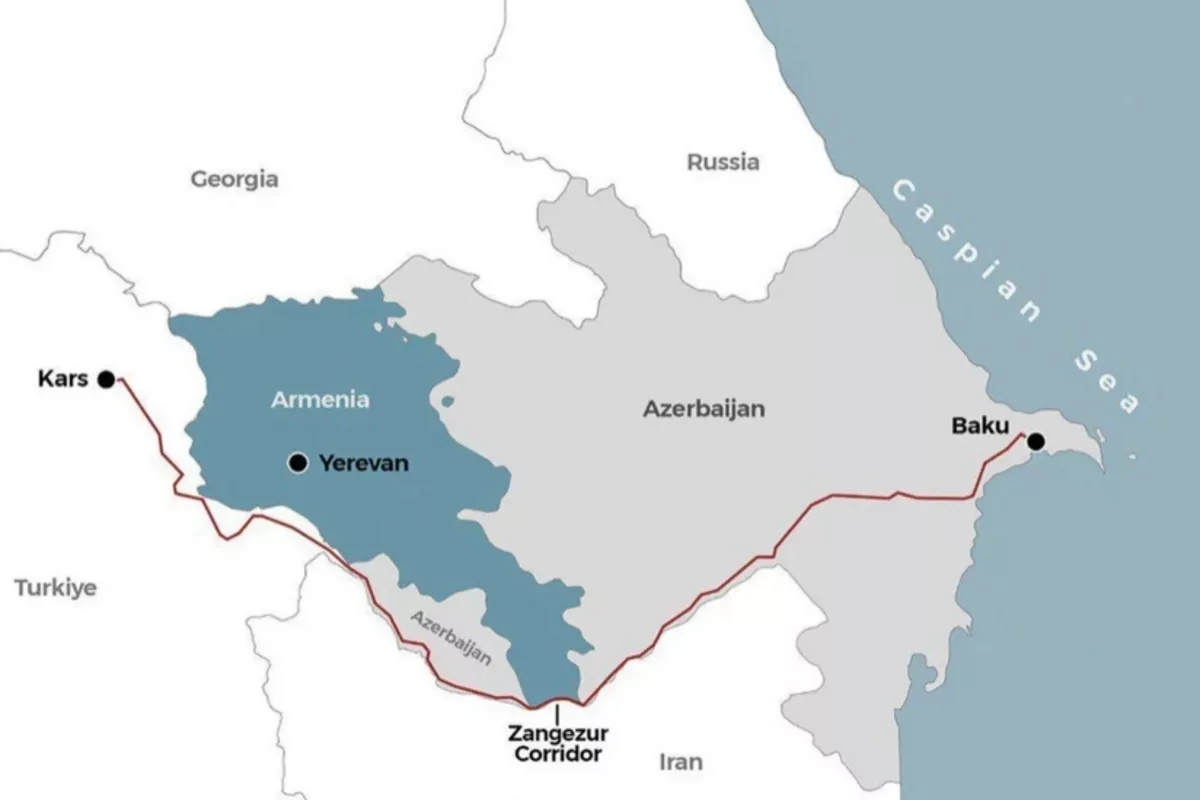
Azerbaijan’s transit advantage extends beyond the Middle Corridor (East-West route), underpinned by the Baku-Tbilisi-Kars (BTK) railway and the Port of Alat (Baku International Sea Trade Port). It must be noted that, on June 2, the BTK railway entered full-scale commercial operation, a milestone expected to increase cargo traffic along the Trans-Caspian International Transport Route (Middle Corridor) while reinforcing Azerbaijan’s role as the principal transit hub connecting Central Asia with Europe. Following the completion of modernization works, the railway’s annual freight-handling capacity increased from 1 million to 5 million tons. Simultaneously, work is underway on the expansion of the Port of Alat, which is expected to increase its annual capacity from 15 million to 25 million tons.
Moreover, Azerbaijan has entered the final stage of developing strategically important road infrastructure within the framework of the International North-South Transport Corridor. The modernization of the 508-kilometer Silk Road highway linking Baku with the Georgian border has been completed, as has the upgrade of the railway connecting Baku and Kars. A modern highway stretching from Alat to Astara and onward to the Iranian border, covering 204 kilometres, has also been completed. Three years ago, a new 152-kilometer high-speed motorway linking the settlement of Haji Zeynalabdin Taghiyev with Guba and the Russian border was opened to traffic. Along almost its entire length, the existing road infrastructure was reconstructed to meet modern international standards. The highway has been expanded to four lanes and equipped with the necessary transport infrastructure. As a result, Azerbaijan now possesses a modern, high-capacity transport network capable of supporting uninterrupted, high-volume freight traffic throughout the year.
At the same time, intensive work continues on modernizing the railway infrastructure of the International North-South Transport Corridor. The project is scheduled for completion by the end of 2028, with annual freight capacity expected to increase in stages - first to 5 million tons and eventually to 15 million tons. The railway section running through Azerbaijan is 511 kilometres long. Crucially, the segment linking the Russian and Iranian borders, which is the backbone of the corridor, is already operational. Meanwhile, completion of the Rasht-Astara railway in Iran will close the last remaining gap in the International North-South Transport Corridor. This is expected to further strengthen Azerbaijan’s global transit role and establish the country as an increasingly indispensable route for international logistics operators.
Asymmetric Comparison of the North-South Corridors
Even if Armenia completes the construction of the North-South highway corridor linking the country’s southern border with Georgia, its functional and economic performance cannot be meaningfully compared with that of the analogous corridor in Azerbaijan. While Armenia’s route may be able to operate with limited capacity, it faces two fundamental constraints that are incompatible with the requirements of modern global logistics.
-
Lack of railway infrastructure. Armenia’s domestic corridor relies exclusively on road transport. In today’s global logistics industry, the efficient movement of large freight volumes over long distances depends considerably on rail infrastructure. Owing to Armenia’s mountainous terrain and the exceptionally high costs of construction, building a railway to the Iranian border remains largely unfeasible. Moreover, projects to restore the previously existing Sadarak-Yeraskh and Ijevan-Gazakh railway lines also face significant legal and institutional obstacles. Since Armenia’s railway network is operated under a concession agreement by South Caucasus Railway CJSC, a subsidiary of Russian Railways (RZD), Yerevan’s ability to independently develop and manage its railway infrastructure is significantly constrained. As a result, plans to build a new railway from scratch, comprehensively modernize the existing network, or construct a new rail line as part of the North-South Corridor appear unlikely to materialize in the foreseeable future. Therefore, a transport corridor dependent entirely on road freight cannot compete with Azerbaijan’s rail-based network. This applies to both transportation costs and cargo capacity.
-
Harsh climatic conditions and topographical risks. Armenia’s domestic transit route passes through high-altitude terrain and mountainous passes. Winters in these areas are exceptionally harsh, with heavy snowfall and prolonged freezing temperatures. Avalanches, icy roads, and dense fog frequently force the closure of key mountain highways for days or even weeks at a time. As a result, adherence to the principle of timely delivery, a core requirement of global supply chains, becomes vulnerable to seasonal weather disruptions. By contrast, Azerbaijan’s transit corridors run predominantly across lowland terrain with comparatively moderate climatic conditions, allowing for more reliable year-round operations. Hence, Armenia’s roads, which are regularly affected by seasonal interruptions, pose a substantially higher operational risk for international logistics operators.
The Geopolitical Paradox of the “Crossroads of Peace” Initiative and Armenia’s Dependence on Azerbaijan
At its core, Armenia’s “Crossroads of Peace” initiative is intended to reduce Azerbaijan’s geopolitical and geoeconomic advantage in the region by positioning Yerevan as an alternative hub through routes that bypass the regional transport architecture developed by Baku. However, the project’s underlying economic and geographic realities paint an entirely different picture. Armenia’s transit ambitions, both in the short- and long-term, remain fundamentally dependent on Azerbaijan. This is evident in several key areas.
-
Azerbaijan’s decisive role in opening regional transport communications. Most of the routes proposed under Armenia’s vision of becoming a regional transport hub either pass through Azerbaijani territory or depend directly on transport links whose reopening requires Azerbaijan’s consent. The geoeconomic logic of the “Crossroads of Peace” initiative therefore contains an inherent contradiction. For the East-West axis (the Middle Corridor) to function effectively, Azerbaijan, not Armenia, remains the indispensable link. Azerbaijan already provides both rail and road connections linking Central Asia with Europe. The situation along the North-South axis differs only partially. While road transport could theoretically pass through Armenia, the railway component of the corridor cannot be realized in the foreseeable future without Azerbaijan and Nakhchivan because the necessary infrastructure simply does not exist. Moreover, even if a North-South transport link extending to Türkiye were established, its operation would still depend on the full normalization of relations between Armenia and Türkiye. Ankara has repeatedly stated that opening the state border is contingent upon the conclusion of a comprehensive peace agreement between Armenia and Azerbaijan. Consequently, the “Crossroads of Peace” initiative itself demonstrates that most of its key transport routes depend, either directly or indirectly, on Azerbaijan’s participation and the establishment of lasting regional peace. Without the strategic approval of Baku, the initiative will not be able to move beyond the conceptual stage.
-
Financial and institutional constraints. Armenia’s large-scale road construction projects depend heavily on financing from international institutions such as the Asian Development Bank, the European Investment Bank, and other external donors. Crucially, international investors are yet to show willingness to commit billions of dollars to high-risk mountain infrastructure before a comprehensive and legally durable peace settlement is reached, particularly in the absence of fully normalized relations with Azerbaijan. As a result, even the financial viability of the project is indirectly tied to the progress of the Armenia-Azerbaijan peace process.
-
Ownership and governance constraints. Armenia’s existing railway network will remain under the management of South Caucasus Railway CJSC, a Russian-owned company, until 2038. This institutional arrangement significantly limits Armenia’s ability to develop and manage its railway system independently. In contrast, Azerbaijan’s transport network operates under a more flexible state-controlled management model. Under these circumstances, Armenia is unlikely to emerge as an independent logistics platform capable of competing with Azerbaijan. Any future integration of Armenia into regional transport corridors will ultimately have to be aligned with the conditions established and shaped by the region’s principal geopolitical actors, most notably Baku.
Conclusion
Armenia’s strategy of competing with Azerbaijan in the field of regional transport connectivity has reached a strategic impasse because of fundamental structural, geographical, and climatic constraints. Evidence ‘on-the-ground’ demonstrates that Azerbaijan is already the region’s principal transit hub, with both the East-West and North-South corridors operating efficiently across its territory while continuing to expand. Armenia’s mountainous terrain, climatic risks, the absence of a modern railway connection to Iran, and the fact that any future Sadarak-Yeraskh railway would inevitably pass through Nakhchivan collectively make Yerevan’s transit ambitions entirely dependent on Azerbaijan.
The “Crossroads of Peace” initiative does not possess the capacity to redirect global logistics flows. At best, it could become a limited regional branch of the broader transport architecture that Azerbaijan has already established and continues to develop. In the foreseeable future, there are no objective economic or geographical conditions that are likely to alter this pattern of dependence. As a result, Armenia’s only realistic opportunity to become a transit country lies in operating within the regional framework and existing realities shaped by Azerbaijan.
Find the original article here