What Can Turkish-Italian Synergy Bring to Ethiopia, Wider Africa?
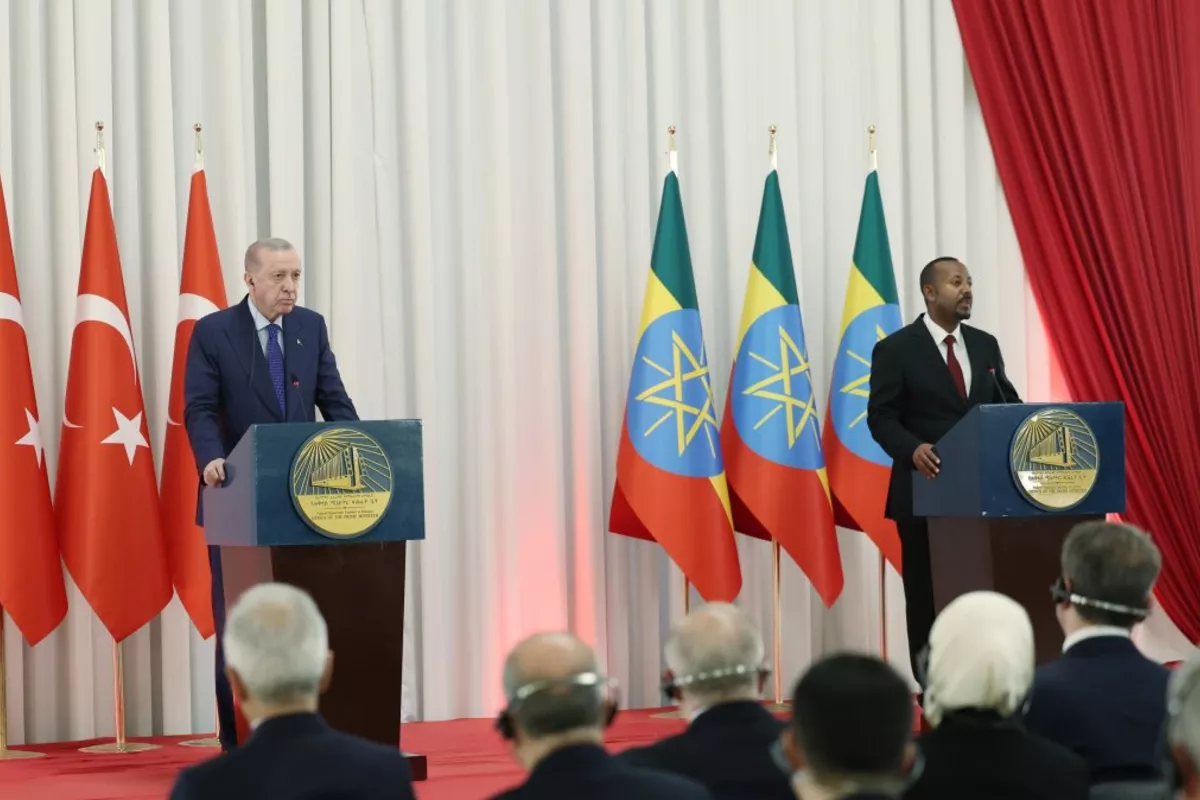
Turkish President Recep Tayyip Erdogan's recent trip to Ethiopia is of great significance, not only symbolically but also, and above all, for its strategic implications at the global level. On the other hand, a few days earlier, Italian Prime Minister Giorgia Meloni had also traveled to Addis Ababa for the second Italian Summit on Africa, in line with the so-called Mattei Plan. Indeed, this signals the convergence of the Italian and Turkish approaches in Africa, aiming to reinforce existing bilateral complementarities and to enhance regional cooperative frameworks.
In Ethiopia, Türkiye marked a century of diplomatic relations along with the signing of important agreements in crucial sectors, such as trade and energy, which further enhanced Ankara's role as a major economic partner. However, Erdoğan's words emphasize the need to guarantee the territorial integrity of African countries and to deter further foreign actors from undermining the order for purely hegemonic purposes. The reference to Israel and the sovereign recognition of Somaliland is therefore explicit and not coincidental.
Africa is, in fact, the main theater where global competition is shaped according to the logic of power and therefore influence. Although the continent has long been excluded from power competition that respects the acquired independence of sovereign states, in the current international context, it has become the focus of great and medium powers that, for political and geographical reasons, are seeking to expand their influence. Political attitudes toward Africa have been following different approaches, based rather on top-down or bottom-up legitimacy processes, with related impacts on the well-being and perceptions of local societies.
Among the major players, Türkiye has always stood out for its soft power policies and geopolitical initiatives aimed at structuring relations with African countries on an equal basis and rising as a facilitator in dispute resolution. Alongside the traditional channels of Turkish diplomacy, noteworthy are the large-scale cultural diplomacy initiatives that, through the action of specialized agencies and cultural centers, operate in Africa to empower populations and strengthen strategic ties based on principles of brotherhood and shared values. These processes are further accompanied by foreign policy actions aimed at ensuring security and stability.
To some extent, the Turkish bottom-up approach goes beyond the win-win principle because it aims to build strategic partnerships pivoting on solid values and humanitarian principles. Hence, Türkiye rises as the main regional stakeholder, especially in terms of soft power and local outreach.
The 2nd Italy-Africa Summit
A few days before Erdoğan visited Ethiopia, Meloni had also traveled to Addis Ababa for the second Italy-Africa Summit, held on the occasion of the Assembly of Heads of State of the African Union, bringing together several African delegations. The summit focused on the Italian Plan for Africa, the so-called “Mattei Plan,” intended as the main driver of the Italian strategy launched in 2024 to promote structured cooperation with African countries.
In addition to promoting investment and aid in key sectors such as energy, infrastructure, water and agriculture, the plan aims to create economic opportunities and jobs while strengthening Italian presence through shared projects in partner countries. As Meloni declares: “The cooperation proposed by Italy is based on respect and mutual benefit, and it aims to build relationships that are not predatory or exclusively based on assistance, but rather based on mutual collaboration, following the principle of equal partnership.”
In this framework, the goal is also to contain the risks and challenges of the current historical moment, including migration and human trafficking, which is a key topic on the Italian government's agenda. Furthermore, according to Meloni, Africa's importance lies in its partnership with Europe. Thus, in Addis Ababa, Italy assessed the Mattei Plan’s outcomes by looking at Ethiopia as a central platform for dialogue for a new model of cooperation based on dignity and mutual development.
Italy-Türkiye convergence in Africa
Within the broader geopolitical context of the Mediterranean, Italy and Türkiye share a structural responsibility of safeguarding regional stability and managing interconnected security issues. Overall, in the current time of international fragmentation and return of great power competition, Rome and Ankara face the same challenges and the opportunities to reposition themselves as proactive middle powers. Hence, they are naturally called to further engage in cooperative frameworks. In this scenario, Africa arises as a strategic theater where Ankara and Rome may reinforce their regional partnerships through consensus-building and diplomatic leverage. Indeed, Italy and Türkiye's existing synergy may be further consolidated through cooperative frameworks extended to third countries and other regions.
Türkiye boasts a multidimensional footprint in Africa, and it complements Italy’s Mattei Plan engagement by pivoting on the same equality principles and long-term sustainability vision. Through the combination of Italian diplomatic credibility, development expertise and cultural soft power with Turkish operational agility, business networks, political outreach and extensive soft power, further cooperation, enhancing effectiveness and sustainability may be established.
As a matter of fact, the Italian-Turkish operational and strategic congruence in Africa hinges on a sort of natural vocation that leads the two countries to be aligned on crucial dossiers thanks to the long-standing friendship and shared values cementing their special relationship. Moreover, the common institutional anchors, such as NATO and the G-20, provide an asset to uniquely positioning Italy and Türkiye as bridge makers by facilitating dialogue while preserving a certain degree of strategic autonomy. This function has already been visible in Libya throughout the establishment of a trilateral mechanism, but in some other African chessboards, Rome and Ankara may maximize their cooperation by pivoting on their retained channels of communication, political credibility, and on-the-ground engagement.
Beyond the economic and security dimensions, expanded cooperation in cultural diplomacy and educational initiatives could further consolidate the synergies, leveraging Italy’s globally recognized heritage and Türkiye’s extensive academic footprint in Africa to foster durable societal linkages. In this sense, a structured and forward-looking Italy-Türkiye partnership would not merely strengthen bilateral relations but could also elevate both countries’ capacity to shape broader geopolitical dynamics through pragmatic multilateral engagement and regional stabilization efforts.
Find the original article here