Bayraktar K2: Türkiye's new answer to modern warfare challenges
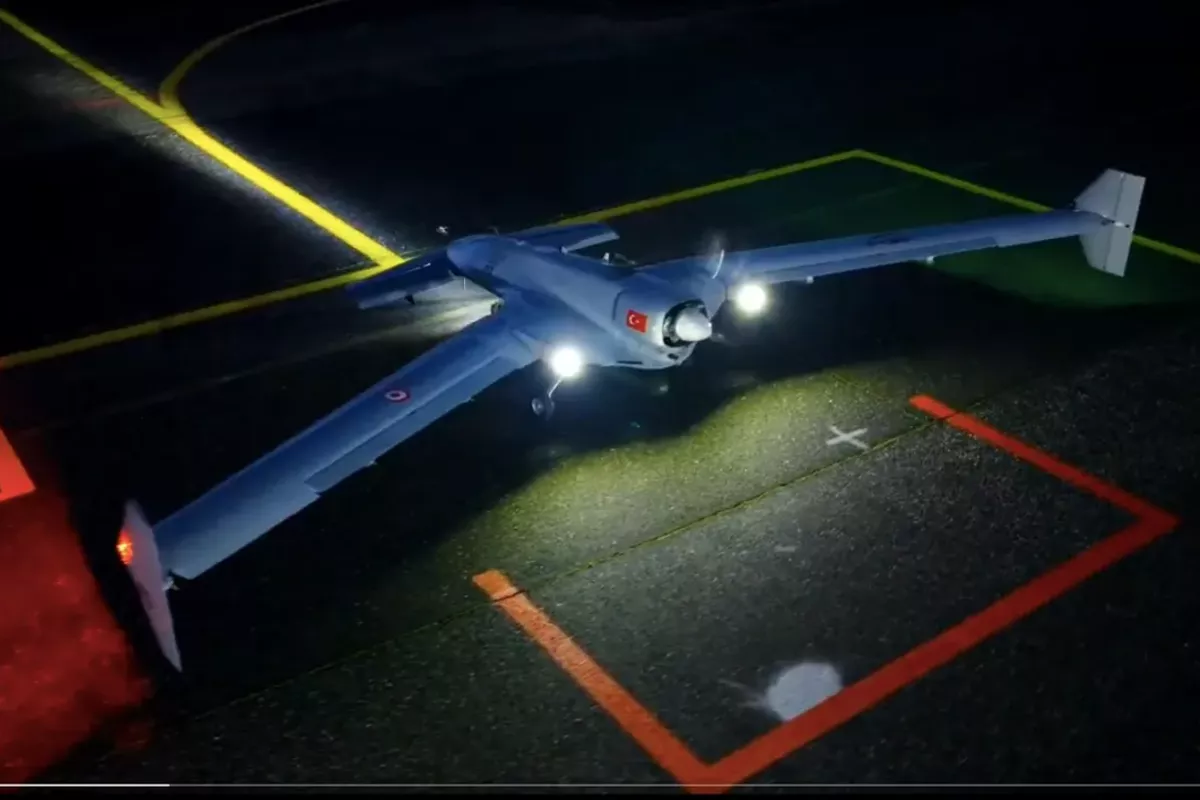
Turkish drone maker Baykar has introduced the Bayraktar K2 loitering munition, a locally developed system with a range of over 2,000 kilometers and a 200-kilogram warhead capacity.
The platform reflects hard lessons from Ukraine and the Middle East, where low-cost, mass-producible strike systems have demonstrated the ability to grind down expensive defenses through economic pressure and sustained attrition, The
With AI integration and swarm capability, the K2 positions Türkiye at the forefront of emerging battlefield dynamics.
Baykar has introduced the Bayraktar K2 loitering munition to the public, marking a significant expansion of Türkiye's unmanned strike capabilities. Developed entirely with domestic resources, the platform boasts a range exceeding 2,000 kilometers and a warhead capacity of approximately 200 kilograms, placing it among the largest systems in its class globally. The unveiling represents not merely a new product but a strategic response to the evolving realities of modern warfare.
Lessons from the Battlefield The conflicts in Ukraine and the Middle East have fundamentally altered defense planning assumptions. In Ukraine, Russian forces have employed Iranian-designed Shahed loitering munitions costing tens of thousands of dollars against Ukrainian air defense systems firing interceptors worth orders of magnitude more-AMRAAM missiles, Patriot batteries, and fighter-launched munitions. This economic asymmetry has proven unsustainable over prolonged campaigns. Ukraine has intercepted roughly 44,000 such munitions with success rates above 80%, yet the cumulative damage to infrastructure demonstrates that kill ratios alone do not determine strategic outcomes.
The concept of "magazine depth"-industrial capacity to produce and sustain offensive systems-has emerged as a critical variable in modern conflict. Low-cost, mass-manufactured platforms can, over time, exhaust numerically limited and extraordinarily expensive high-end defenses. As Baykar CEO Haluk Bayraktar noted, the K2 costs "roughly one-fiftieth of a comparable guided munition," a statistic that speaks directly to this new defense economics.
Strategic Integration The K2's significance extends beyond its individual specifications. Battlefield experience demonstrates that loitering munitions are most effective when employed in layered strike packages-saturating air defenses to create corridors for heavier ballistic and cruise missiles. Within Türkiye's expanding defense ecosystem, one can envision future strike packages combining Cenk ballistic missiles, Gezgin cruise missiles, and aeroballistic munitions from Kizilelma or Akinci platforms, preceded by waves of K2 systems configured as both attackers and decoys. Even a 10-20% penetration rate would impose compounding strategic costs on any defender.
The K2's AI integration and swarm capability address the electromagnetic spectrum's growing importance. Platforms capable of autonomous decision-making under electronic warfare pressure carry decisive advantages, while simultaneous mass attacks overwhelm defense prioritization architectures. These capabilities reflect Baykar's accumulated expertise in AI-driven solutions, demonstrated through exports exceeding $2.2 billion in 2025, with approximately 90% of revenues from foreign markets including NATO member states.
Global Implications The security environment across the Middle East and NATO's eastern flank points toward growing demand for affordable, mass-producible strike systems. Gulf states facing repeated aerial attacks and European nations confronting Russian pressure both have compelling incentives to explore this category. The K2 positions Türkiye's defense industry to meet these requirements while translating battlefield lessons directly into operational capability-answering the threats of today with steadily growing technological sophistication.
See the original article here