It is true that Russian capabilities in the Arctic significantly exceed some of the capabilities of NATO member states. One of Russia’s key advantages is its icebreaker fleet, which is currently the largest in the world and includes nuclear-powered units that enable a strategic advantage in harsh Arctic conditions.
Furthermore, by modernising and expanding its military infrastructure along the Northern Sea Route, Russia has built more than 475 military facilities along its northern border over the last decade, providing it with a denser and more extensive network of installations than any single NATO state in the region.
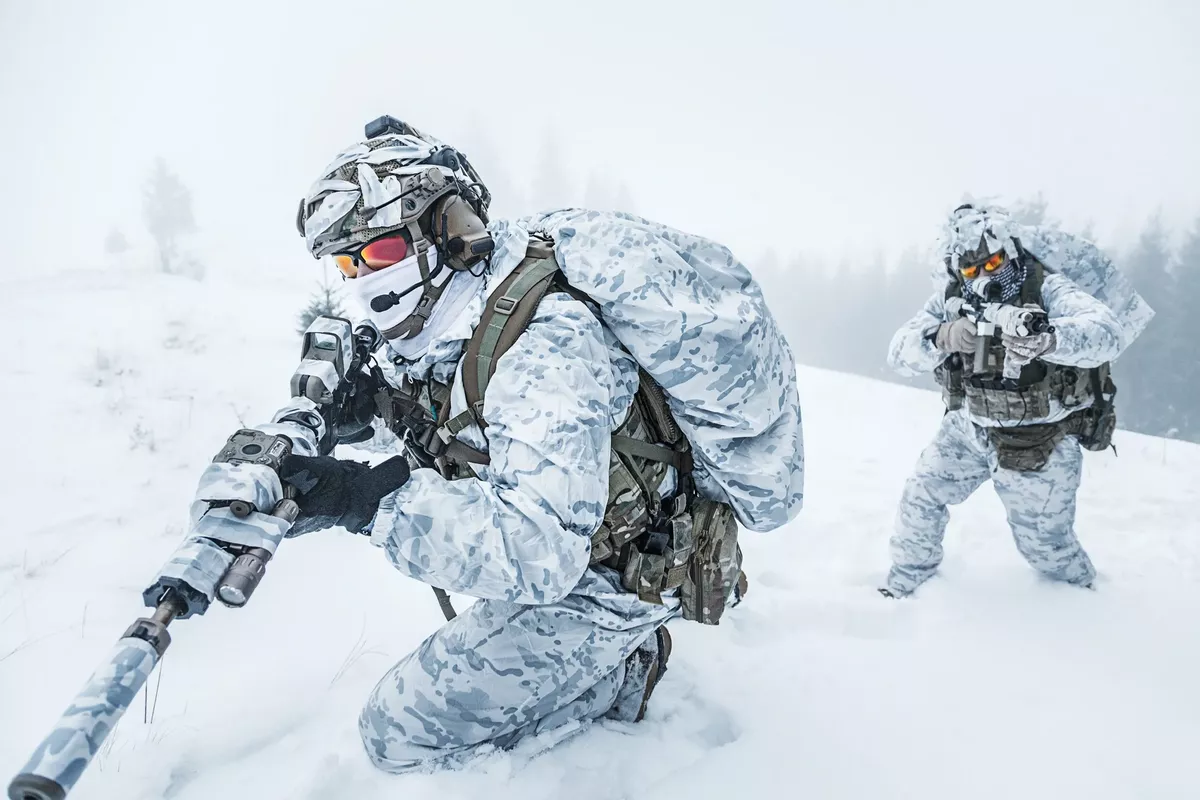
Regional military exercises by the Russian Armed Forces - such as Ocean-2024, the largest naval manoeuvres in over 30 years, involving 400 ships and over 120 aircraft in the Arctic and Pacific Oceans; the joint Russian-Chinese North-Joint 2024 exercises; or regular exercises by the Northern Fleet in the Barents Sea - further demonstrate operational readiness in difficult Arctic conditions.
However, despite its relative quantitative advantage over NATO states in many aspects, Russia also possesses significant qualitative weaknesses. These include, among others, limited anti-submarine warfare (ASW) capabilities and insufficient air defence in the central Arctic, which could be exploited by NATO in the event of escalation.
Russia’s limitations in the Arctic are also linked to a lack of funding for new investments, the impact of sanctions, infrastructure degradation due to thawing permafrost, logistical difficulties, the high costs of maintaining a military presence, limited availability of modern technologies, and the growing presence of NATO in the region. As a result, it is unlikely that Moscow will opt for an open confrontation with other states in the region to achieve dominance in the Arctic in the near future. A more realistic scenario remains hybrid actions (partially even military ones) that allow pressure to be exerted without entering into open conflict, such as nuclear blackmail. Recent events demonstrate that Finland and Norway are particularly vulnerable, with Oslo’s situation being influenced by both the status of Svalbard and interests related to the Barents Sea.
One of the less obvious constraints on the Russian presence in the Arctic remains logistical problems resulting from scattered bases, harsh climatic conditions, and limited port infrastructure. Maintaining constant supplies of fuel, food, and equipment to remote locations requires significant resources, and the availability of suitable transport units and efficient ports varies greatly. Thus, the ability to maintain a long-term military presence in the region depends not only on military infrastructure but also on the efficiency of the supply system, which remains one of Moscow’s main challenges.
Due to insufficient technological development, Russia cannot begin the exploitation of offshore deposits, and turning to foreign technical solutions is impossible due to international sanctions. However, it is difficult to expect this state of affairs to last forever, especially since Russia can benefit from Chinese technical assistance. For this reason, Moscow views the Arctic region as the key to achieving global dominance in the energy market.
The War Against Ukraine as a Turning Point
Russia’s full-scale invasion of Ukraine in 2022 led to three distinct changes in Moscow’s approach to the Arctic. Firstly, Western sanctions hit the energy sector, leading to the withdrawal of companies such as ExxonMobil and BP and restricting access to technology, which slowed down the development of extraction. In response, Russia began to seek support from China, though the solutions available there cannot fully replace Western know-how. Secondly, the expansion of NATO to include Finland and Sweden changed the security landscape in the region, prompting Moscow to strengthen its military presence, increase the number of exercises, expand air defence systems, and deploy new units in the north. Thirdly, Russia is tightening cooperation with China under the Polar Silk Road initiative, attempting to maintain infrastructure development and the functioning of the Northern Sea Route to limit the presence of Western nations.
It should be emphasised here that the accession of Finland and Sweden to NATO reinforces Moscow’s conviction that Arctic areas outside Russia are under Alliance control, leading to a perception of the region in a „NATO versus Russia” formula. The Kremlin is closely monitoring the way Finland and Sweden develop their presence in NATO, especially in the context of troop deployments and new command structures. The establishment of a multinational land component command and forward forces in Finland, based on Norwegian, Swedish, and Finnish units, among others, strengthens the defensive capabilities of Northern Europe. At the same time, these actions will be perceived in Moscow as a direct challenge, increasing the risk of a Russian response and potential errors in assessing the situation, which could lead to a further escalation of tensions. In practice, this encourages a further increase in tensions and shifts the discussion about the Arctic towards military issues. Consequently, Russia is increasingly preparing for various scenarios, including the possibility of an open conflict in the region.
On the other hand, the war against Ukraine has clearly weakened Russia’s capabilities in this area. Some Arctic units were redeployed to the front, suffering losses, which significantly limits the capacity for further force expansion, including the planned corps in the Karelia region. Additionally, military infrastructure in the north has become a target of attacks, as exemplified by strikes on the Olenya air base. Although Russia continues exercises, including in cooperation with China, these actions are largely demonstrative in nature and do not compensate for the limitations resulting from current involvement in the war.
The war against Ukraine has significantly affected Russian activity not only in the Arctic but also in other regions of the world, leading to a partial division of resources and a change in foreign policy priorities. Military involvement in Ukraine has weakened the land component in the Arctic and limited the pace of modernising some equipment, but it has also prompted Moscow to intensify activities outside the Euro-Atlantic area, especially in Africa. Russia has increased its presence there through paramilitary groups, utilising mercenary structures and cooperation with local regimes, allowing it to compensate for political and economic losses resulting from isolation in the West. As a result, the Kremlin’s actions took on an increasingly multi-directional character, combining military pressure in Europe with the expansion of influence in regions such as Africa. Now, four years after the attack on Ukraine, Russia sees again that the USA and some NATO states are much more interested in this region than in Africa, so the Kremlin must engage here.
Russia’s invasion of Ukraine in 2022 also led to a deep institutional crisis in the Arctic Council. Seven member states - Canada, Denmark, Finland, Iceland, Norway, Sweden, and the United States - suspended work in the Council, to which Moscow responded with accusations of politicising the forum and halting membership contributions. Under the Norwegian chairmanship in 2023-2025, working groups met only remotely, and ministerial meetings in the „Arctic Five” format remain suspended to this day. The lack of transparent communication channels fosters increased tensions in the region and limits crisis management capabilities. Russia, however, maintains a selective presence where it serves its interests - primarily in the area of maritime and aeronautical Search and Rescue (SAR), which Moscow uses to build an image of a responsible Arctic actor. At the end of 2025, Russia even formally withdrew from the framework of rescue cooperation with Norway, Finland, and Sweden in the Barents Sea, demonstrating that it treats Arctic cooperation as an instrument of political pressure that can be suspended and restored at will. The marginalisation of Russia in the Arctic Council prompted Moscow to seek alternative partners - the Foreign Minister of the Russian Federation pointed directly to China as a key direction for cooperation in the region.
The Transactional Russia-China Axis
Despite visible conflicts of interest, Russian-Chinese Arctic cooperation is deepening, which is particularly evident in the context of Russia bypassing Western sanctions. Following the start of the Russian invasion of Ukraine and the imposition of sanctions on the Russian energy sector, Chinese companies began taking over parts of investments; for example, in Yamal LNG and Arctic LNG-2, they have acquired 30% and 20% stakes respectively. Additionally, China provides Russia with equipment and technologies to replace some Western components, enabling the continuation of projects despite Western sanctions.
Common Russian-Chinese interests in the Arctic primarily include the joint exploitation of strategic resources and the diversification of maritime routes, such as the Northern Sea Route, where technological innovations, joint resource exploitation, and the deepening of diplomatic cooperation play a significant role. On the other hand, significant discrepancies are also visible. Despite the declared „no-limits partnership,” China approaches the deepening of cooperation with Russia with clear caution, fearing the risks arising from Russia’s weakened position relative to Europe and the United States. This caution is reflected, among other things, in the development of alternative transport routes and plans to build its own nuclear-powered icebreaker.
For Russia, therefore, China remains both a partner and a challenge. Moscow seeks to limit Beijing’s permanent presence in the Arctic while maintaining space for negotiations with other states in the region. As a result, Chinese-Russian cooperation, despite shared interests, remains burdened by persistent contradictions.
Looking ahead to the coming years, Russian-Chinese relations in the Arctic may develop in several directions: from deepening economic cooperation and an increased Chinese presence in the region, through maintaining a purely transactional model, to a more strained variant resulting from growing divergences of interests. This means that although Moscow and Beijing are currently united by a community of certain goals, especially in the area of raw materials, infrastructure, and limiting Western influence, the durability of this cooperation is not guaranteed. Its future shape will depend on the level of tension in the region, international relations (for instance, EU-China or USA-Russia), the scale of mutual dependence, and the readiness of both parties to accept the growing presence of the other partner in the Arctic.
See the original article here