Azerbaijan and Turkmenistan Deepen Strategic Partnership
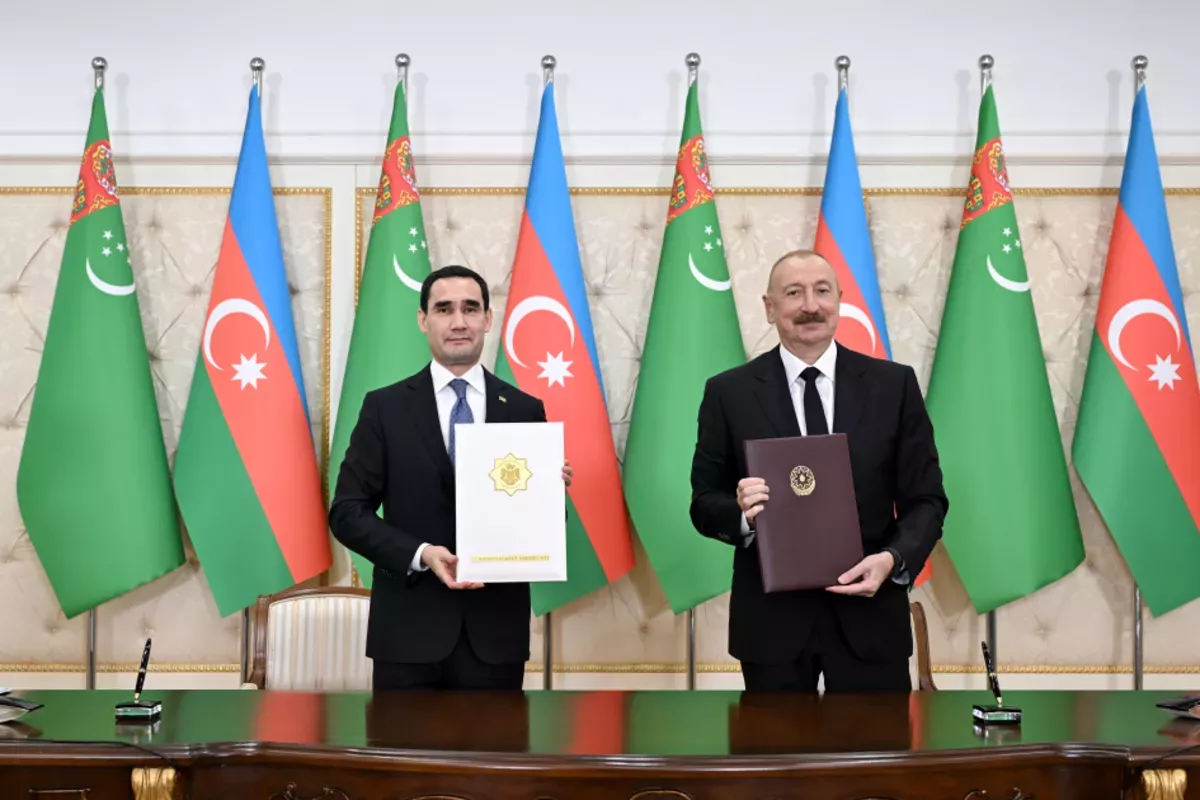
On June 22, Turkmen President Serdar Berdimuhamedov paid a state visit to Azerbaijan. During the visit, he met with Azerbaijani President Ilham Aliyev and participated in a series of bilateral meetings and signing ceremonies of agreements. The visit was another step in the continuing Azerbaijan-Turkmenistan cooperation in transportation, energy, trade, and regional connectivity. This comes at a time when alternative Eurasian transit routes are attracting increasing international attention amid Russia’s ongoing war against Ukraine and persistent disruptions to global maritime trade routes.
During the visit, Aliyev and Berdimuhamedov held one-on-one and expanded-format meetings. The talks were followed by the signing of a joint statement outlining the two countries’ shared commitment to deepening cooperation across multiple sectors. The meetings reflected the steady evolution of Azerbaijan-Turkmenistan relations from traditional neighborly ties into a more comprehensive strategic partnership encompassing economic, infrastructural, and diplomatic dimensions.
One of the major outcomes of the visit was the signing of 13 bilateral cooperation agreements covering customs cooperation, transport facilitation, energy, industry, agriculture, healthcare, labor policy, sports, food safety, and foreign policy coordination. The breadth of these documents demonstrated both governments’ determination to institutionalize cooperation and to create new mechanisms for long-term collaboration.
Among the agreements inked during the visit were two customs-related documents. The documents seek to improve information sharing on cross-border goods and vehicles while strengthening bilateral cooperation in customs statistics. These measures are expected to facilitate cross-border trade, enhance transparency, and streamline transit operations across the wider Caspian region. They are also likely to boost the efficiency and competitiveness of the Middle Corridor as a key Eurasian transport route.
The economic dimension of the partnership was further reinforced through the signing of an Agreement on the Main Directions of Development and Deepening of Economic Cooperation between the Governments of Azerbaijan and Turkmenistan. In addition, the two sides signed a memorandum of understanding to promote collaboration between Azerbaijan’s Central Bank and Turkmenistan’s Ministry of Finance and Economy. Industrial cooperation also featured prominently on the agenda. They also signed an agreement for a Program on Cooperation in the Field of Industry for 2026-2028 to provide a framework for closer collaboration in manufacturing and industrial development.
Energy remains one of the most important pillars of Azerbaijan-Turkmenistan relations. The parties signed an Agreement on Cooperation in the Field of Energy to strengthen coordination in the sector, which is central to both countries’ economies and regional positions. For more than a decade, Azerbaijan’s energy transit infrastructure has served as the principal westward export channel for Turkmen energy resources. Since 2010, the Baku-Tbilisi-Ceyhan (BTC) pipeline has facilitated the export of millions of barrels of Turkmen crude oil to international markets via Azerbaijan.
The diplomatic, social, and humanitarian dimensions of bilateral cooperation were also expanded between the two Caspian littoral states. Memoranda of understanding were signed in the areas of healthcare, labor, social protection, and sports. Diplomatic coordination also received additional attention through the signing of a Cooperation Program for 2026-2029 between the foreign ministries of Azerbaijan and Turkmenistan. These documents are expected to facilitate closer consultations on regional and international issues and enhance coordination within multilateral organizations.
Both leaders emphasized the importance of expanding cooperation in transport and transit. Berdimuhamedov stated that the two sides had agreed to work closely on developing transport and transit corridors along the east-west route that passes through the territories of both countries. He identified transport and transit as a priority area for bilateral cooperation, noting that the geographic locations of Turkmenistan and Azerbaijan offer significant advantages for developing international transport corridors. Berdimuhamedov also called for strengthening the activities of the Turkmen-Azerbaijani Commission on Transport, Transit, and Logistics to further enhance coordination and connectivity.
The Afghanistan-Turkmenistan-Azerbaijan-Georgia-Türkiye transport corridor was presented as a successful example of regional cooperation, while both sides reaffirmed their support for developing the Caspian Sea-Black Sea transport corridor along the Turkmenistan-Azerbaijan-Georgia-Romania route. These statements align with broader efforts by both countries to strengthen trans-Caspian connectivity and improve the efficiency of Eurasian supply channels. As the southern branch of the Middle Corridor gains momentum, connecting the People’s Republic of China to European markets via Kyrgyzstan, Uzbekistan, Turkmenistan, Azerbaijan, Georgia, and Türkiye, Baku and Ashgabat are emerging as key players in the broader Caspian connectivity and trade architecture.
Bilateral transportation cooperation has intensified in recent months, with the ports of Baku and Turkmenbashi playing an increasingly important role in enhancing the efficiency of the Middle Corridor. In January and April, government officials and port representatives from Azerbaijan and Turkmenistan held meetings to facilitate cooperation in the maritime transport and logistics sector. These discussions mainly focused on increasing cargo flows through improved logistics coordination, enhanced digital connectivity, and expanded transport links between the two seaports as part of broader measures to stimulate trans-Caspian trade connectivity.
The presidents also reaffirmed their readiness to continue cooperation within international and regional organizations and maintain close interaction through Caspian cooperation mechanisms. This commitment builds on the longstanding coordination between Azerbaijan and Turkmenistan within various multilateral frameworks, including the Economic Cooperation Organization, the Organization of Islamic Cooperation, the Non-Aligned Movement, the Organization of Turkic States, the Middle Corridor Initiative, CASCA+ Framework, and the C6 Platform. Such engagements enable both countries to promote regional cooperation, multilateral dialogue, and economic connectivity across Eurasia.
The outcomes of Berdimuhamedov’s visit to Azerbaijan demonstrate how Baku and Ashgabat are steadily expanding their partnership across a wide range of sectors. The combination of new economic agreements, energy cooperation, customs modernization initiatives, and commitments to enhance east-west transit connectivity suggests that both countries view deeper bilateral cooperation as an essential component of their broader regional strategies. As demand grows for efficient transcontinental transport routes linking Europe and Asia, the strengthening Azerbaijan-Turkmenistan partnership is likely to shape this connectivity across the Caspian region and the wider Eurasian space.
Find the original article here