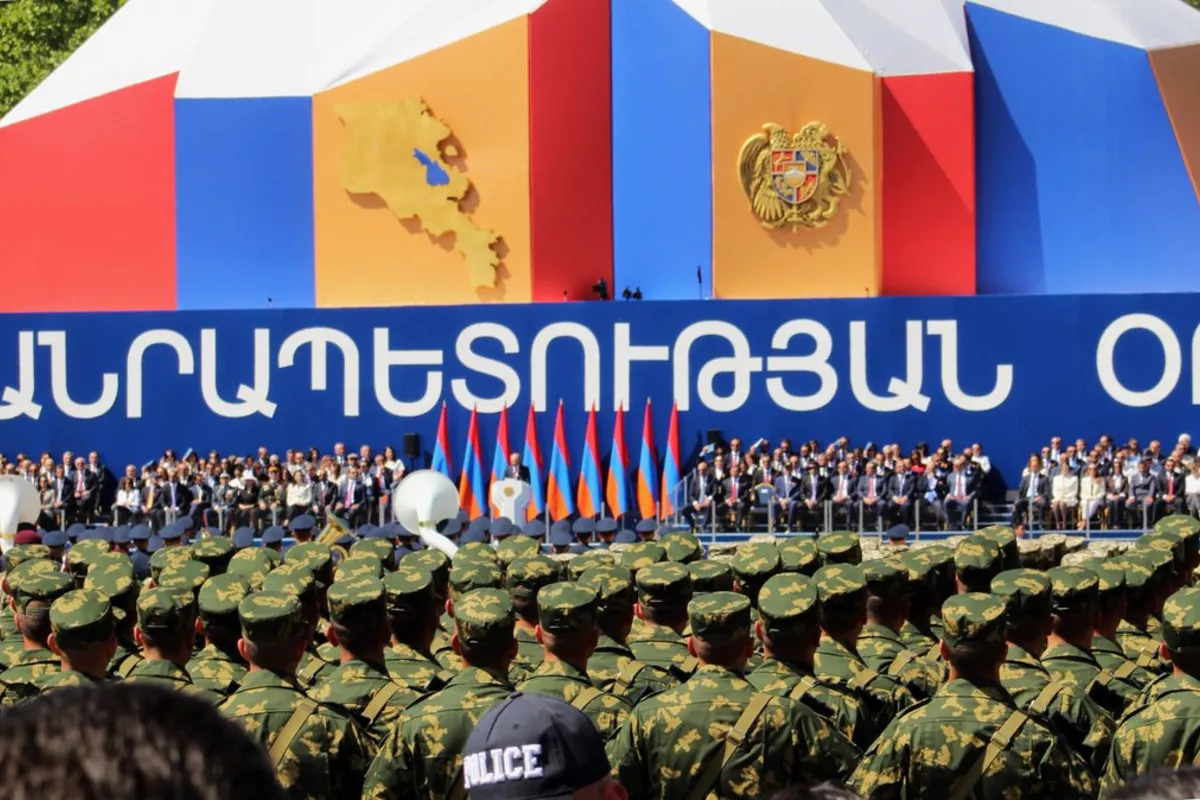
The military parade in Yerevan on 28 May was not merely a ceremonial celebration of Republic Day for the Armenian authorities, but a political and military declaration of a new course for Armenia after the Second Karabakh War and subsequent agreements with Azerbaijan. It was the first major military parade in the country in nearly 10 years - the previous one was held in 2016.
It should be noted that the current parade was not comparable to the 2016 event. There was no traditional Armenian sense of triumphalism, no references to Karabakh, and none of the “militaristic aesthetics” typical of the years of conflict.
Armenian experts particularly emphasise that the main feature of the parade was its demonstrative “post-Karabakh” philosophy. Whereas previous Armenian parades were built around the idea of a “victorious army” and effectively served the concept of “miatsum”, the current parade was framed around a very different idea: Armenia as a state within internationally recognised borders, and an army exclusively for the defence of Armenia’s own territory. Prime Minister Nikol Pashinyan underlined this point several times in his speech.
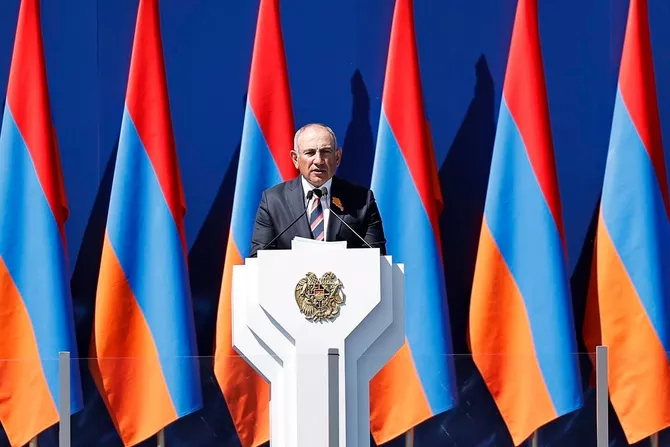
Source: Armenpress
Weapons from seven countries - Russia, India, France, Iran, China and others - were displayed at the parade. According to Armenian media, most of the systems were shown publicly for the first time. These included Russian heavy flamethrower systems TOS-1 and the Pole-21 electronic warfare system. Indian weaponry was also displayed for the first time, including Pinaka multiple launch rocket systems, ATAGS towed howitzers, MArG self-propelled artillery systems, Akash air defence systems, and anti-tank systems. French Caesar self-propelled howitzers and Bastion armoured vehicles, Iranian AD-08 Majid air defence systems, and Chinese CH-4 strike reconnaissance drones were also presented.
Armenian analysts noted that although any parade is typically a demonstration of strength, this time the authorities sought to ensure that Azerbaijan would not perceive it as a threat.
It is also notable that non-Russian-made weapons were given Armenian names. Russian-made systems, by contrast, were left outside this “Armenianisation”, as if excluded from the demonstration of national ownership. This was likely intended to signal Yerevan’s desire to gradually distance itself from Russia in the military sphere as well. Existing purchases remain in service, but new acquisitions - if Nikol Pashinyan remains in power - are unlikely.
Units of the land forces, special forces, artillery, air defence, engineering units and drone divisions marched through Republic Square. Particular attention was given to new equipment acquired after 2022. Pashinyan himself had earlier described the parade as a form of “report” on the army’s rearmament. This rearmament is also interpreted as a signal directed at Russia rather than Azerbaijan. Armenia demonstrated not only Chinese or Indian systems, but also a reduction in dependence on Russia, an attempt to integrate into a new system of military ties and to build a new type of army - more mobile, technological, and oriented towards defence rather than the positional warfare of the 1990s.
The 28 May parade was a clear signal to Russia. A deliberate one, and an unwelcome one. Yerevan made it clear that it is leaving Russia’s near-monopoly military-political orbit, maintaining its CSTO presence only nominally, and seeking to diversify its arms procurement regardless of Moscow’s position. Recall that Pashinyan did not attend the Victory Day parade in Moscow on 9 May, but instead held his own large-scale military parade in Yerevan less than three weeks later, demonstrating a level of autonomy unprecedented for Armenia and doing so in a somewhat defiant manner. At the same time, Pashinyan and members of his team regularly state that they do not intend to sever ties with Russia, nor damage relations, but rather seek to fit them into a multi-vector foreign policy model.
However, in Russia, such statements are not taken seriously. As Russian Foreign Ministry spokesperson Maria Zakharova said at a briefing the previous day, “We are accustomed to judging not only by words, but also by deeds. And those deeds increasingly diverge from the words.” According to her, Russia has never opposed Armenia diversifying its foreign ties, but “the current line of the Armenian authorities can hardly be described in that way, and it is difficult to speak of balance in relation to Russia”, Russian media reported. Zakharova added that Yerevan’s reassuring statements about Armenian-Russian relations “contrast and conflict with what we see and hear in the context of active election campaigning”.
If the military parade in Yerevan and the visit of Marco Rubio to Armenia were signals to Moscow, then Zakharova’s statements were no less clear a signal to the Armenian leadership. Through her remarks, Moscow is effectively conveying one message to Yerevan: a sharp geopolitical turn towards the West will carry comprehensive consequences for Armenia.
And the consequences of Armenia’s signals are already being felt.
In the run-up to elections in Armenia, Russia has already begun to “tighten the screws”. Over the past two weeks, imports from Armenia into Russia have been gradually restricted, including flowers, “Jermuk” mineral water, and brandy from several key enterprises. The Federal Service for Veterinary and Phytosanitary Surveillance has also introduced, according to Russian media, temporary restrictions on imports of fresh tomatoes, cucumbers, peppers, green vegetables and strawberries from Armenia “until an appropriate algorithm for ensuring product safety is developed”. It is not difficult to imagine the impact these bans will have on Armenian producers. Russia is Armenia’s main export market, and its loss would be catastrophic for the Armenian economy.
Armenia’s economy remains deeply tied to Russia. Despite Pashinyan’s statements on diversification, a significant share of foreign trade is still oriented towards the Russian market.
The ban on Armenian exports is an early warning sign - and a serious one for the Armenian economy.
Russia owns Armenia’s power grids, contributes to its energy security, and is involved in its infrastructure. In 2025, Russia accounted for more than 34 per cent of Armenia’s total external trade. Russia supplies nuclear fuel and equipment for Armenia’s nuclear power plant, energy resources, timber, machinery, non-ferrous metals and chemical products. Two days ago, media reported that Armenia had received a letter from Russia indicating the possibility of unilateral termination of agreements on the supply of natural gas, petroleum products and rough diamonds.
Source: Shutterstock
Russia also has the capacity to tighten migration rules, increase inspections of Armenian communities and companies, and create administrative barriers for labour migrants. This is one of the most sensitive levers, as remittances from Russia play a significant role in Armenia’s economy.
Russia could also intensify efforts in Armenia’s domestic political arena by increasing support for the opposition to the current government.
The fact that Russia holds highly effective instruments of pressure and influence over Armenia is not Pashinyan’s fault. It is a systemic issue that has shaped Armenian statehood for two centuries. Armenia has always been economically and politically dependent on Russia. It has never been fully self-sufficient or independent in its decision-making.
Dismantling this system will be extremely difficult for Pashinyan - if it is possible at all.
By Tural Heybatov