Georgia is seeking to strengthen its role as a key transport and communications hub linking the Caspian region, Central Asia, China and Europe. However, the sustainability of this strategy will depend on Tbilisi's ability to participate simultaneously in several major transport networks, including the International North-South Transport Corridor. The Caspian Post spoke to Georgian political analyst Dmitry Lortkipanidze about Georgia's prospects, regional connectivity, and the potential for the South Caucasus to become a major financial and economic hub of greater Eurasia.
- Mr Lortkipanidze, what explains Georgia's increasingly active engagement with the countries of Central Asia?
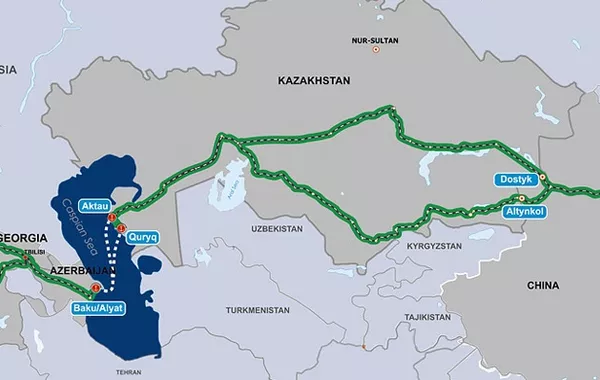
- This activity is driven by the objective logic behind the emergence of new Eurasian transport routes. Georgia is seeking to strengthen its position as a key link connecting Central Asia, the Caspian Sea, the South Caucasus, the Black Sea region and European markets.
The Central Asian countries are currently seeking additional access to the world's major transport arteries. Kazakhstan, Uzbekistan and Turkmenistan are interested in diversifying their export routes, as dependence on a single direction creates both economic and political risks. For them, the Trans-Caspian route through Azerbaijan and Georgia has become an important instrument of foreign economic diversification.
For Tbilisi, this represents an opportunity to turn its geographical location into long-term political capital. The more cargo flows, investment projects and energy routes pass through the country, the more important Georgia becomes to major centres of power, including the European Union, China, Türkiye, the Central Asian states and the countries of the Caspian region.
Geography alone, however, is not enough. Georgia needs to develop its ports, railways, motorways, customs infrastructure and digital logistics systems. In the 21st century, a transit country must offer speed, security, predictable tariffs and political stability.
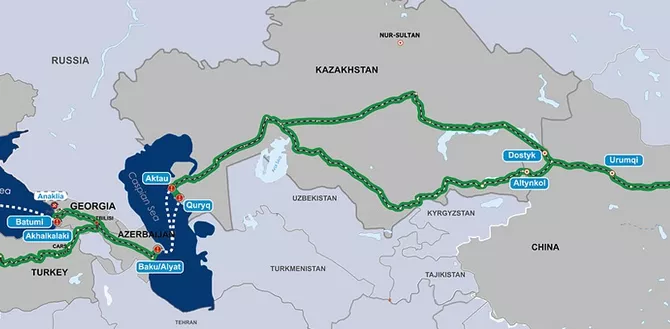
photo: eurasianet
- Can participation in the Middle Corridor provide a sufficient foundation for Georgia's economic and political resilience?
- The Middle Corridor offers considerable opportunities, but limiting the country to a single route would be strategically risky. Any transport system depends on global economic conditions, political crises, regional conflicts, the quality of infrastructure and competition from alternative routes.
Georgia should therefore seek to participate in several complementary transport corridors. The International North-South Transport Corridor is of particular importance in this regard. It is intended to connect Russia with the South Caucasus, Iran, India and the markets of the Persian Gulf.
For Georgia, becoming part of this transport architecture would mean expanding its economic space. It would provide access to the Indian market, Iran's transport network, the ports of the Persian Gulf, new financial flows, tourism routes and service industries.
Of course, the project faces political constraints, sanctions-related risks and the complex relationships between the states involved. Nevertheless, geoeconomic strategy must be developed with a view to the coming decades. Political alignments change, whereas transport infrastructure retains its importance for much longer.
Georgia's task is to ensure that participation in one corridor does not evolve into geopolitical dependence. The broader its transport and communications network, the more resilient the country becomes and the greater its ability to pursue an independent foreign policy.
- You have spoken about the possibility of transforming the South Caucasus into a kind of regional Switzerland. How realistic is this prospect?
- The idea may appear ambitious, but it has a solid economic foundation. The South Caucasus lies at the crossroads of Europe, Asia, Russia, the Middle East, and the Black Sea and Caspian regions. Energy, transport, trade and digital communications all pass through the region.
Azerbaijan possesses substantial energy resources, significant financial capacity and access to Central Asia across the Caspian Sea. Georgia provides access to the Black Sea and European markets. Armenia has considerable human capital, technological potential and opportunities to participate in regional production chains.
Provided political stability can be achieved, the South Caucasus could become a centre for banking services, cargo insurance, energy trading, arbitration, digital services, international logistics and the regional headquarters of major companies.
Such a prospect, however, requires a new culture of interstate cooperation. The countries of the region must view connectivity as a shared resource rather than as an instrument of pressure against one another. No South Caucasus transit project will be fully sustainable as long as it remains surrounded by conflicts, closed borders, political mistrust and competition among external powers.
Cooperation does not mean abandoning national interests. On the contrary, it allows those interests to be coordinated while enabling the region to emerge as an independent economic actor.
If the countries of the South Caucasus succeed in establishing a common framework for transport security, investment guarantees and economic coordination, the region will have a genuine opportunity to become a financial, energy and logistics hub of Greater Eurasia. In that case, the South Caucasus will no longer be perceived solely as an arena of rivalry. Instead, it will acquire the status of a region where the interests of the world's major centres of power can converge on the basis of mutual benefit.