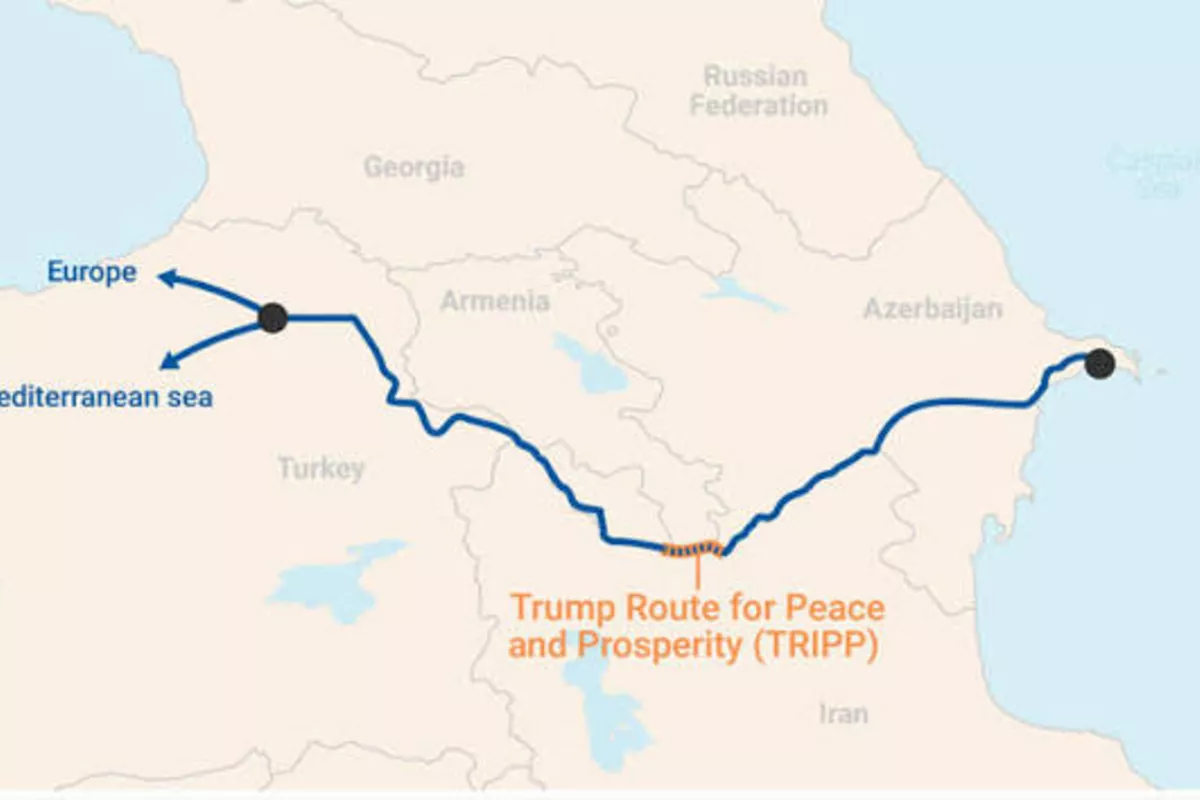
When discussing the TRIPP project, it is important to understand that if Washington has entered the game, the stakes are far greater than a road through Meghri. The United States appears to view this route as the foundation of a new economic architecture extending beyond Armenia to the entire South Caucasus and Central Asia.
Last week, the US government approved the launch of the ratification procedure for the framework agreement on TRIPP - the “Trump Route for International Peace and Prosperity.” The document was signed on June 1 by Armenian Foreign Minister Ararat Mirzoyan and US Secretary of State Marco Rubio. The Armenian parliament is also preparing to ratify the agreement.
Under the agreement, a joint company, TRIPP Development Company, is to be established. The US International Development Finance Corporation will hold a controlling 74 percent stake, while Armenia will retain 26 percent.
At the same time, the US Department of State announced the creation of the TRIPP+ Enterprise Fund, with an initial capital of $201 million. Crucially, its area of operation is not limited to Armenia but also includes other countries of the South Caucasus and Central Asia.
This is where the true scale of American ambitions becomes clear. Washington no longer sees TRIPP as a separate Armenian-American transport project. It is treating it as an instrument for building its own financial, infrastructure and energy system across a vast area stretching from the South Caucasus to Central Asia.
US Vice President JD Vance did not describe TRIPP+ as part of a “historic transformation” by accident. According to him, the initiative could open an entirely new world of trade, transit and energy flows. In other words, this is not simply a transport corridor but an economic platform through which the United States intends to secure a long-term regional presence.
Particular attention, however, has been drawn to the appointment of Russian-American investor Konstantin Sokolov as head of the TRIPP+ fund. Over more than two decades, he has participated in major investment, energy and telecommunications projects. Sokolov is a shareholder in Viva Armenia and is also one of the prominent donors to the Republican Party in the United States.
His background has prompted Armenian experts to view the American initiative from a different perspective. Formally, the fund is intended to invest in critical infrastructure, energy, transport and mineral extraction, providing financial support for the strategic Trump Route. Questions have nevertheless arisen because the institution will be headed by a Russian-born businessman who continues to maintain close ties with the post-Soviet business environment.
In my view, this appointment is unlikely to be accidental. Donald Trump appears to be acting in his characteristic pragmatic manner, seeking a balance between the interests of the United States and those of Russia, which, despite its weakening position, continues to regard Armenia as part of its traditional sphere of influence.
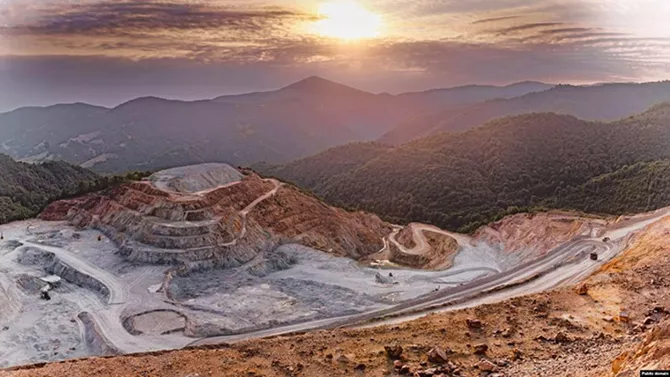
photo: getty images
Signs of a possible consensus can also be seen in the deal involving the Teghut copper-molybdenum mine, the second-largest deposit of its kind in Armenia. The asset was sold to the American company Dynamic Frontier Holdings, which is headed by the same Konstantin Sokolov.
Since 2018, the mine had been controlled by Russia’s VTB Bank, which obtained it from the heavily indebted Vallex Group. In addition, one of Sokolov’s companies already owns the Armenian telecommunications operator Viva Armenia, which was also previously considered a Russian asset.
The fact that the Russian side agreed, without significant public resistance, to transfer first a telecommunications company and then a major mining asset to an American investor may point not so much to Russia being forced out of Armenia as to the existence of certain understandings.
Trump appears to have found a formula allowing the United States to pursue its strategic objectives without provoking an open crisis with Moscow. American influence is expanding, but it is doing so not through direct political pressure, but through investment funds, private capital and the transfer of major assets to a businessman who is acceptable both to Washington and to elements of the Russian business establishment.
This is the fundamental difference between the American approach and the policy pursued by the European Union. Brussels often acts according to the logic of geopolitically displacing Russia from Armenia. Washington, by contrast, is advancing its interests through major business projects while avoiding direct confrontation and, where possible, ensuring that Moscow is not left looking like a complete loser.
The United States does not need a clash of interests in the region. Washington’s plans for the South Caucasus and Central Asia are too extensive for Armenia to be turned into yet another arena of direct confrontation with Russia.
The question of Donald Trump’s political loyalty toward Moscow has been debated since his first presidential term. At that time, the issue was repeatedly raised in the US Congress. The discussion has now gained new momentum following Sokolov’s appointment as head of TRIPP+.
Armenian expert Beniamin Matevosyan believes that Sokolov’s role forces observers to look at the American initiative from an entirely different angle. In his view, Sokolov is not merely a major businessman and Republican donor, but an entrepreneur whose professional biography is closely connected with St. Petersburg and with former Russian assets in Armenia.
photo: getty images
Matevosyan points out that structures associated with Sokolov have taken control of former Russian assets, including Viva Armenia, Ovio and the Teghut mine, which had previously been owned by VTB. He suggests that instead of directly and politically involving Russian state companies in an American project, the White House placed the financial levers in the hands of a person capable of communicating effectively with both the American and Russian elites.
According to this logic, Washington is not seeking to eliminate Russia entirely but is allowing for a certain division of economic influence in the region. Such an arrangement, however, should hardly be viewed as a concession to the Kremlin.
Suggestions that an American investor of Russian origin could somehow sabotage Washington’s plans are not serious. Whatever Sokolov’s background or wherever his business career began, he will be managing an American fund and implementing, above all, an American strategy.
Equally unfounded were expectations that the war in Iran or an apparent cooling of US interest in the project would push TRIPP into the background. The project is already in motion, its institutional and financial foundations are being established, and American plans clearly extend far beyond the construction of a road linking Azerbaijan’s western regions with Nakhchivan.
Washington intends to work with Armenia comprehensively. Transport infrastructure, energy, telecommunications, mining and investment are all part of the broader agenda. In other words, the United States intends, figuratively speaking, to take Armenia wholesale rather than retail.
At the same time, Trump appears determined to avoid a scenario in which the expansion of the American presence automatically leads to open confrontation with Russia. Such a conflict would be dangerous not only for Armenia but for the entire South Caucasus.
Sokolov’s appointment may therefore be not a contradiction, but part of a carefully designed model. The United States gains control over key financial and infrastructure instruments, Russia avoids the appearance of a humiliating geopolitical defeat, and Armenia becomes a central element of a much larger American project.
TRIPP is no longer simply a road through Meghri. It is Washington’s bid to build a new regional economic system. Trump, it seems, intends to implement it in a way that prevents the expansion of American influence from turning into a destructive clash of interests with Moscow.
By Tural Heybatov