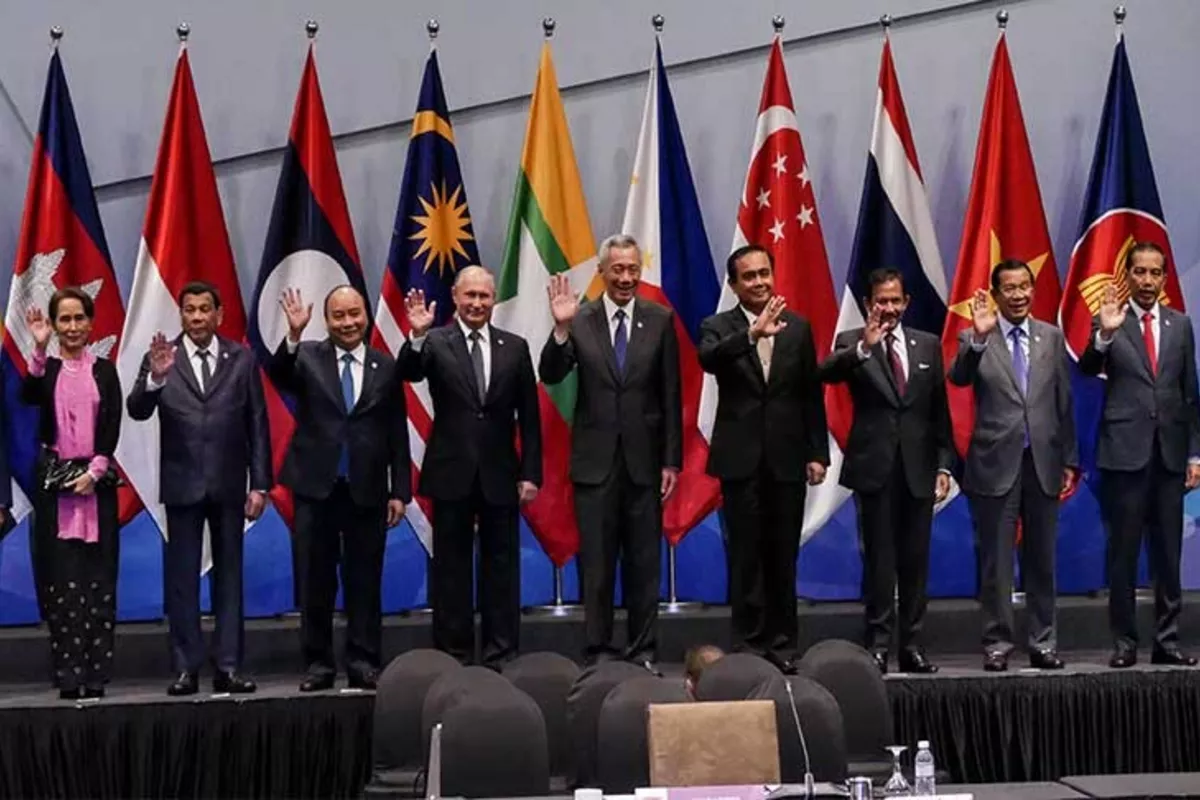
Russian President Vladimir Putin will host leaders and senior officials from Southeast Asia in the Russian city of Kazan from June 17-18 for a commemorative summit marking 35 years of relations between Russia and the Association of Southeast Asian Nations (ASEAN) as well as the 30th anniversary of Russia as an ASEAN dialogue partner.
The summit comes as Russia seeks to deepen engagement with its Asian partners amid continuing tensions with the West over the Ukraine war while ASEAN countries pursue their longstanding policy of balancing relations among major powers, including China, the US and Russia.
According to the ASEAN Secretariat, the summit will commemorate the 35th anniversary of ASEAN-Russia relations, which were formally established in 1991, shortly before the dissolution of the Soviet Union.
Over the past three decades, cooperation has expanded from political dialogue to trade, energy, security, education, disaster management and people-to-people exchanges.
Relations between Russia and ASEAN were elevated to a Strategic Partnership in 2018, reflecting growing cooperation between Moscow and the 10-member Southeast Asian bloc.
The Kazan gathering is expected to be the highest-level ASEAN-Russia meeting since the onset of the Ukraine conflict in 2022 and one of the most significant milestones in the partnership since the first ASEAN-Russia summit in Kuala Lumpur in 2005.
A second commemorative summit was held in Russia’s Black Sea resort city of Sochi in 2016 to mark the 20th anniversary of dialogue relations, while subsequent engagements have taken place through ASEAN-led mechanisms, including the East Asia Summit and ASEAN-Russia summits held on the sidelines of regional meetings.
Expectations from the Summit
The summit is expected to bring together leaders or senior representatives from all ASEAN member states - Brunei, Cambodia, Indonesia, Laos, Malaysia, Myanmar, the Philippines, Singapore, Thailand and Vietnam - along with ASEAN Secretary-General Kao Kim Hourn.
Several participants are expected to make their first visits to Russia since Moscow launched its full-scale military operation in Ukraine more than four years ago, underscoring the significance that Russia attaches to strengthening ties with non-Western partners despite continuing Western sanctions and diplomatic pressure.
The meeting also comes as global geopolitical tensions continue to rise.
Discussions are expected to cover international and regional developments, including the Ukraine conflict, the war in Gaza, the escalating confrontation between Israel and Iran, maritime security and developments in the Indo-Pacific.
ASEAN has traditionally avoided taking unified positions on major-power conflicts, preferring dialogue and neutrality. While most ASEAN members supported UN resolutions affirming Ukraine’s sovereignty, the bloc has maintained engagement with Russia through its multilateral frameworks.
Economic cooperation is expected to dominate the agenda.
Trade between Russia and ASEAN has grown steadily over the past decade despite disruptions caused by the COVID pandemic, sanctions and geopolitical tensions.
According to ASEAN and Russian data, two-way trade has generally remained above $20 billion annually in recent years, covering energy products, agricultural commodities, fertilizers, machinery, metals and manufactured goods.
Russia has increasingly viewed Southeast Asia as a key destination for trade diversification as its economic ties with Europe have contracted following the Ukraine war.
ASEAN economies, meanwhile, have sought to maintain access to Russian energy, fertilizers and raw materials while expanding investment opportunities.
Agendas on Discussion
Energy security is expected to receive particular attention amid volatility in global markets caused by conflicts in Eastern Europe and the Middle East.
Russia remains one of the world's largest exporters of oil, natural gas and nuclear technology, while several ASEAN members are exploring expanded cooperation in energy infrastructure, oil and gas development and civilian nuclear projects.
Food security is also likely to feature prominently, with Russia remaining a major global supplier of wheat, fertilizers and other agricultural products that are important for many Southeast Asian economies.
The summit is expected to endorse a new roadmap for cooperation covering the next decade, focusing on trade, digital transformation, connectivity, science and technology, sustainable development, education and tourism.
For Moscow, the gathering represents another step in its broader "pivot to the East" strategy, which has accelerated since 2022 as Russia seeks to strengthen economic and political partnerships across Asia.
For ASEAN, the summit reflects the bloc’s commitment to maintaining strategic autonomy by engaging all major powers while avoiding alignment with any single geopolitical camp.
Find the original article here