Daily Sabah, a Turkish daily newspaper, has published an article highlighting NATO's Steadfast Dart-2026 exercise and the growing role of Türkiye in the Alliance.
The Caspian Post republishes the article.
Given the persisting Russia-Ukraine war, alongside sudden U.S. military intervention in Venezuela and the deepening crises of confidence among NATO allies over Greenland’s status, NATO's Steadfast Dart-2026 exercise takes on special importance at a critical time when Europe is attempting to redefine its defense and security architecture.
Indeed, U.S. Secretary of State Marco Rubio stated at the Munich Security Conference that the U.S. is determined to build a new world order: “While we are prepared, if necessary, to do this alone, it is our preference and it is our hope to do this together with you, our friends here in Europe.”
In contrast, French President Macron declared that, “Europe must redesign its security architecture independently.”
So, could the NATO Steadfast Dart-2026 exercise, hosted by Germany, mark the beginning of a historic challenge and a turning point for the trans-Atlantic alliance? Could the Turkish Armed Forces (TSK), NATO's second-largest force, with its superior capabilities and most modern weapons, replace the U.S. in the Baltic region?
U.S. President Donald Trump’s National Security Strategy (NSS), framed as a modern Monroe Doctrine, shifts U.S. focus from the Western Hemisphere to Europe-Russia relations, economic ties with China, and countering China in Taiwan and the Pacific. By limiting NATO’s conventional support while keeping its nuclear role, the U.S. underfunds European defenses. Washington's Ukraine policies, including the Alaska summit with Putin, benefit Moscow, reinforcing NATO’s weaknesses and encouraging Russia’s firm stance on peace and internal consolidation.
Another significant development at the end of last year, the violation of the airspace of the Baltic states, Germany, Poland and Romania by certain Russian missiles and unmanned aerial vehicles (UAVs), as well as the entry of MiG-31 fighter jets into Estonian airspace, led to questions about Article 5 of the alliance. Indeed, the fact that Russian missile attacks are testing NATO's air defense capabilities, along with the corresponding nuclear readiness and response levels, is causing extreme concern among the Baltic states, Central European allies, including Germany, and the broader public.
For European allies who are belatedly confronting the reality of "defending Europe with fewer American troops" against Russia, it is a fact that Türkiye, given its rising military-strategic importance and economic power along the Black Sea-Turkish Straits-Mediterranean axis, is playing a more active role in the defense industry and European defense policies.
In light of these observations, Steadfast Dart 2026 brought together approximately 10,000 military personnel from 11 member countries, encompassing not only traditional land, sea and air forces but also emerging operational domains such as space and cyberspace. Following accusations that Trump was weakening the alliance, the exercise was closely watched by some observers to assess how successful it could be without the U.S. Army, the allies’ most important partner. Despite these concerns, NATO Secretary-General Mark Rutte stated that the alliance has undergone a "shift in mindset."
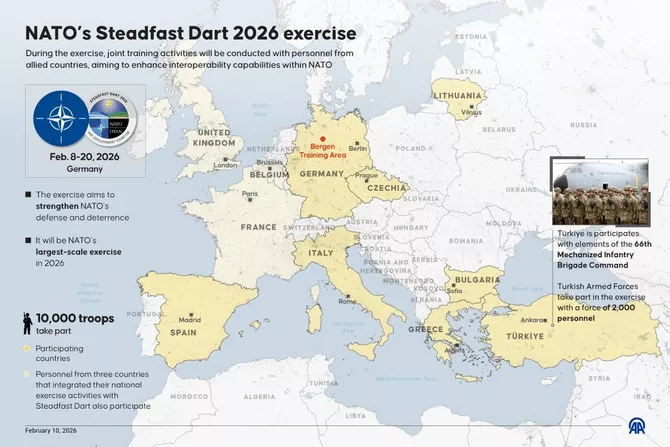
An infographic detailing information on NATO's "Steadfast Dart 2026" exercise. (Photo: Anadolu Agency)
Purpose of exercise, Türkiye's contributions
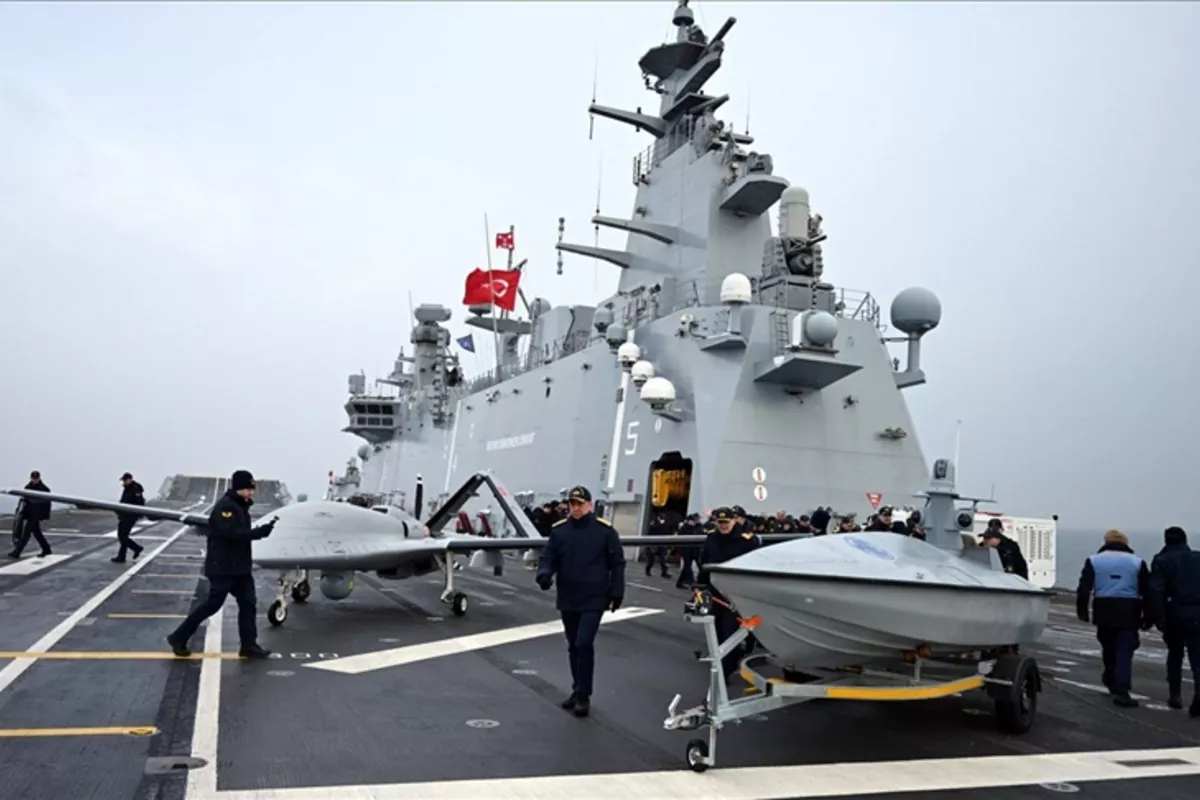
In this context, Türkiye, with the TCG Anadolu and its powerful rapid response forces, is at the very center of European security. DART 2026 is conducted to test and train the operational deployment and reinforcement of the newly formed NATO Rapid Reaction Force-ARF 25 elements under peacetime conditions. The military objective of the exercise is to apply submarine warfare and anti-submarine warfare capabilities for submarines, anti-submarine warfare surface units and naval aircraft to achieve maritime objectives related to maritime control and maritime interdiction within the scope of collective defense and crisis response. The operation is an enhanced readiness activity in the Greenland-Iceland-United Kingdom Channel, Arctic and Baltic Sea regions, with adjacent activities in the Mediterranean and Central-Eastern Europe. The allied strike capabilities, consisting of the French aircraft carrier strike group, the Italian aircraft carrier, and the Spanish and Turkish navies, include scenarios with live ammunition and amphibious landing operations. The exercise also includes training on the reception, equipping and redeployment of multinational forces under realistic conditions, to enhance and demonstrate NATO's ability to defend against any attack targeting its territory.
Bayraktar TB3 armed UAVs stationed on the TCG Anadolu, tested for the first time in this exercise, took off as part of the exercise and hit their targets in the Baltic Sea with precision. After hitting the targets, the unmanned aerial vehicles returned to the TCG Anadolu and landed safely. This operation once again demonstrated Türkiye's ability to use unmanned aerial vehicles from naval platforms in an international exercise, bringing the military doctrine concept of “Flag Show” to the Baltic waters. This military success has essentially been defined as the first step in NATO's development of new tactics and strategies for future wars.
Secondly, the participation of Turkish units in the exercise with modern weapons and ammunition produced by the domestic defense industry has strengthened the hypothesis that Ankara could introduce newer co-production models in the new European armament. The third important gain, in terms of public diplomacy, is that the increased visibility of Turkish soldiers within NATO with the most modern weapons has contributed positively to the European public and press, as well as providing serious political credibility in the context of the Turkish diaspora living abroad. Indeed, the German press attached great importance to this exercise and featured Türkiye as the strongest country in the exercise on their front pages. Following the exercise, the Türkiye's Ministry of National Defense stated in a post, “The same discipline, the same will in every geography, the power that comes from unity.”
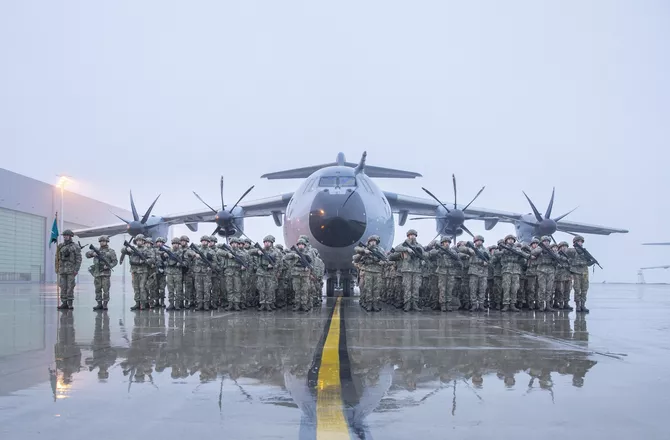
Personnel from the 66th Mechanized Infantry Brigade Command, representing the Turkish Armed Forces (TSK), arrived at Wunstorf Air Base to participate in the Steadfast Dart 2026 Exercise, Wunstorf, Germany, Feb. 2, 2026. (Photo: Anadolu Agency)
With this exercise, Türkiye has clearly demonstrated that it is an important NATO ally by contributing to the alliance’s collective security through the successful deployment of its best-trained, heavily armed soldiers at the division level to the Baltic theater, along with land, sea and air assets. Türkiye, one of NATO's largest armies, has contributed to NATO missions and operations, as clearly demonstrated in the Bosnian and Kosovo Wars. It has received the support of the allied armies as a critical message that it will provide significant support to all NATO missions carried out, even under the critical tension conditions outlined above. Ultimately, Gen. Ingo Gerhartz, commander of the NATO Joint Force Command (JFC), praised the contribution of the TSK to this year's largest NATO exercise. Gerhartz stated that Türkiye's contribution cannot be overstated as it provided by far the largest contribution with approximately 2,000 personnel, the amphibious assault ship TCG Anadolu and its accompanying task force.
Indeed, German Foreign Minister Johann Wadephul argued that NATO has both strengthened and expanded, emphasizing that this, along with Europe's new role in defense, will become more apparent at the NATO summit to be held in Ankara in early July. However, in my opinion, the most important development is that the Turkish Armed Forces, which have participated in NATO exercises with foreign military weapons for years, are now participating with “domestic, national, autonomous” defense industry weapons under the leadership of President Erdoğan, and have risen to become the world's 11th largest arms exporter. Yes, Türkiye can export the Hürjet training aircraft, air defense systems, armored combat vehicles, warships, and their ammunition systems to Spain, Poland, Hungary and many NATO countries. This is a Turkish revolution in the defense industry. However, Türkiye supports the diplomatic option for a solution to the Iran crisis, just as it contributed to the cease-fire and peace efforts in the Ukraine and Gaza wars. Its peaceful efforts against religious radicalism and terrorism in Syria and Somalia demonstrate that Ankara is a reliable partner in the geopolitical axis stretching from the Baltic to the Red Sea.