Key Takeaways:
-
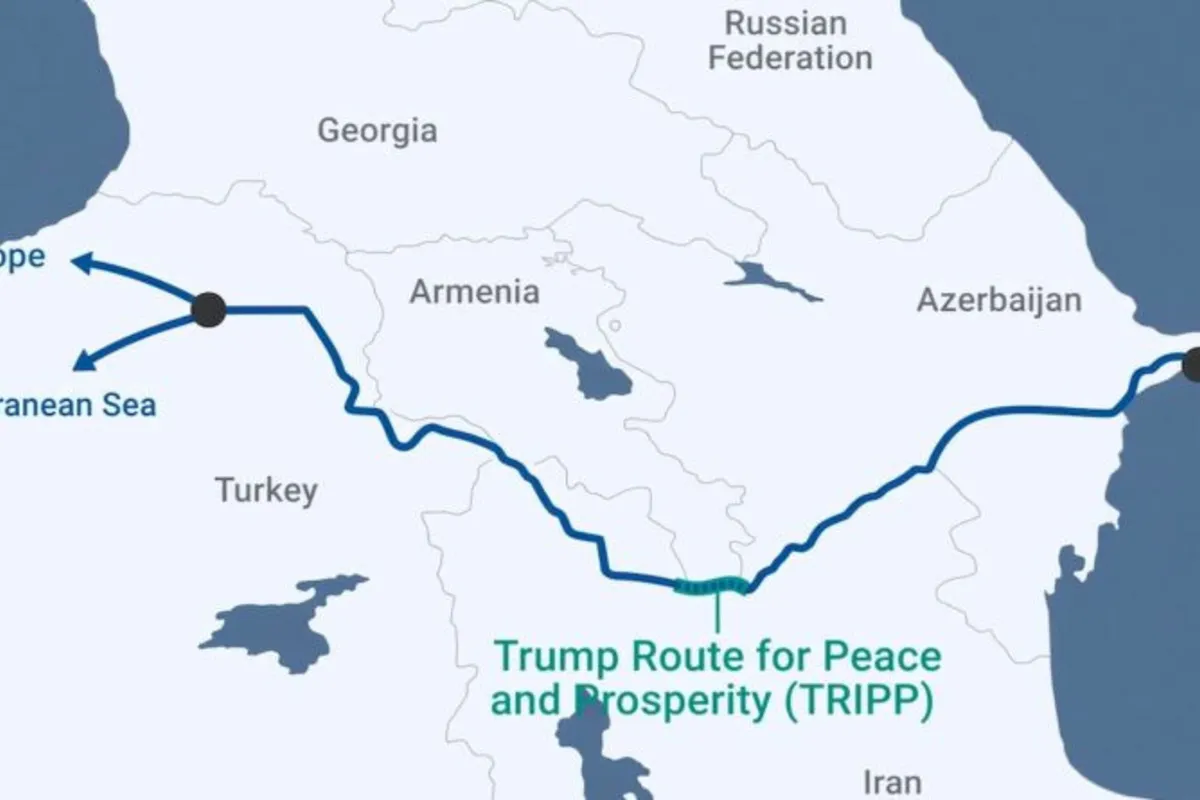
The Zangezur Corridor, envisioned in the 2020 trilateral statement and advanced under the August 2025 Washington Joint Declaration as the “Trump Route for International Peace and Prosperity” (TRIPP), aims to restore direct land links between mainland Azerbaijan and Nakhchivan while expanding South Caucasus transit.
-
A US-Armenia Framework Agreement initialled in May 2026 and signed in early June establishes a joint venture (74 percent US, 26 percent Armenia) with 49-year development rights, targeting construction as early as spring 2027 and encompassing roads, railways, energy lines and digital infrastructure.
-
The project is presented as a multifunctional link that could strengthen the Middle Corridor, diversify Europe-Asia routes, deepen Azerbaijan-Türkiye-Central Asia connectivity, and give economic substance to Azerbaijan-Armenia normalisation, thereby reinforcing both regional interdependence and strategic autonomy.
The Zangezur Corridor Concept and Azerbaijan’s Strategic Position
Restoring a direct land link between mainland Azerbaijan and the Nakhchivan Autonomous Republic has long been a central priority of the country’s transport policy. The idea acquired a new political dimension following the Second Karabakh War. Paragraph 9 of the Trilateral Statement of 10 November 2020 envisaged the restoration of all economic and transport links in the region, including transport connections between Azerbaijan’s western districts and Nakhchivan. In the post-war period, Azerbaijan consequently kept the reopening of regional communications consistently on the agenda, linking it to the development of an economic foundation for peace.
The defining feature of Azerbaijan’s approach is that the Zangezur Corridor is not merely a route connecting two parts of the country, but a strategic link capable of expanding transit opportunities across the South Caucasus. To this end, Baku has prioritised infrastructure development on its own territory, particularly the Horadiz-Aghband railway and road route, and made improved connections towards Nakhchivan a priority of regional transport policy. Azerbaijan’s initiatives and infrastructure preparations have established an important political and material basis for implementing the project.
The agreements reached in Washington on 8 August 2025, with the participation of Azerbaijani President Ilham Aliyev and Armenian Prime Minister Nikol Pashinyan, marked a new phase in this process. The Joint Declaration signed in the presence of the US President expressed political support for reopening regional communications, ensuring connectivity between mainland Azerbaijan and Nakhchivan, and implementing the “Trump Route for International Peace and Prosperity” (TRIPP) initiative. Alongside the initialling of the text of a peace agreement, these decisions demonstrated that economic cooperation was being viewed as a key pillar of the normalisation process.
US-Armenia Agreements and the Project’s Transition to the Implementation Phase
Following the Washington understanding, the United States and Armenia presented the TRIPP Implementation Framework in January 2026. The document outlined the creation of an unimpeded multimodal transit connection, the development of modern infrastructure, improvements to the organisation of border and customs procedures, investment mobilisation, and the definition of a governance model for the project. This marked a step towards underpinning the political agreement with concrete economic and legal mechanisms.
In this context, US Secretary of State Marco Rubio’s visit to Armenia on 26 May 2026 was particularly significant. At Zvartnots Airport in Yerevan, Rubio and Armenian Foreign Minister Ararat Mirzoyan initialled the Framework Agreement on Strategic Cooperation concerning TRIPP. At the same meeting, the two countries also signed a comprehensive strategic partnership charter and a document on cooperation in the extraction and processing of critical minerals and rare-earth elements. It would, however, be inaccurate to suggest that the TRIPP agreement was definitively signed that day: according to official information, Rubio signed the document in Washington on 1 June, while Mirzoyan signed it in Yerevan on 4 June. This sequence illustrates how the political importance the United States attaches to the initiative has translated into institutionalised cooperation.
Under the Framework Agreement, a joint venture named TRIPP Development Company is envisaged, with a planned ownership structure allocating 74% to the US side and 26% to Armenia. The company is expected to receive initial development and operating rights for 49 years, while project preparation and implementation mechanisms are to be established. These provisions, however, represent the model set out in the agreement and remain subject to the company’s establishment and completion of the relevant procedures. In September 2026, the Armenian government continued discussions on the project’s corporate and legal documentation and implementation mechanisms. Armenia’s foreign minister stated that construction could begin in spring 2027, while Armenia’s ambassador to the United States identified early 2027 as a possible starting period. These statements reflect the government’s objective of moving the project into its practical implementation phase.
An important factor enhancing TRIPP’s significance is that it extends beyond roads and railways. The project also envisages exploring the development of electricity transmission lines, infrastructure for transporting energy resources, fibre-optic communications and other digital links. It therefore represents a multifunctional communications system with the potential to bring transport, energy and information flows together along a single geographical route.
The Project’s Geoeconomic Significance
The Zangezur Corridor’s foremost geoeconomic significance lies in establishing a direct connection between mainland Azerbaijan and Nakhchivan, complemented by access to wider markets via Türkiye. In addition to strengthening domestic economic ties, this would diversify freight routes, increase the geographical flexibility of transport operations, and enable the emergence of new logistics and service hubs. Connecting Azerbaijan’s existing port, railway and logistics capacity in the Caspian basin with the Zangezur route could further consolidate the country’s position as an international transit hub.
In this sense, the project is a logical extension of the transport strategy Azerbaijan has pursued consistently in recent years. The Baku International Sea Trade Port, the Baku-Tbilisi-Kars railway and the country’s domestic trunk infrastructure all serve to develop East-West connectivity. Adding the Zangezur route to this system would strengthen the complementarity of transport corridors, positioning Azerbaijan not simply as a transit country but as a regional hub taking the initiative in connecting different transport networks.
The Zangezur Corridor could become an important component of the developing Middle Corridor along the China-Central Asia-Caspian Sea-Azerbaijan-Türkiye-Europe route. The Middle Corridor’s principal advantage is that it offers additional, competitive and diversified transport options for economic links between Asia and Europe. According to World Bank estimates, coordinated investments and reforms could triple freight volumes along the Middle Corridor by 2030 and halve transit times. This assessment applies to the Middle Corridor as a whole; the Zangezur route should be regarded as another important connection that could enhance its potential.
The corridor’s importance for Europe is particularly far-reaching. The European Union places considerable emphasis on diversifying access to Asian markets and Central Asian resources, improving supply-chain resilience, and expanding alternative transit options. In 2024, the EU and its partners announced commitments to mobilise €10 billion in investment to develop Trans-Caspian transport connections. In January 2026, the EU and Azerbaijan put cooperation on a feasibility study for the Nakhchivan railway on the agenda. These developments indicate that new connections in the region align with Europe’s long-term economic interests. Beyond the transport of goods, the Zangezur Corridor could also create additional opportunities for future flows of energy, data and investment.
The project also matters for Armenia’s deeper integration into the international transport system, the expansion of Türkiye’s overland connections with Azerbaijan and Central Asia, and the diversification of export routes for Central Asian states. For China, it offers the prospect of additional transport alternatives towards Europe. TRIPP is therefore an initiative capable of bringing the distinct economic interests of several countries together within a single transregional transport and communications space.
Geopolitical Significance: Peace, Interdependence and Strategic Autonomy
One of the project’s main geopolitical implications is its potential to give substantive economic content to the normalisation process between Azerbaijan and Armenia. Reopening links that have remained closed for many years would create sustained incentives for cooperation in both countries. Regular trade, transit and service relations could broaden shared economic interests and strengthen the social and economic foundations of peace. From Azerbaijan’s perspective, a particularly important outcome is that the agenda for reopening regional communications, advanced at the country’s initiative, is taking shape as a concrete project within an international partnership.
TRIPP’s implementation could also accelerate the institutionalisation of regional cooperation. Harmonising transit regulations, coordinating customs and logistics services, aligning technical standards and developing workable arrangements for the joint operation of infrastructure would foster sustained dialogue among countries. The South Caucasus could thereby emerge not only as an arena of geopolitical competition but also as a platform for mutually beneficial economic cooperation.
Another important outcome would be stronger strategic autonomy for the region. Situated at the intersection of East-West and North-South routes, the South Caucasus would gain greater choice in international economic relations through multiple connections to external markets. In this regard, expanding links among Azerbaijan, Türkiye and Central Asian states could further advance transport and economic integration across the Turkic world, while strengthening the interest of Europe and China in regional cooperation. Active US participation in the project, meanwhile, signals the growing importance of the South Caucasus on the international transport and connectivity agenda.
Ultimately, TRIPP (the Zangezur Corridor) reflects the growing international significance of Azerbaijan’s post-war strategy for regional connectivity. The project has the potential to expand Azerbaijan’s land links with Nakhchivan, develop the Middle Corridor, create new economic opportunities between Europe and Asia, and strengthen the material foundations of lasting peace in the South Caucasus. These multiple dimensions transform the Zangezur Corridor from a regional transport initiative into a broader geoeconomic and geopolitical project of strategic importance.
Find the original article here