In a new Politico analysis, journalists Dasha Burns and Nahal Toosi examine a striking strategic debate among senior officials in the White House: some advisers believe “the politics are a lot better” if Israel strikes Iran first, potentially shaping how the U.S. approaches military action in the escalating standoff over Tehran’s nuclear and missile programs.
As the administration mulls military action in Iran, officials argue it’d be best ifIsrael makes the first move, The Caspian Post republishes the article.
Senior advisers to President Donald Trump would prefer Israel strike Iran before the United States launches an assault on the country, according to two people familiar with ongoing discussions.
These Trump administration officials are privately arguing that an Israeli attack would trigger Iran to retaliate, helping muster support from American voters for a U.S. strike.
The calculus is a political one - that more Americans would stomach a war with Iran if the United States or an ally were attacked first. Recent polling shows that Americans, and Republicans in particular, support regime change in Iran, but are unwilling to risk any U.S. casualties to achieve it. That means Trump’s team is considering the optics of how an attack is conducted in addition to other justifications - such as Iran’s nuclear program.
“There’s thinking in and around the administration that the politics are a lot better if the Israelis go first and alone and the Iranians retaliate against us, and give us more reason to take action,” said one of the people familiar with discussions. Both individuals were granted anonymity to describe private conversations.
With hopes dimming in Washington for a diplomatic resolution to the standoff with Iran, the primary question is becoming when and how the U.S. attacks.
Regardless of the desire for Israel to act first, the likeliest scenario may be a jointly launched U.S.-Israel operation, the two people said.
In response to a request for comment, White House spokesperson Anna Kelly said, “the media may continue to speculate on the president’s thinking all they want, but only President Trump knows what he may or may not do.” The Israeli embassy in Washington declined to comment.
Israeli Prime Minister Benjamin Netanyahu was at the White House last week pressing the administration to do what it must to derail Iran’s nuclear program, its ballistic missile infrastructure and its support for proxy militias in the region. Meanwhile the president’s go-to negotiating team of special envoy Steve Witkoff and Trump son-in-law Jared Kushner are heading to Geneva on Thursday to try to make a deal with the Iranians.
This is a serious effort, but the thinking among those closest to the president is that “we’re going to bomb them,” according to the first person familiar with discussions.
The question of scope, however, also remains. The person familiar with discussions said two key considerations include the risks of depleting U.S. munition stockpiles, which the administration worries could give China an opening to take Taiwan, and the likelihood of American casualties should the U.S. go for the most aggressive option.
“If we’re talking about a regime-change scale attack, Iran is very likely to retaliate with everything they’ve got. We have a lot of assets in the region and every one of those is a potential target,” said the first person familiar with discussions. “And they’re not under the Iron Dome. So there’s a high likelihood of American casualties. And that comes with lots of political risk.”
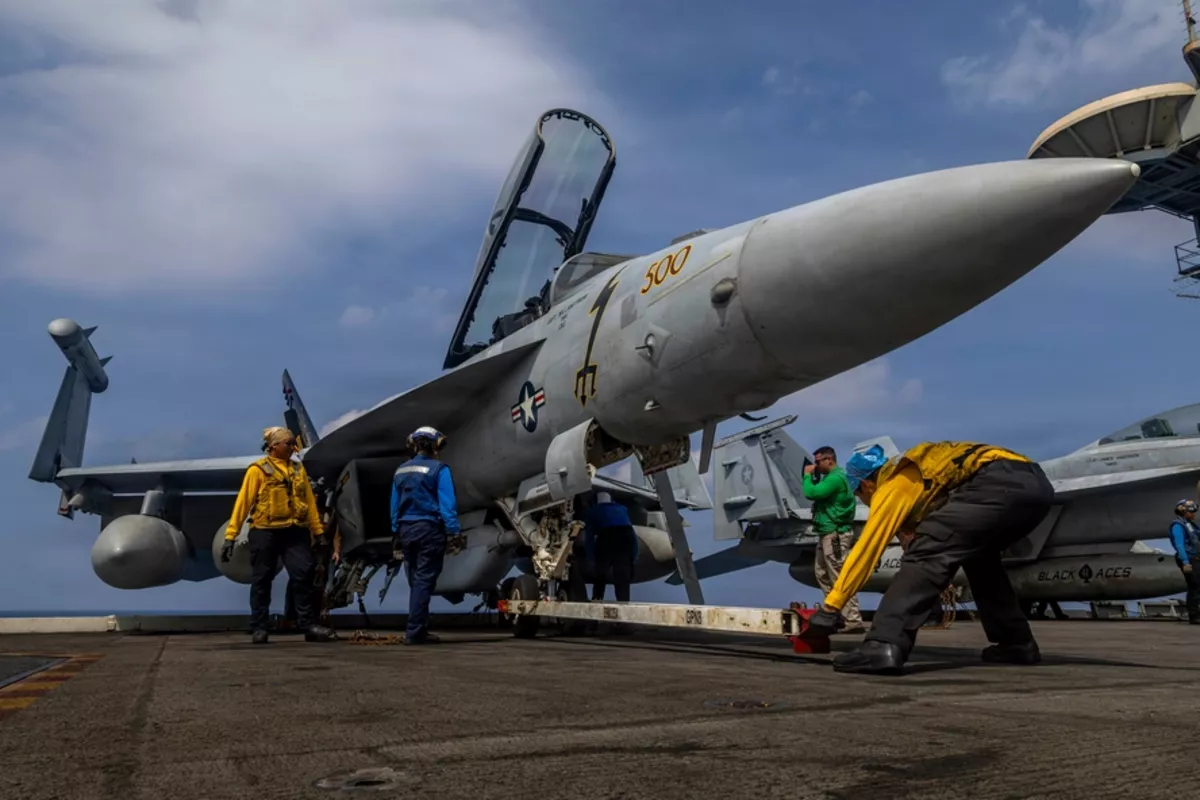
Even in calmer times, the U.S. has thousands of troops stationed at bases across the Middle East. Now, Trump has sent two aircraft carrier strike groups and dozens of fighter jets, surveillance aircraft and aerial refuelers to target Iran in the biggest accumulation of U.S. firepower in the region since the 2003 U.S. invasion of Iraq.
In recent weeks, Pentagon officials and Hill lawmakers have increasingly warned that prolonged Iran strikes could stress U.S. military stockpiles.
The U.S. intelligence community is “concerned and monitoring” potential asymmetric retaliation by Iran on U.S. facilities and personnel in the Middle East and Europe, per a senior U.S. intelligence official.
Trump has an array of options for how to hit Tehran. They include an initial, limited strike that could act as leverage to force the Islamist regime into a deal the U.S. can accept, according to a U.S. official familiar with the Iran discussions. If no deal is reached, Trump could order a larger set of strikes later, the official said.
The military options would almost certainly target Iranian nuclear sites - or the remnants that exist after U.S. strikes last June, the official said. Also sure to be hit is Iran’s ballistic missile infrastructure, which Israel views as a major threat to its safety.
In terms of damage to the regime itself, the official said a “decapitation strike” is an option, meaning targeting Iran’s elderly supreme leader, Ayatollah Ali Khamenei.
Iran’s governing system, however, consists of more than just one man, and it is designed to have people step into higher roles when those are vacated. That said, the U.S. could still aim for facilities and multiple layers of the government, including the top ranks of the powerful Islamic Revolutionary Guard Corps.
Such an operation could last days or weeks, and its results could be unpredictable, especially if the U.S. relies solely on airpower. Last June, during Israel’s war with Iran, which the U.S. joined, Netanyahu urged ordinary Iranians to seize the moment and overthrow their rulers.
Trump claimed that U.S. strikes last June had “obliterated” Iran’s nuclear program. But in recent weeks, Trump has suggested he’s not convinced Tehran has given up on having such a program.
House Armed Services Committee Chair Mike Rogers (R-Ala.), said he received a briefing from administration officials Wednesday morning providing details of Iran’s efforts to restart its nuclear program. He said the evidence is clear, and presents a compelling case that U.S. officials may need to intervene militarily.
“They are trying to get that equipment,” he said.
But Rogers could not say when the classified information may be shared more broadly. Rep. Don Bacon (R-Neb.) said he was told lawmakers will get additional details on the nuclear threats soon. Democrats on the committee said they have not been briefed or told when they may receive answers to their questions on Iran.
The Iranian government has long insisted that it is not seeking a nuclear weapon, but it also says it has a right to a peaceful nuclear program, including for scientific and medical purposes. The U.S. has long been skeptical of Iran’s promises, especially considering its levels of uranium enrichment.
An Iranian government official did not immediately respond to a request for comment.