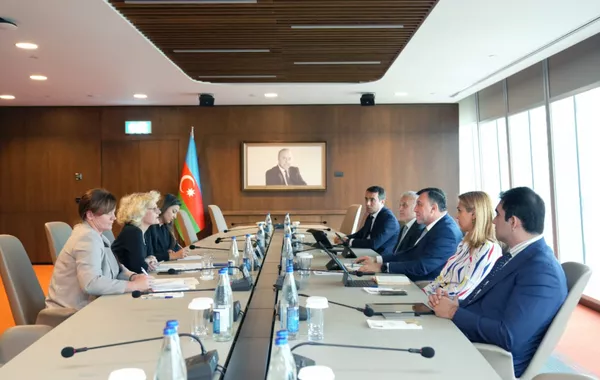
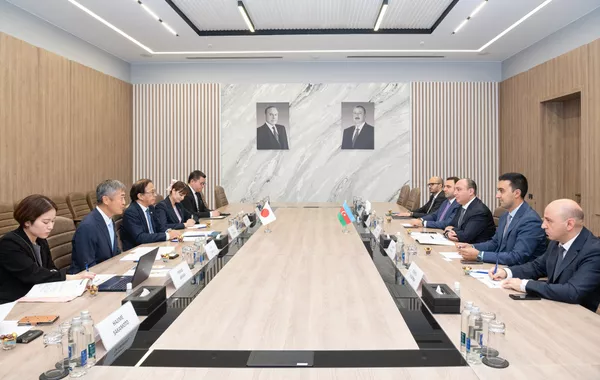
More than 250 German companies are currently operating in Azerbaijan, representing industries such as manufacturing, logistics, and construction.
Relations between Azerbaijan and Germany now extend well beyond the energy sector, with the two countries deepening cooperation in industry, logistics, and trade as Europe seeks to diversify supply chains and reduce its dependence on Russia, The Caspian Post reports via Euronews.
“Azerbaijan is gradually no longer viewed in Germany solely as an energy supplier. It is increasingly becoming an integral part of the emerging Eurasian industrial and logistics architecture,” said Orkhan Yolchuyev, Director of the CASPIA Analytical Center.
Yolchuyev said that bilateral trade between Azerbaijan and Germany reached approximately €1.7 billion in 2025, driven primarily by German exports of industrial equipment, machinery, and transport systems.
More than 250 German companies are currently operating in Azerbaijan across the manufacturing, construction, logistics, and energy sectors.
The partnership gained further momentum after Azerbaijan began direct natural gas supplies to Germany and Austria in early 2026, as part of Europe's broader effort to diversify energy sources and reduce dependence on Russian energy following Moscow's full-scale invasion of Ukraine.
Beyond Energy
Yolchuyev said that the real transformation is reflected not so much in the trade figures themselves as in what they represent.
“They demonstrate that bilateral relations are evolving toward a higher level of industrial cooperation,” he said, pointing to Germany's growing need for new export markets and more resilient supply chains.
German companies already operating in Azerbaijan could soon play a greater role in reconstruction projects and the expansion of the country's growing industrial zones, particularly in engineering, transport, renewable energy, and high-tech manufacturing.
Much of this transformation is being driven by the Middle Corridor-the strategic trade route linking China and Central Asia with Europe via the Caspian Sea, Azerbaijan, Georgia, and Türkiye.
Russia's war against Ukraine has significantly increased the corridor's importance, as European businesses seek alternative trade routes capable of making their supply chains more secure, resilient, and less vulnerable to geopolitical disruptions.
Azerbaijan sits at the strategic heart of the Middle Corridor, with its seaports and rail network playing an increasingly pivotal role in the transcontinental trade route linking Asia and Europe.
Yolchuyev noted that the corridor's true value lies not merely in the volume of cargo it handles, but in the nature of the goods being transported.
“The greater the share of high-value-added products-such as automotive components, industrial machinery, electrical equipment, electronics, and chemical products-the greater the corridor's economic efficiency,” he said.
Yolchuyev identified the ongoing expansion of the Port of Baku and the Alat Free Economic Zone as key drivers for attracting new investment in manufacturing, logistics, and export-oriented industries, further strengthening Azerbaijan's position as a regional industrial and transport hub.
Energy Remains the Foundation
Despite the broadening scope of cooperation, energy continues to be the cornerstone of Azerbaijan-Germany relations. Since early 2026, Azerbaijan has been supplying natural gas directly to Germany and Austria, reinforcing its role as a reliable energy partner for Europe.
Farid Shukurlu, a non-resident research fellow at the Institute for European and American Studies, said that Russia's full-scale invasion of Ukraine marked a turning point in bilateral economic relations.
“Traditionally, economic ties between Azerbaijan and Germany were concentrated in a relatively narrow range of sectors, including heavy engineering, the automotive industry, and pharmaceuticals,” he said.
“However, Russia's full-scale invasion of Ukraine fundamentally reshaped bilateral economic relations,” Shukurlu said.
Shukurlu said that within five months of Azerbaijan's first crude oil shipment to Germany, the country exported 360,300 tonnes of crude oil and petroleum products worth approximately $210.9 million (€196 million).
He believes Azerbaijan could eventually become a key transit hub for Kazakh oil and Turkmen gas destined for Germany and other European markets, further strengthening its strategic role in Europe's energy security.
Germany's shift is particularly significant given its former dependence on Russian gas. While Italy remains the largest European importer of Azerbaijani gas via the Trans Adriatic Pipeline (TAP), Germany is now moving in the same direction, reflecting Europe's broader strategy to diversify its energy supplies and reduce reliance on Russian imports.
Manfred Scherer, Mayor of the Sprendlingen-Gensingen municipality in Germany's Mainz-Bingen district, recalled meeting Parviz Shahbazov, Azerbaijan's current Minister of Energy, during his tenure as Azerbaijan's ambassador to Germany.
“Economic relations between Germany and Azerbaijan have developed positively in recent years. There is significant potential to further strengthen our cooperation,” Scherer said.
He added that he has fond memories of Shahbazov's visit to the municipality during his diplomatic posting in Germany.
“At the time, we discussed opportunities to deepen our ties through partnerships between our municipalities and to strengthen cooperation between our regions,” Scherer said.
A Broader European Shift
Germany's changing approach reflects a broader European pivot toward the South Caucasus and Central Asia, driven in part by support for the Armenia-Azerbaijan peace process, which could unlock new opportunities for energy diversification and regional connectivity.
High-level diplomatic engagement has accelerated in recent months. European Commission President Ursula von der Leyen has described the EU's partnership with Azerbaijan as "of great importance to the European Union" and said it has "real momentum."
European Council President António Costa visited Baku for talks on deepening EU engagement with Azerbaijan, while EU High Representative for Foreign Affairs and Security Policy Kaja Kallas traveled to the country in May.
Meanwhile, Italian Prime Minister Giorgia Meloni and Slovak President Peter Pellegrini have also held high-level meetings with President Ilham Aliyev, underscoring Azerbaijan's growing strategic importance in Europe's energy, transport, and connectivity agenda.