A Year of Peace in the Caucasus—and How to Keep It
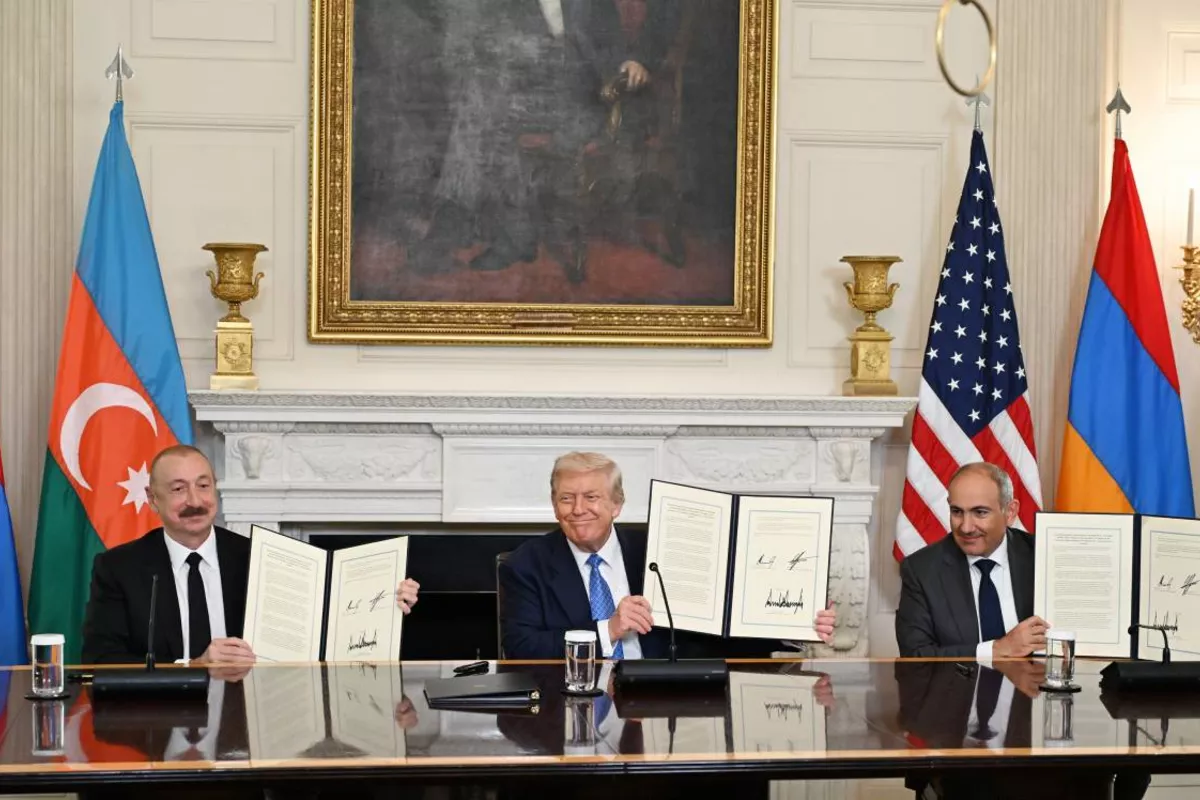
Last August, President Trump hosted Azerbaijani President Ilham Aliyev and Armenian Prime Minister Nikol Pashinyan at the White House to sign a historic peace declaration, which Mr. Trump signed as witness. The agreement includes the Trump Route for International Peace and Prosperity (TRIPP) corridor, a transportation route operated by American companies that will connect Azerbaijan to Türkiye via southern Armenia - and establish a U.S. commercial presence in a region bordering Russia and Iran.
A year later, that plan matters more than ever.
Mr. Trump’s continued personal engagement has helped the peace hold. But because Moscow and Tehran haven’t given up on disrupting it, Washington needs a plan to protect what it built.
The initial diplomatic breakthrough was the hard part in theory; sustaining it against two determined spoilers is the hard part in practice.
The South Caucasus sits at one of the world’s most consequential geopolitical junctions, where Russia, Iran and Türkiye meet. It is also a source of energy that bypasses maritime chokepoints like the Strait of Hormuz and the Red Sea. Reliable transit through the region gives Central Asian states an alternative to dependence on China and Russia.
A third of Iran’s population is ethnic Azerbaijani, so developments in the South Caucasus reverberate inside Iran’s domestic politics. And when Iran’s air routes closed during the recent war, the South Caucasus corridor became a critical east-west air artery.
Washington helped the South Caucasus and wider Caspian basin secure their independence in the 1990s, then largely disengaged for two decades. TRIPP marks America’s return to the region, and after just one year, the peace process has notched real gains.
The ceasefire has held, border-delimitation talks have advanced, contacts between Armenians and Azerbaijanis have multiplied, and trade has grown. Azerbaijan has supplied Armenia with large volumes of fuel below market prices even as global prices rose. Yerevan and Baku are discussing gas trade and linking their electricity grids, and construction linking to TRIPP is progressing.
None of this means Washington can declare victory. Russia and Iran may no longer have the resources to build up the region, but they retain the means to wreck it. Over a third of the members recently elected to Armenia’s parliament are aligned with Moscow, and Russian troops and bases remain on Armenian soil. Iran has struck Azerbaijani territory as part of a broader campaign against its neighbors. Identifying and countering these attempts at disruption should be an ongoing task for Washington, not a box already checked.
Four steps would help lock in TRIPP’s achievements.
First, a joint Armenian-Azerbaijani parliamentary delegation should travel to Washington to brief Congress on the peace process and enlist bipartisan support for sustaining it.
Second, the energy component of the deal should be expanded. The Strait of Hormuz crisis has been a reminder that diversifying the geography of energy supply is a matter of strategic necessity, not just economics. The peace creates an opening to increase development and export of Caspian oil and gas to world markets, offsetting supply that could be lost elsewhere. The White House should lead on this the way it did in the 1990s, when American diplomacy helped bring Caspian energy online for the first time. The Three Seas Initiative, which links Central and Eastern Europe on energy and infrastructure, should become a Four Seas Initiative that folds in the Caspian.
Third, Washington should hold Armenia to its commitment, made at the White House signing ceremony, to remove its constitutional clause calling for unification with Azerbaijan’s Karabakh region. Left in place, it can allow future Armenian governments to withdraw from its peace promise.
Fourth, and most fundamentally, the administration should fold the South Caucasus into its broader Iran, Russia, and China strategies rather than treat it as a self-contained regional file. It is not a remote or peripheral place; it sits astride the trajectories of America’s three principal strategic rivals.
The Armenia-Azerbaijan peace is a genuine foreign policy achievement that has already shifted the geopolitical standing of Russia, Iran, and China in the region. But peace processes are rarely self-sustaining, and this one sits in a neighborhood full of actors with an interest in seeing it fail. Having done the hard work of brokering this peace, Washington now has to do the less glamorous work of defending it.
Find the original article here