Photo credit: NASA
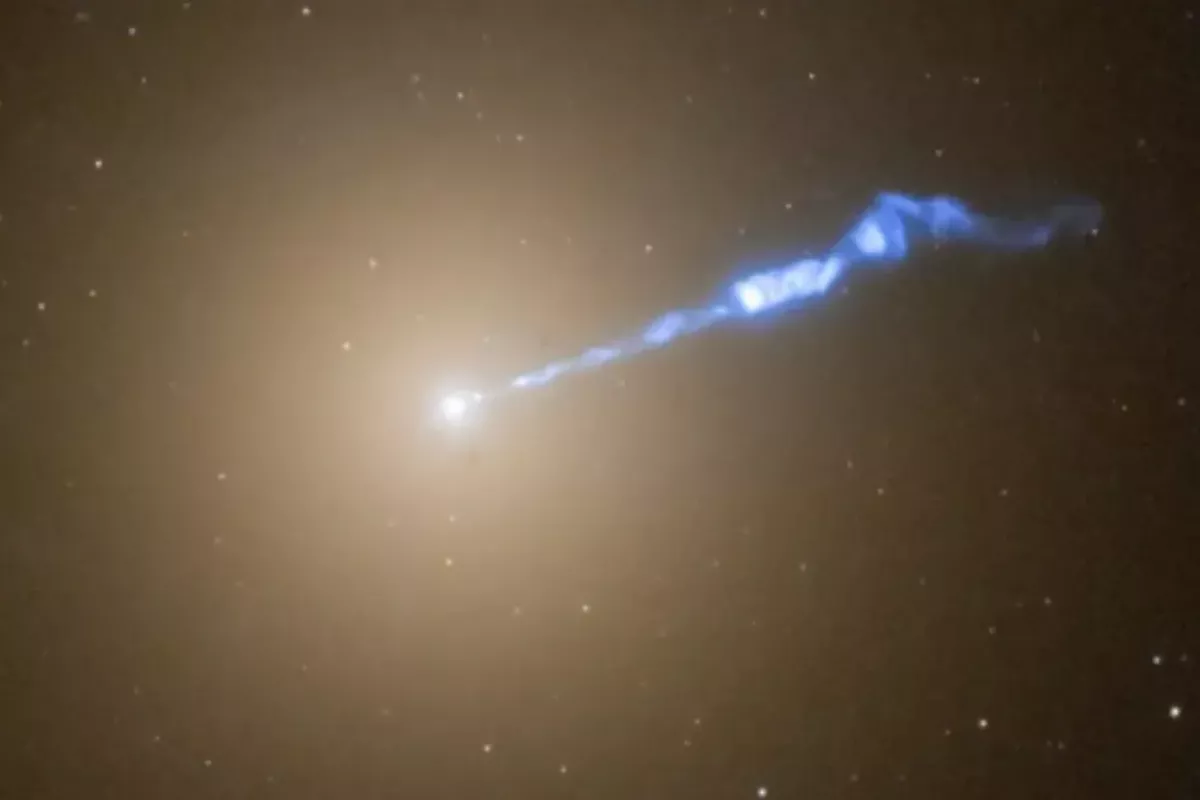
Astronomers have traced a 3,000-light-year-long cosmic jet to its origin using data from the Event Horizon Telescope (EHT), connecting it directly to the supermassive black hole M87-the first black hole ever captured in an image.
M87 lies at the center of the galaxy Messier 87, about 55 million light-years from Earth. The black hole, with a mass equivalent to around 6.5 billion suns, was first imaged by the EHT in 2017, with the historic image released publicly in April 2019, The Caspian Post reports, citing Space.com.
Unlike the supermassive black hole at the center of the MIlky Way, Sagittarius A*, which has a mass of about 4 million suns, M87 is highly active. It consumes surrounding gas and dust while launching enormous jets of charged particles from its poles at speeds approaching that of light. Despite years of study, the precise origin and driving mechanism of these jets have remained unclear.
To investigate further, researchers analyzed EHT observations of M87 collected in 2021 using Very Long Baseline Interferometry (VLBI), a technique capable of resolving extremely fine structures around black holes. These data allowed scientists to link the glowing ring of superheated matter-the black hole’s “shadow” seen in the 2019 image-directly to the base of the jet, identifying a likely launch point.
“This study represents an early step toward connecting theoretical ideas about jet launching with direct observations,” said team leader Saurabh from the Max Planck Institute for Radio Astronomy. He noted that pinpointing the jet’s origin near the black hole’s shadow adds a crucial piece to understanding how such extreme cosmic engines operate.
Modeling of the system suggested that radio emissions absent from EHT observations between 2017 and 2019, but present in the 2021 data, originate from a compact region less than one-tenth of a light-year from the black hole. This area appears to correspond to the base of the jet and aligns with structures seen in radio observations.
“We have observed the inner part of the jet of M87 with global VLBI experiments for many years,” said Hendrik Müller of the National Radio Astronomy Observatory. “It is remarkable to see how these observations across multiple frequencies are now coming together to complete the picture of where and how the jet is launched.”
Share on social media