In the context of the ongoing escalation around Iran, one trend is becoming increasingly clear: the scenario on which the initiators of the attack appear to have relied is showing signs of strain. Rather than a rapid collapse of the Iranian state, the world is witnessing a consolidation of society, a rise in resistance, and the emergence of new foreign policy dynamics, with China standing out in particular.
To understand why the current war is already extending far beyond the framework of a simple Iran-Israel confrontation, what the real objectives of its key actors are, and why Beijing could ultimately emerge as the main arbiter of the crisis, The Caspian Post spoke with Roland Laffitte, a French expert, independent researcher and essayist, president of the French Society of Arabic Linguistics and Etymological Research, and editor of the “Words of Islam” section at Orient XXI.
- Many expected that joint pressure from Israel and the United States would quickly force Iran to yield. However, we are now increasingly hearing the opposite assessment: that Iran is resisting far more firmly than anticipated. Why?
- It appears that one fundamental factor was not fully taken into account in these calculations: in the face of external aggression, a society often rallies around the state, even when there are serious internal grievances against the authorities, the regime or the political system. This is precisely what we are observing in Iran. What we are seeing is no longer just the Islamic Republic as an ideological construct, but the Iranian state as a historical, territorial and civilisational reality.
Source: Reuters
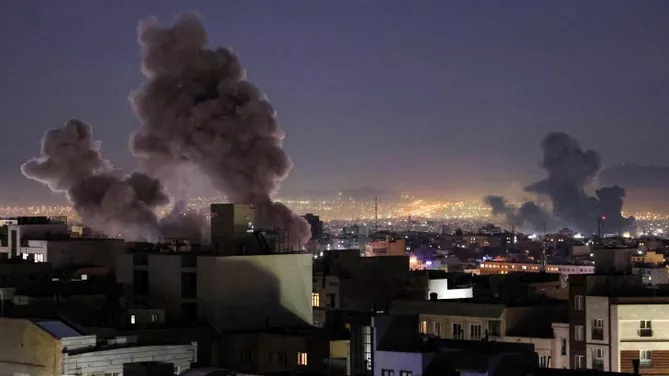
Even a significant portion of those who previously held a critical view of the country’s internal organisation are now, in the face of infrastructure destruction, civilian deaths, and attacks on basic living conditions, beginning to perceive what is happening not as an attack on the regime, but on the country itself. This is where patriotic mobilisation emerges. It is not born from sympathy toward any particular centre of power or symbol, but from a reaction to the destruction of roads, energy systems, vital networks, and the rising number of civilian casualties, which are no longer isolated tragedies, such as the death of schoolgirls in Minab.
- In other words, the strike that may have been intended to weaken Iran’s internal stability has produced the exact opposite effect?
- Exactly. External aggression often produces a kind of political alchemy that its initiators did not anticipate. When people see their country being systematically destroyed, a phenomenon of national cohesion emerges. People may criticise the authorities, reject certain practices, and be dissatisfied with the economic situation or repressive mechanisms; but when the country itself is targeted, an instinct to defend the common home is activated in collective consciousness.
This is why figures from the émigré or monarchist camp, including Reza Pahlavi, often appear disconnected from reality in such circumstances. Against the backdrop of bombings, civilian deaths, and infrastructure destruction, all externally imposed “alternatives” begin to be perceived not as political solutions, but as politically questionable accompaniments to a foreign war.
- You say the attack on Iran is joint, but at the same time dual in nature. How do the objectives of Israel and the United States differ?
- The attack on Iran is formally an allied operation, but the strategic horizons of the two sides differ. Israel appears to be acting according to its own long-term regional logic. Its goal is to deprive Iran of the ability to challenge Israeli hegemony in the Middle East. This is not about the rhetoric of an “existential threat,” which Israeli propaganda has framed for years in emotional associations with a new Holocaust. In practical terms, it is about eliminating a state that possesses political, military, and civilisational resistance potential to Israeli dominance in the region.
Source: CNN
If this logic is taken to its conclusion, the final scenario is not simply a change of policy in Tehran, but the weakening, or even dismantling, of Iran, following a model previously seen in certain Arab countries, fragmented into ethno-confessional segments and zones of chronic instability.
- And the United States? Are its objectives broader than Israel’s?
- Washington has at least two major motives. The first is support for Israel as the main regional outpost of American influence. In this context, one must also consider the desire to extend to Iran the logic of the so-called Abraham Accords, effectively integrating the region into an architecture where Israel becomes the recognised centre of a new political normality.
The second motive is far more global. It relates to energy and the struggle for control over resource flows on which Asia, and particularly China, depends. If the United States were to gain decisive control over Iran’s oil potential, this would significantly strengthen its ability to influence the global hydrocarbon market and, consequently, the largest Asian consumers. In this configuration, China emerges as a key player, increasingly perceived in Washington as the principal rival in the struggle for global leadership.
- In other words, can the war against Iran also be seen as an indirect strike against China?
- Yes, and that is precisely why what is happening cannot be analysed in purely regional terms. Iran is not just a Middle Eastern node. It is an important element of Eurasian logistics, energy, and the future architecture of the greater continent. For China, Iran is a significant resource supplier, a market, a transit territory, and a key component of the Belt and Road Initiative. Therefore, any attempt to place Iran under external control automatically introduces a Chinese dimension.
Source: CNN
The American logic here is clear: whoever controls the energy tap gains additional leverage over Asian economies. And if the primary target of this pressure is China, then the war itself acquires an anti-China dimension.
- If Iran continues to resist and the situation escalates, for example, in the Strait of Hormuz, how serious could the consequences be?
- The consequences could be dramatic. If Iran maintains its current pace of resistance and the crisis leads to a de facto blockade of Hormuz for the United States, Israel, and their allies, the oil market could explode. In such a scenario, a $200-per-barrel price would no longer be science fiction. The chain of effects would then unfold rapidly: inflationary pressure, rising costs, domestic discontent in importing countries, market volatility, and declining political stability among those who launched the campaign expecting a quick victory.
For the United States, this is particularly sensitive ahead of congressional elections. Donald Trump has also built his image on promises to end wars, not to become entangled in new ones. If anti-war sentiment grows within the United States itself, including among supporters of the MAGA movement, the White House could face an internal political crisis alongside the external one.
- And is this where China could truly step in?
- Yes, and it is already entering not as a distant observer, but as a power interested in ending the war and equipped with real instruments to do so. Today, China is Iran’s main economic partner in many sectors, including energy. It provides technologies, infrastructure solutions, and systems that enhance Iran’s resilience. Among them is often mentioned the BeiDou satellite navigation system, whose importance in modern military and logistical processes cannot be overstated.
But the most important point lies elsewhere: China also has a symmetrical set of levers vis-à-vis the United States. These include rare earths, financial instruments, and structural influence over global supply chains. Beijing is therefore, in theory, capable of speaking to both Tehran and Washington from a position of strength, without demonstrative aggression. This is precisely its uniqueness.
- Can we say that China is now almost the only power capable of proposing a compromise acceptable to both sides?
- Under current conditions, this no longer seems like an exotic hypothesis. On the contrary, it is one of the most realistic scenarios. Moreover, the groundwork for compromise formulas already existed. We recall diplomatic meetings in Oman, Geneva, and other channels where de-escalation options were explored at various times. We can also recall more recent attempts to reach an agreement, sabotaged precisely by the logic of military pressure.
Source: AI
In this situation, China can offer what others cannot: a form of exit in which Washington avoids a total loss of face, while Tehran obtains guarantees that this is not a capitulation but a political agreement. For the American side, the question of appearances matters almost as much as the material terms of the deal. Beijing understands this perfectly.
- Why China specifically, and not Europe or even Russia?
- Because Europe has effectively excluded itself from the circle of autonomous strategic actors. It comments on a moral level, expresses concern, issues statements, but no longer reaches the level of real influence. Russia retains certain weight, but it is too occupied with Ukraine. In this particular case, China appears far more naturally as a mediator, because it has both economic depth in its relations with Iran and systemic leverage over the United States.
Moreover, China is a civilisation that thinks in long historical cycles. It has already gone through its own “century of humiliation” and emerged with a radically different diplomatic temperament. For Beijing, it is extremely important to demonstrate that the new era does not imply a permanent American monopoly on force, but the possibility of resolving crises through balance, restraint, and calculation. If a crisis such as the Iranian one were to be resolved, even partially, through Chinese mediation, it would send a very powerful signal to the entire world.
- In other words, by engaging in confrontation with China, could the United States ultimately find itself unable to do without it?
Source: Reuters
- This is one of the most ironic reversals of the situation. If the logic of confrontation goes too far, Washington may have to turn to Beijing as the power capable of helping it out of a strategic deadlock. It would be a paradox: by seeking to weaken Chinese influence, the United States would itself contribute to strengthening it further. History often unfolds in such ways. Empires tend to stumble precisely where they were most confident in their omnipotence.
- How might these developments affect the position of Gulf Arab states and, more broadly, the countries of the Mashreq?
- Much will depend on the conclusions they draw from the current war. These conclusions could prove extremely uncomfortable for the United States and Israel. Gulf states have seen that American bases on their territory primarily serve Washington’s interests, not necessarily the security of the host states. This is an eye-opening experience.
Even more importantly, the Arab world sees the fate of Palestine, what is happening in Gaza and the West Bank, and the destruction of Lebanon. It is no longer just about confrontation with a specific force such as Hezbollah, but about the systematic destruction of a country itself-its urban fabric, historical spaces, and social and cultural environment. For many in the region, this appears as further evidence that the main destabilising factor in the Mashreq is Israel itself, rather than those long presented as sources of chaos.
- Could the Abraham Accords eventually be reconsidered?
- Yes, because normalization is not based on abstract declarations, but on a political sense of benefit and security. If Arab states begin to see that rapprochement with Israel does not reduce risks but instead draws the region into even more dangerous scenarios, a reassessment becomes inevitable. Especially if it becomes clear at the same time that traditional Western “protectors” are primarily ready to defend their own interests and their own infrastructure of influence.
In such a situation, regional countries could begin seeking counterbalances, whether in Russia, China, or new multilateral formats. From that point on, the balance in the Middle East would begin to shift in a far deeper way.