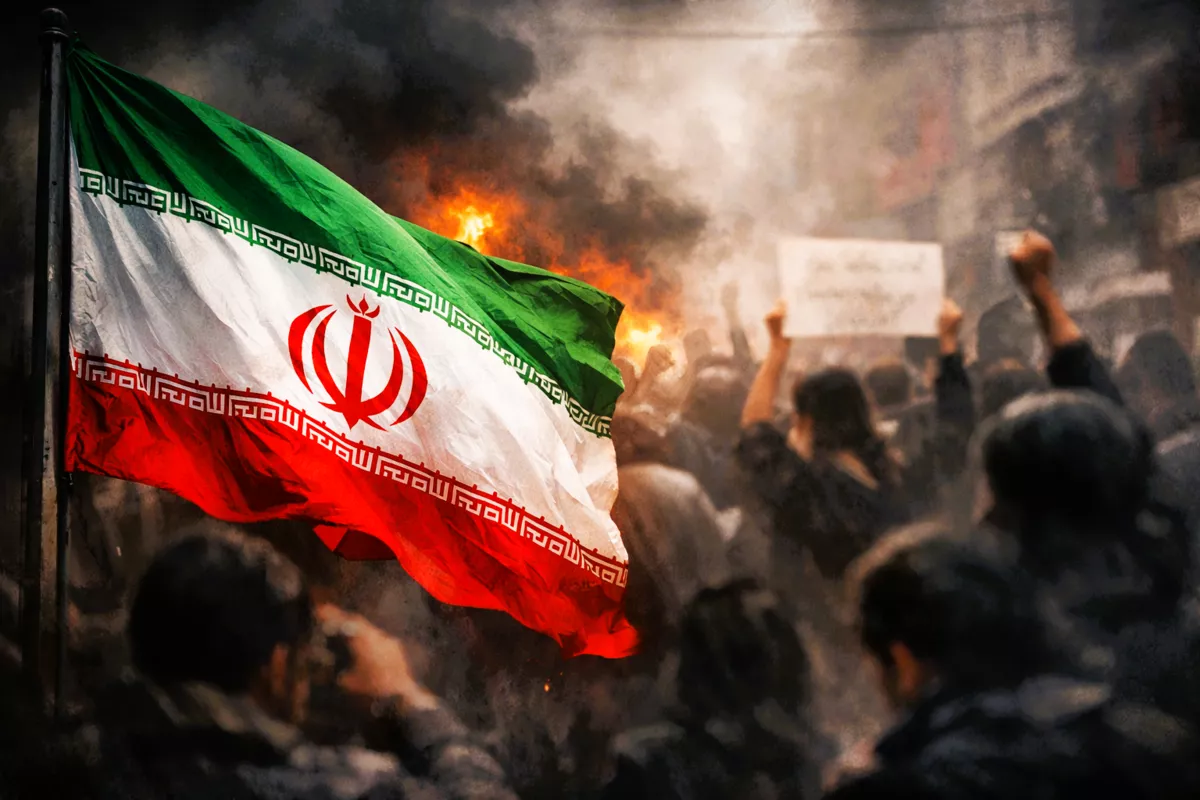
The protests in Iran have gradually diminished as the regime's crackdown has taken its toll. So, what has transpired in Iran over the past week, and what are the potential developments going forward?
Protests spread as blackout continues
It was reported on 10 January that the ongoing protests in Iran, which had begun 13 days earlier, were continuing as the death toll mounted and the internet blackout continued.
The following day reports emerged that protests had continued with fireworks being set off over Tehran’s Punak Square while demonstrators shouted slogans in support of the Pahlavi rulers ousted after the 1979 Islamic revolution and banged pots. It was also noted that there was an increasingly brutal response from the police and that some protestors had been coerced into making false confessions.
It was also reported that US president Donald Trump had been briefed on possible military options against the Iranian regime, as his government debated how to respond to Iran’s crackdown on the anti-government protests. Indeed Trump was said to have encouraged protestors and pledged that “help is on its way”. That help never came.
More threats to protestors
Trump did threaten Iran with military action if protesters were executed and this seemed to work at first, but by 15 January, Supreme leader Ayatollah Ali Khameini, was stating publicly that protestors were foreign saboteurs and ‘armed hypocrites’ who would be put to death.
A huge death toll
Alongside the threats from Khamenei, Amnesty International among many others reported an alarming rise in the number of protestors killed by the regime, since the protests began on 28 December. Due to the internet blackout, it was not clear exactly how many protestors had been murdered by the regime, but the number was thought to be well into the thousands and possibly as high as 20 000.
A permanent break from the internet
The story of Iran and its recent protests took another potentially sinister turn with the news that Iranian digital rights activists had stated that the Iranian regime was planning to break permanently from the global internet, by allowing only individuals vetted by the regime to connect online.
A report from Filterwatch, an organisation which monitors Iran’s internet censorship, and which cited a number of sources in Iran stated: “A confidential plan is under way to turn international internet access into a ‘governmental privilege’,”
“State media and government spokespersons have already signalled that this is a permanent shift, warning that unrestricted access will not return after 2026.” If this was to happen it could of course have potentially catastrophic effects if and when future anti-regime protests are being put down by the regime.
British Iranians protest
The threats from the regime have not cowed British-Iranians from showing their support for the protests as it was reported on 12 January that British-Iranians had said that they would continue to protest against the Iranian regime despite threats to their lives.
The Iranian expats told Metro that they had not heard from “relatives inside their homeland for weeks as the country’s clerical government brutally cracked down on protestors”.
It was also noted that thousands of people had joined protests on the streets of London over the weekend of 10 and 11 January, flags of the regime and images of Ayatollah Khamenei being burnt by protesters..
News also emerged that a number of high-profile British-Iranians including comedian Omid Djalili, who commented: “It’s time for us to speak up. The world needs to act. We are on the precipice of something seismic”.
Djalili, a long-standing critic of the regime, was joined by former Love Island star Anna Vakili and Iranian-born British comedian Shaparak Khorsandi, who both took to social media in support of the demonstrators.
Hopes for the future
Despite all the deaths and threats from the regime, there are British Iranians who are staying hopeful about Iran. It was reported on 11 January that hopes were high among many British activists that the regime of Khamenei was about to be toppled.
One of those speaking hopefully was the director of the Association of Anglo-Iranian Women in the UK, Laila Jazayeri, who commented: “A pluralistic, a secular, a non-nuclear Iranian republic, it is achievable. The people of Iran are fed up of monarchical and clerical dictatorship.
“This time it’s different because (the uprising) is well-organised. And we have a leadership, an alternative ready to take over. A woman is leading this resistance, Maryam Rajavi. She has a progressive 10-point plan for a free, democratic Iran.”
Where does Iran go from here?
Reports coming out of Iran in recent days seem to suggest that an uneasy calm has descended across the country. By the weekend of 17 and 18 January it was noted that the protests had subsided and there had been no signs of protests in Tehran for a number of days. However, it was also maintained that the protests could begin again.
The sheer scale of the repression used by the regime in Tehran was summed up by Arash Azizi, a supporter of an Iranian Republic, and author of What Iranians Want, which is available here, and who commented on the unprecedented scale of this repression: “The impact has been disastrous and numbing. We are still digesting it. We are talking about the most brutal actions by the Islamic Republic since the 1980s. The vast majority of Iranians do not remember anything like this. It’s now emerging that we almost all knew someone who was killed.”
Consequently, it is difficult to know exactly where the opposition in Iran go from here. Azizi went on to say that he hopes that “the moral authority of those inside Iran in prison such as Nobel prize winner Narges Mohammadi and Mostafa Tajzadeh will grow. The so-called Republicans will now have the ball thrown at us in a way. It’s our turn to organise a serious, credible alternative to the regime, something we have consistently so far failed to do.”
Thoughts have also turned to what countries like the UK could do, to help the Iranian opposition. Simon Tisdall, writing in the Guardian has suggested the following:
“Britain and its allies must do more to support Iran’s fractured opposition and identify future leaders. Western tech companies could provide ways for ordinary people to circumvent internet and information blackouts. Use of soft-power tools, such as Persian language broadcasts, should be expanded, rather than shortsightedly cut. All possible means must be employed to help strengthen Iranian civil society, independent media and the rule of law.”
So, in many ways Iran, like Myanmar and a number of other countries is on a cusp between darkness and light. There is still a great sense of fear in the country about what might happen next. But the flame of hope remains inextinguishable and with it the dream of an Iran where the dignity of all people is upheld and people can be free to fulfil their potentials.