Lukas Sieper: Europe must stop speaking to Azerbaijan with two voices - VIDEO
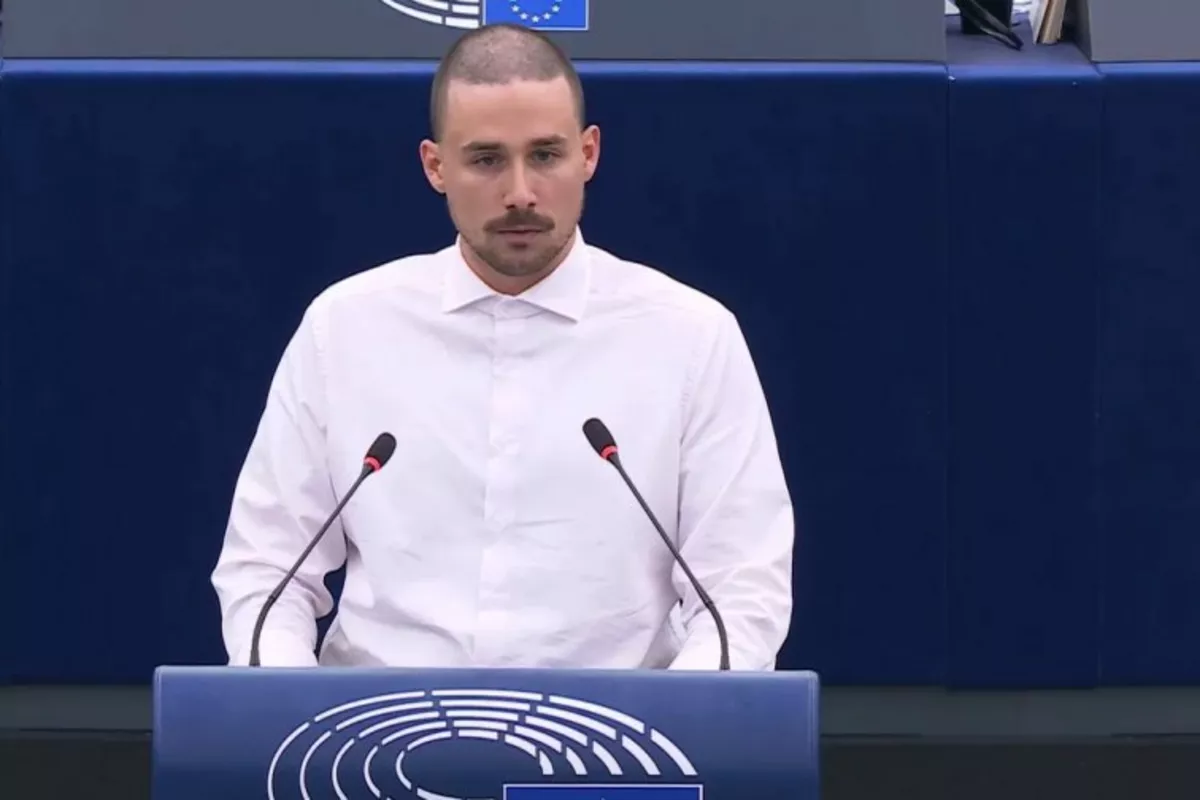
Lukas Sieper, a German Member of the European Parliament from the Renew Europe group and a member of the Committee on Legal Affairs and the Delegation to the Euronest Parliamentary Assembly, has said that the suspension of parliamentary relations between Europe and Azerbaijan should not be treated as a minor diplomatic episode. He described it as a warning for the European Union and a reflection of a much broader problem: Europe has been trying to conduct two foreign policies at the same time.
Speaking during a debate in the European Parliament, Sieper said the current crisis is “not only about Azerbaijan”, but also about the EU’s own strategic confusion, The Caspian Post reports, citing News.Az.
“The suspension of parliamentary relations between Europe and Azerbaijan is not a diplomatic footnote. It’s a warning for the Union,” he said.
According to him, the European Union has for years attempted to balance two different approaches. One comes from the European Commission and the Council - pragmatic, geopolitical and energy-focused. The other comes from the European Parliament - moral, value-based and often confrontational.
Sieper stressed that both approaches can at times be justified. However, when they operate without coordination, they create what he described as “strategic incoherence”.
He argued that Europe cannot simultaneously tell a country that it is an indispensable strategic partner while politically treating it as though it stands outside the community of acceptable states.
“We cannot simultaneously tell a country you are an indispensable strategic partner to Europe while politically communicating you are fundamentally outside the community of acceptable states,” Sieper said.
In his view, this contradiction weakens the EU’s credibility and explains why many countries are increasingly confused by Europe’s behaviour. Sieper said the problem is not that the world rejects Europe, but that it no longer understands which Europe it is dealing with.
“The world does not hate Europe. The world simply no longer knows which Europe it’s talking to,” he said.
The MEP also criticised the EU’s fragmented external image, saying that from the outside Europe sometimes looks less like a union and more like “27 nations sharing a press conference”. According to him, a geopolitical actor must be predictable, coherent and capable of speaking with strategic clarity.
He warned that the more fragmented Europe appears, the more influence it loses - economically, diplomatically and geopolitically.
At the same time, Sieper emphasised that strategic coherence should not mean abandoning European values. He stated that Europe must never remain silent on human rights, democracy or the rule of law.
“A stronger Europe must never become a silent Europe. We can never back down on human rights. We can never back down on democracy. We can never back down on the rule of law,” he said.
However, he argued that values without strategic coherence risk becoming performative, while strategy without values becomes cynical. Europe, he said, cannot afford either of these extremes.
Sieper concluded by recalling that Europe was built on the idea that cooperation is stronger than hatred, dialogue is stronger than violence, and dignity matters more than power. In his view, the EU can regain respect only if it manages to unite its values with strategic clarity.
“If Europe can unite its values with strategic clarity, then Europe will not only be respected again, Europe will be believed again,” he said.
Azerbaijan’s decision to suspend parliamentary relations with the European Parliament has once again exposed a deeper crisis in the European Union’s foreign policy. While some MEPs focused on criticising Baku, others argued that the real problem lies within the EU itself - in its inability to combine values, strategic clarity and geopolitical pragmatism.