Europe Must Not Let the Havel Prize Become a Tool of Political Laundering
In today’s world, at a time when real geopolitics is unfolding before our eyes, it is important to understand one very simple thing: Russian influence networks operate according to the principle of distorting mirrors. Falsehood is presented as absolute truth, while the truth itself is turned into a lie. This is a standard technique of hybrid warfare and one of its key instruments.
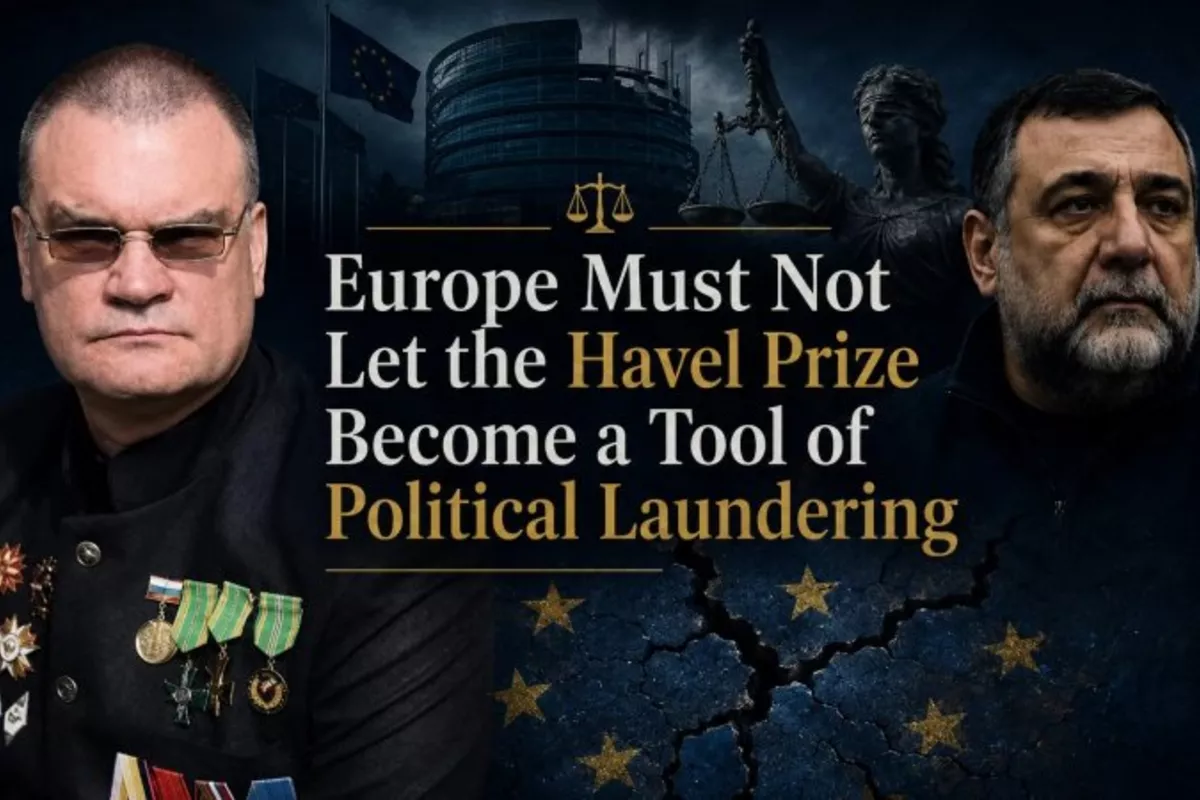
If we move from general observations to specific individuals and concrete facts, the attempt to present Ruben Vardanyan as a human rights defender and promote him as a candidate for the Václav Havel Human Rights Prize is, in my view, a clear illustration of this very mechanism, The Caspian Post reports via News.Az.
The consequences of such a step - even the nomination itself, not to mention a possible award - could be serious for Europe, for the European Union as a whole, and for the reputation of Western democracy. When individuals with a deeply questionable past are nominated for one of the most prestigious human rights awards in Europe, this inevitably raises fundamental questions about the moral standards of Western institutions.
In my opinion, nominating individuals with a serious criminal background - people who participated in supporting unrecognized entities and may have been involved in crimes against humanity - for a prestigious Western democratic prize named after Václav Havel means, first and foremost, discrediting Western democratic values. It undermines the very understanding of what is right and wrong in international politics.
Secondly, such a nomination damages the historical legacy of Václav Havel himself - a man whose name is associated with moral courage, resistance to authoritarianism and the defense of human dignity. Thirdly, it discredits the Václav Havel Prize as an institution, as well as all those who have previously received the award and whose reputations are linked to genuine human rights work.
This situation must be understood realistically. We are dealing with a multi-vector influence operation directed not only against one country or one political issue, but against Western society, European institutions and normal international relations more broadly. The issue is not simply one nomination. The issue is an attempt to reshape moral categories, to blur the line between victims and perpetrators, between genuine defenders of rights and those who should be held accountable.
To understand why this has become possible, we must look back at the history of Europe’s relations with Russia. In my view, responsibility also lies with a number of European leaders whose policies helped Russia transform into an authoritarian and aggressive state accustomed to resolving domestic political problems through external aggression. I am referring, first and foremost, to the period of Angela Merkel’s leadership, as well as to figures such as Gerhard Schröder and Silvio Berlusconi. This is not a complete list, but these are among the political figures whose approach, in my opinion, contributed to the situation Europe is facing today.
How far the legacy of the KGB, the Stasi, Russia’s Foreign Intelligence Service or the Fifth Service of the FSB extends within these processes is a question for historians and intelligence specialists. But what is already obvious is that the reputation of the European Union and its institutions is being placed at risk.
If, under the current circumstances, Ruben Vardanyan were actually awarded the Václav Havel Human Rights Prize, then, in my opinion, the award as an institution would suffer a blow from which it would be extremely difficult to recover. In that case, the Václav Havel Prize could simply be removed from the serious human rights agenda. The matter would effectively be closed - and closed forever.
It cannot be that, on one day, people who meet the highest moral, ethical and personal standards are honoured with such an award, while on another day individuals who, in principle, should face the harshest legal consequences are placed in the same category. This is my personal assessment based on the analysis I have conducted. As for court decisions, existing or future, that is a matter for the competent judicial authorities.
My position is clear: people who, for the gravest criminal offences, should in fact face life imprisonment are not nominated for human rights prizes. A human rights award cannot become a tool for political laundering. It cannot be used to transform a controversial figure into a symbol of moral resistance simply because such a narrative serves someone’s geopolitical interests.
This is not the only situation in which Europe has found itself in an ambiguous position, to put it mildly. It is not the first such case, and it will likely not be the last. Today, hybrid warfare is underway, and what we are observing here is one of its elements.
The nomination of Ruben Vardanyan for the Václav Havel Prize should therefore not be treated as a routine human rights matter. It should be viewed as a test of Europe’s ability to defend its own moral criteria. If Europe loses the ability to distinguish between genuine human rights defenders and figures whose past raises the most serious questions, then the damage will go far beyond one award, one nomination or one individual. It will strike at the very credibility of Europe’s democratic values.