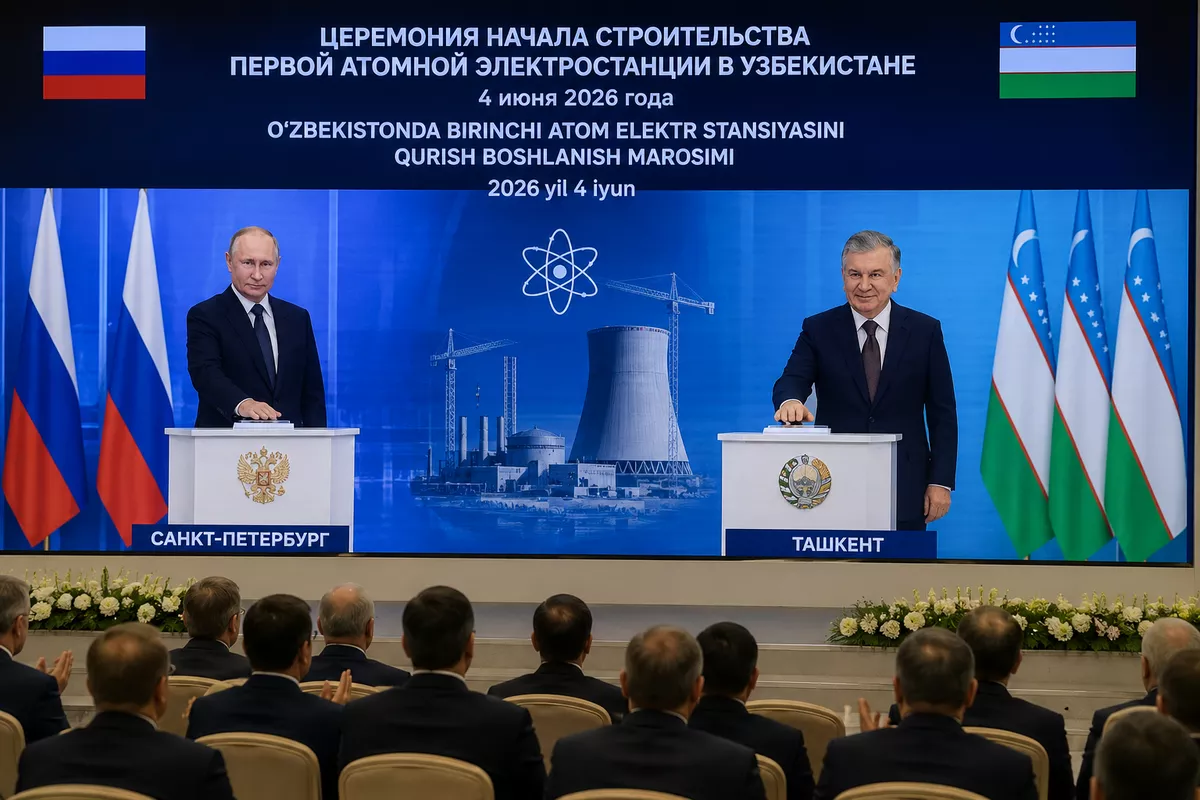
The 4th of June 2026 may go down in history not only for Uzbekistan, but for Central Asia as a whole. On that day, Russian President Vladimir Putin and Uzbek President Shavkat Mirziyoyev officially launched the construction of the first nuclear power plant in the republic’s history. Symbolically, the ceremony was held via video link during the Uzbek leader’s visit to St Petersburg. However, the significance of the event extends far beyond bilateral cooperation between Moscow and Tashkent.
The project is capable of transforming the energy balance of Central Asia’s most populous country, providing fresh impetus to the region’s industrial development and opening the way for Uzbekistan to join the group of states with a fully developed nuclear energy sector.
Shavkat Mirziyoyev described the start of construction of the nuclear power plant as a historic day. This assessment is far from accidental.
The event followed decades of discussions and uncertainty. The possibility of building a nuclear power plant in the Uzbek Soviet Socialist Republic was considered as far back as the Soviet era. However, the region’s high seismic activity and the technological limitations of the time made it impossible to guarantee the necessary level of safety. Today, the situation is fundamentally different. Modern Generation III+ reactors are designed in line with the strictest safety standards and are capable of withstanding impacts that only a few decades ago were considered critical risks for nuclear facilities.
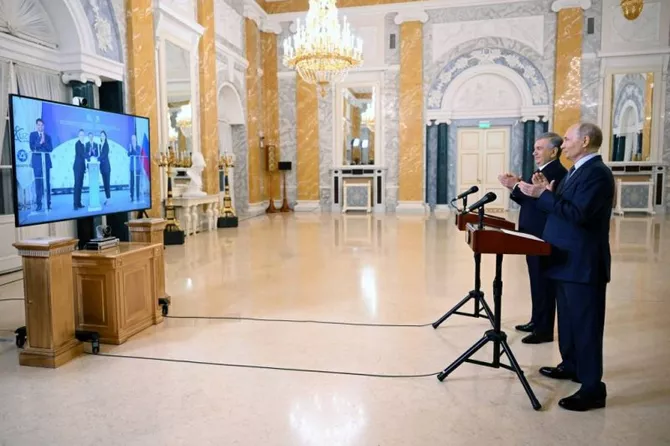
Source: Press Service of Uzbekistan's President
Tashkent’s decision to embrace nuclear energy is understandable. The country’s economy is growing rapidly, requiring a corresponding expansion of its energy capacity. Uzbekistan is currently the most populous country in Central Asia, with a population exceeding 38 million. Its industrial sector, transport system, digital economy and housing construction all require steadily increasing volumes of electricity, which the country currently cannot fully meet.
By 2030, Uzbekistan plans to increase the installed capacity of its energy system to 51,600 megawatts. This would represent more than a twofold increase within six years. Such expansion cannot be achieved solely through conventional power generation, Uzbek media report, citing local experts.
Following global trends, Uzbekistan is actively developing solar and wind power. However, renewable energy sources have significant limitations.
Once the nuclear power plant reaches its designed capacity, it is expected to generate approximately 17 billion kilowatt-hours of electricity annually and meet up to 15% of the country’s energy needs. For Uzbekistan, this would mean not only greater energy security, but also an opportunity to redirect significant volumes of natural gas towards exports or use them as feedstock for the chemical industry.
Another factor behind Uzbekistan’s shift towards nuclear power is its position among the world’s leading countries in terms of uranium resources. The country ranks fifth globally in uranium production and tenth in uranium reserves. This creates a certain paradox: a major uranium producer that has not previously used nuclear energy domestically.
For many years, Uzbekistan exported this strategic raw material while playing virtually no role in producing the final high-technology product. That situation is now changing. Uzbekistan will now be not only a supplier of raw materials, but also a producer of nuclear energy. This is expected to significantly enhance the country’s technological standing and investment attractiveness.
According to TASS, Russia and Uzbekistan signed an intergovernmental agreement on cooperation in the peaceful use of nuclear energy on 29 December 2017. The document, signed in Tashkent by Rosatom Director General Alexey Likhachev and Uzbekistan’s then Deputy Prime Minister Nodir Otajonov, envisaged cooperation in several areas, including the construction of a nuclear power plant in the country and the development of uranium deposits.
On 7 September 2018 in Moscow, Dmitry Medvedev, then Russia’s Prime Minister, and Uzbek Prime Minister Abdulla Aripov signed an intergovernmental agreement on cooperation in the construction of a large-scale nuclear power plant in Uzbekistan based on a Russian design. Under the agreement, Rosatom planned to build a nuclear power plant consisting of two Generation III+ units equipped with VVER-1200 reactors.
In the early 2020s, it was decided that, alongside the large-scale nuclear power plant project, Uzbekistan would also build a small modular nuclear power plant. On 27 May 2024, during Vladimir Putin’s state visit to Uzbekistan, amendments were introduced to the intergovernmental agreement on the large-scale project, allowing for the possible construction of a small modular plant. The corresponding contract was signed the same day.
On 15 April 2025, construction of the first industrial facilities for the project’s construction and installation base began in Uzbekistan’s Jizzakh Region as part of the small modular nuclear power plant project. On 13 May 2025, Rosatom began manufacturing reactor equipment for the first unit. However, in June 2025, Russia’s Ministry of Economic Development announced that the presidents of Russia and Uzbekistan had agreed to reconfigure the project. The revised plan envisaged the construction of a two-unit large-capacity nuclear power plant and a two-unit small modular plant in the Farish district of Jizzakh Region.
On 24 March 2026, Russia’s state nuclear corporation Rosatom and Uzatom signed an addendum to the contract establishing a new integrated configuration for Uzbekistan’s nuclear power programme. The project will include two large-capacity power units based on Generation III+ VVER-1000 pressurised water reactors, each with an electrical capacity of 1,000 megawatts, as well as two RITM-200N pressurised water reactors with a capacity of 55 megawatts each.
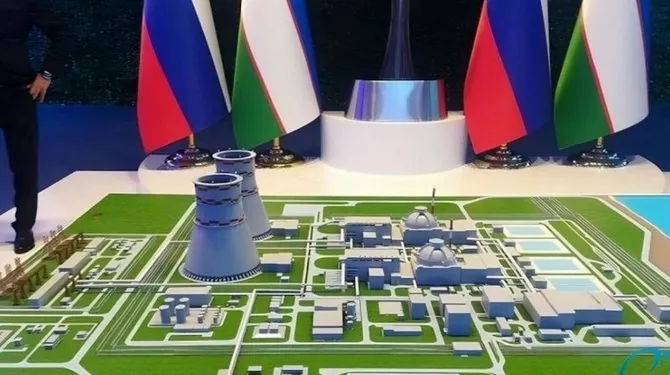
Source: Kun.uz
On the same day, concrete work began at the construction site in the Farish district of Jizzakh Region for a small modular nuclear power unit equipped with an RITM-200N reactor. A new town designed for 10,000 residents will also be built for plant personnel and their families.
Speaking at the launch ceremony, Putin said the project has no direct equivalent anywhere in the world. The Uzbek outlet Daryo.uz quoted him as saying: “It is important that Russia will not only build the nuclear power plant, but will also provide its Uzbek partners with a preferential export loan and support the facility throughout its entire life cycle. This includes commitments to the long-term supply of reactor fuel, servicing and maintenance, and the management of spent nuclear material.”
Putin assured that all safety standards would be fully observed and said approximately 15,000 people would be involved in the construction process.
A nuclear power plant is not only about energy; it is also about geopolitics. Joining the group of countries operating nuclear power facilities will raise Uzbekistan’s international standing.
According to the Kremlin press service, the International Atomic Energy Agency will support the implementation of Uzbekistan’s integrated nuclear power project at every stage. IAEA Director General Rafael Grossi made the statement during the ceremony marking the start of construction of the first power unit.
“You have both described this project as unique, and it does indeed have unique characteristics,” Grossi said.