Turkish Navy Showcases Enhanced Capabilities in Baltic at NATO's Steadfast Dart 2026
Iranian Navy Commander Rear Admiral Shahram Irani held separate meetings with senior naval commanders from Russia, Saudi Arabia, and Myanmar during the MILAN 2026 international naval exercise in India.
The Turkish Navy deployment to the Baltic Sea marks a significant milestone in both Türkiye’s NATO contributions and the operational employment of Bayraktar TB3 carrier-based combat drones, The Caspian Post reports, citing foreign media.
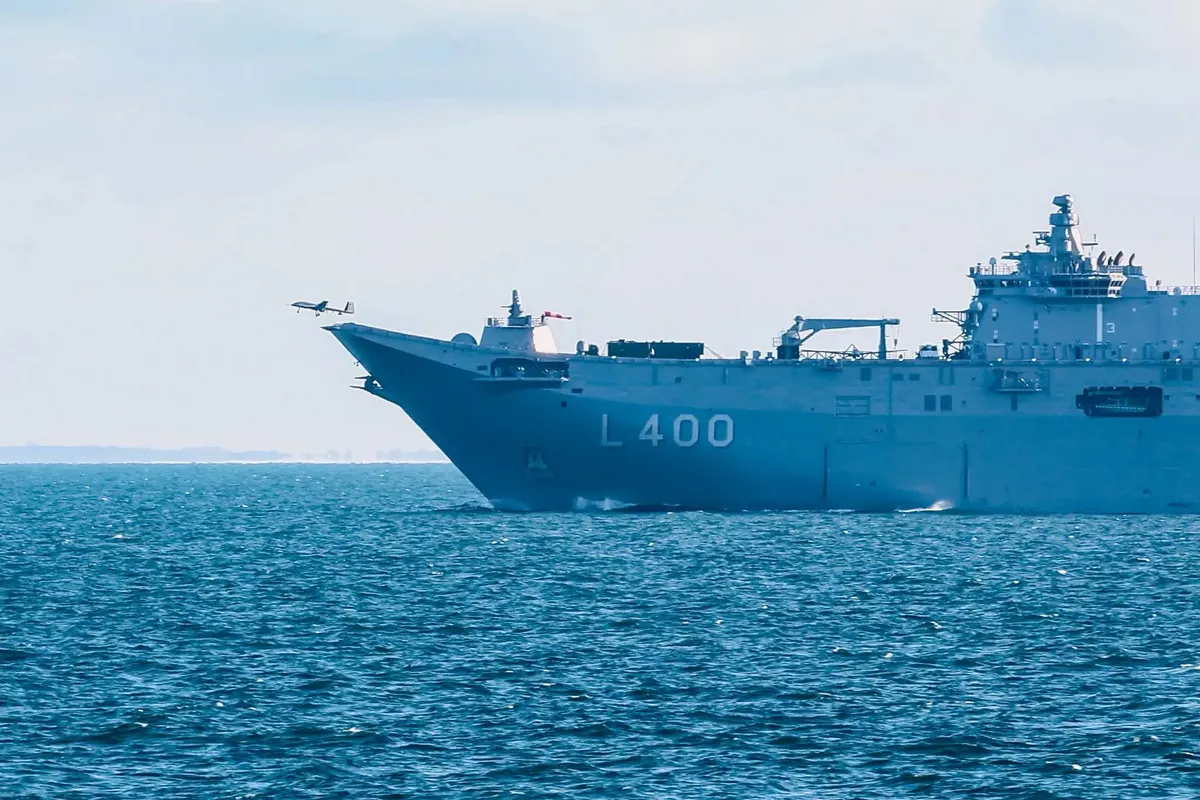
The Turkish Navy has deployed one of its most capable task groups to the Baltic Sea for NATO’s Steadfast Dart 2026 exercise, conducting the first operational use of armed drones from a flat-deck ship in Alliance history. The deployment represents Türkiye’s largest naval presence in the Baltic region and demonstrates the fleet’s ability to project power across approximately 8,000 kilometers from its homeland.
Steadfast Dart 2026, running from January 2 to March 18, is NATO’s premier joint deployment exercise for 2026. Hosted by Germany under NATO’s Joint Force Command Brunssum, the exercise involves approximately 10,000 personnel from 11 member states. It is designed to validate the newly established Allied Reaction Force’s (ARF) rapid reinforcement capabilities across land, sea, air, space, and cyber domains. Notably, no U.S. forces participated in this iteration, a development some observers interpret as testing NATO’s operational capacity independent of American conventional support amid shifting transatlantic security dynamics.
The Anadolu Task Group
The Turkish contribution centers on the Anadolu Task Group, comprising four surface combatants representing the breadth of the country’s naval modernization efforts.
TCG Anadolu, the 27,000-ton, 232-meter amphibious assault ship, serves as the formation’s flagship and command-and-control hub. The vessel features a full-length flight deck with a ski-jump ramp, a well deck for landing craft, vehicle storage for armored units, and extensive command facilities supported by the GENESIS-ADVENT combat management system. With is combat drone operation capabilities, it is called the first drone-carrier vessel worldwide.
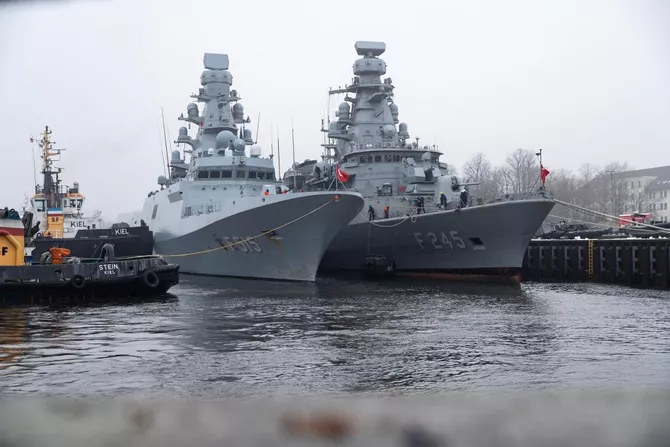
Turkish Navy’s newest I-class frigate TCG Istanbul (F515) and newly modernized Meko-200TN frigate TCG Oruçreis berthed in Kiel before the exercise (Unknown source image circulating on social media) TCG İstanbul (F-515), commissioned in January 2024, is the lead ship of the I-class frigates-the first indigenous frigate designed and built entirely by Turkish industry under the MILGEM program. The 3,100-ton warship achieved an 80 percent indigenousness rate across its systems, including the ADVENT combat management system, CENK-S AESA radar, Atmaca anti-ship missiles, and the MiDLAS vertical launching system. Over 220 Turkish companies contributed to its construction.
TCG Oruçreis (F-245) completed the world’s most comprehensive MEKO-class frigate mid-life upgrade in April 2025. The modernization replaced 21 systems aboard the Barbaros-class frigate, including installation of a new stealth mast structure, as well as ASELSAN’s FERSAH sonar, AKREP fire control radars, and the GÖKDENIZ close-in weapon system. The upgrade effectively transformed the 1990s-era platform into a contemporary surface combatant with capabilities approaching those of new-build frigates.
TCG Derya, the Turkish Navy’s first fleet oiler with gas turbine propulsion, provides logistics support enabling sustained operations far from home ports. Her high-speed capability allows her to keep pace with the combatants rather than constraining task group mobility.
The embarked force includes an amphibious marine infantry battalion, “ZAHA” amphibious armored assault vehicles, naval special warfare elements (SAT and SAS teams), helicopters, and three “Bayraktar TB3” unmanned combat aerial vehicles.
Combat Drone Operations: A New Chapter for NATO Naval Aviation
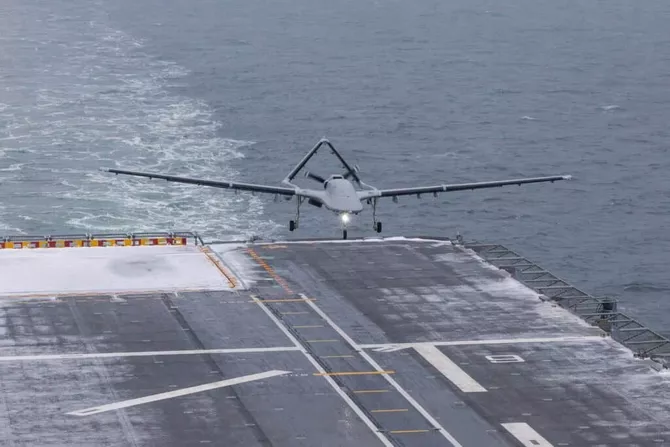
TB3 UCAV landing to TCG Anadolu under heavy weather and low temprature conditions (Turkish MoD picture) The deployment’s most significant aspect is the operational employment of armed drones from TCG Anadolu during a NATO exercise. On February 14, a Bayraktar TB3 launched from the ship’s ski-jump deck, located and engaged a designated surface target with Roketsan MAM-L precision-guided munitions, and recovered aboard-completing the first full ship-to-target combat cycle for a carrier-based drone in NATO history.
The TB3 is purpose-built for operations from short-deck ships. Its folding wings, reinforced landing gear, and low stall speed enable launch and recovery without catapults or arresting wires. Powered by a domestically developed TEI-PD200 turbodiesel engine, the aircraft offers over 24 hours of endurance and can carry up to 280 kilograms of ordnance across six hardpoints. According to Baykar, TB3 drones carried out 232 sorties from TCG Anadolu throughout the exercise, and all takeoffs and landings were conducted autonomously. Baykar also showed its virtual corridor technology in the video below, which allows the drone to land on the deck of the carrier in all weather conditions. The drones conducted operations in -6 celcius degrees temperature weather conditions, which is out of the limitations of numerous air assets.
The TB3 combat drones also carried out live firings with Roketsan-made MAM-L smart munitions and hit the target with pinpoint accuracy. These firings were recorded as a first in NATO history, as a shipborne drone strikes a target within an exercise scenario.
Dr. Lee Willett, naval expert and regular Naval News contributor, noted the broader implications for the Alliance:
“The key capability uncrewed systems bring for NATO at the moment is mass-especially for sensing. Navies across NATO are starting to see all surface ships of any type, and especially new classes, as drone carriers. For NATO, any platform that can bring uncrewed systems to the fight quickly adds operational advantage.”
Three TB3s are embarked on TCG Anadolu for Steadfast Dart, conducting intelligence, surveillance, and reconnaissance missions alongside strike operations. The employment of armed drones in an amphibious landing context-using UCAVs to soften coastal defenses before troop landings-represents a doctrinal first for the Alliance.
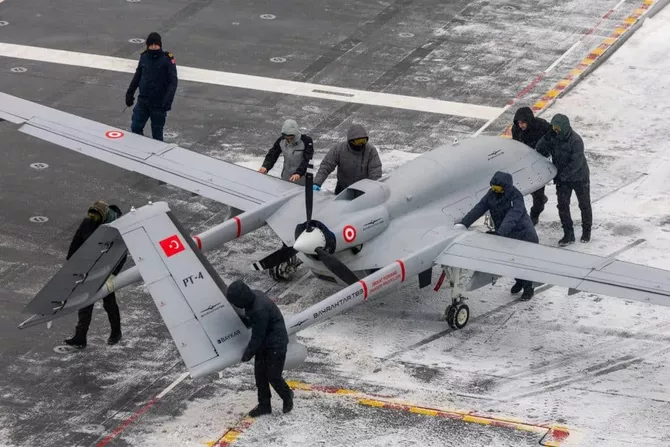
Crew of TCG Anadolu and Baykar Tech preparing TB3 drone for operations on the icy deck (Turkish MoD picture) Turkish Naval Forces Commander Admiral Ercüment Tatlıoğlu characterized the development as establishing “a new doctrine for amphibious operations within the Alliance.”