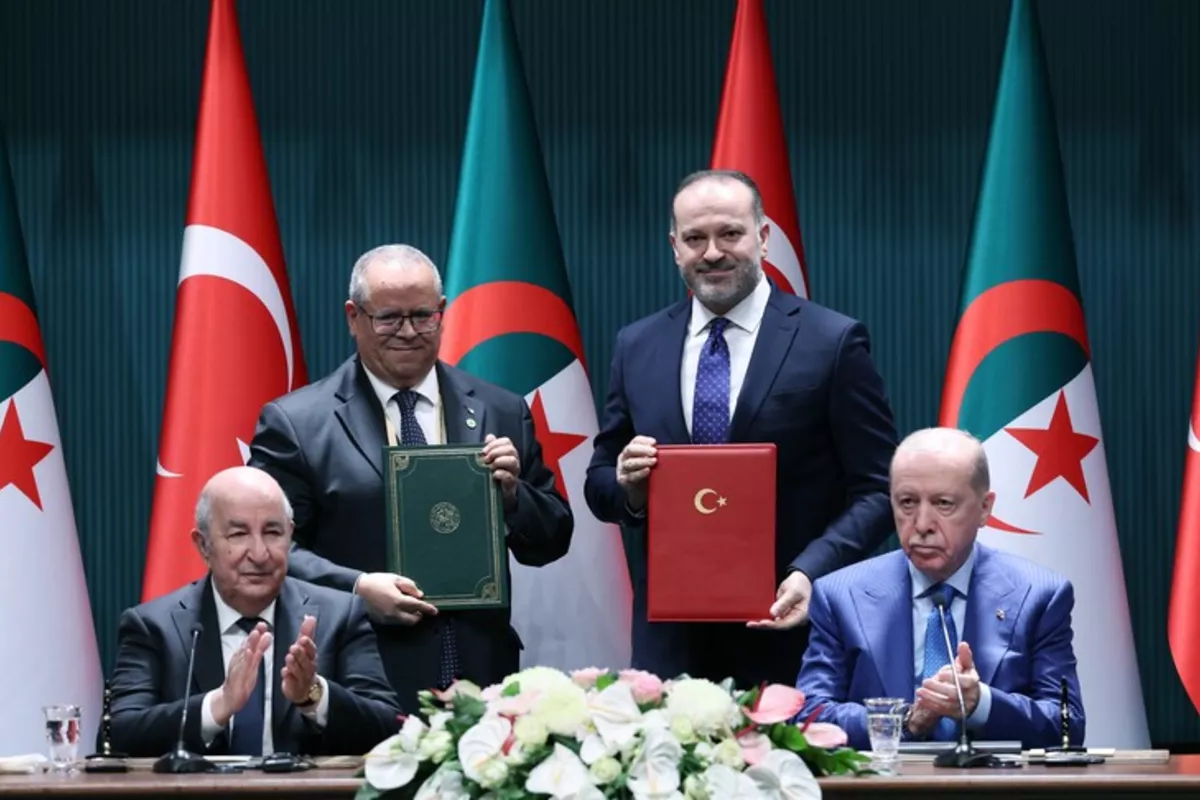
The latest round of high-level agreements between Türkiye and Algeria marks a clear acceleration in bilateral relations, moving beyond traditional diplomacy toward a structured, multi-sector strategic partnership. With 14 new agreements signed in Ankara under the supervision of President Recep Tayyip Erdogan and President Abdelmadjid Tebboune, both countries are signaling a long-term intention to institutionalize cooperation across trade, infrastructure, governance, and information space. The scope and diversity of the deals reflect not only political alignment but also a shared ambition to build a resilient interregional partnership linking the Mediterranean, Africa, and Eurasia.
What makes this development particularly notable is the breadth of cooperation mechanisms now being activated simultaneously. Rather than isolated sectoral agreements, Türkiye and Algeria are constructing an integrated framework that includes economic integration, administrative coordination, and soft-power collaboration. The establishment of the High-Level Strategic Cooperation Council and its first meeting-overseen directly by both presidents-further institutionalizes this relationship at the highest political level.
From Political Alignment to Structured Strategic Cooperation
The signing of the joint declaration of the High-Level Strategic Cooperation Council represents a turning point in Türkiye-Algeria relations. While both countries have maintained historically friendly ties, especially within the context of shared post-colonial experiences and independent foreign policy orientations, the current phase shows a shift toward formalized strategic coordination.
The presence of both heads of state at the signing ceremony underscores the political weight attached to this partnership. It also reflects a mutual recognition that bilateral relations are no longer limited to diplomatic symbolism but are evolving into operational cooperation across ministries and agencies.
Key agreements in this phase include cooperation in postal services, telecommunications, transport logistics, and disaster management. These areas are not incidental; they form the backbone of modern state connectivity. International passenger and freight transport agreements, for instance, are directly linked to trade facilitation and supply chain integration. Similarly, disaster and emergency management cooperation reflects an effort to coordinate responses to climate-related risks and natural disasters, which are increasingly relevant across the Mediterranean basin.
Another important dimension is the agreement on mutual recognition and exchange of driver’s licenses. While seemingly technical, such arrangements significantly ease mobility for citizens and business communities, reinforcing human connectivity alongside economic integration.
Economic Integration and Industrial Expansion as Core Drivers
At the center of the expanding Türkiye-Algeria partnership is a strong economic agenda. The declaration initiating negotiations for a preferential trade agreement signals a potential structural shift in bilateral commerce. If realized, such an agreement could reduce trade barriers, expand market access, and increase investment flows between the two countries.
This economic direction is reinforced by agreements in industrial cooperation, standardization, and investment promotion. Türkiye’s Industry and Technology Ministry and Algeria’s industrial authorities have committed to collaboration in areas such as conformity assessment and training. These are foundational elements for aligning industrial standards, which is often a prerequisite for deeper manufacturing and technology integration.
Agriculture and food security also feature prominently. The agreement on plant protection and quarantine cooperation indicates an effort to facilitate agricultural trade while managing biosecurity risks. For Algeria, which is working to diversify its economy and strengthen food security, Türkiye’s experience in agricultural technology and agribusiness development is particularly relevant.
Investment promotion cooperation between the Turkish Investment and Finance Office and Algeria’s Investment Promotion Agency further highlights a shared strategy to attract capital and encourage joint ventures. This reflects a broader trend in Türkiye’s foreign economic policy, which increasingly emphasizes coordinated investment diplomacy in Africa and the Mediterranean.
Expanding Soft Power: Media, Social Policy, and Mobility
Beyond economics and infrastructure, Türkiye and Algeria are also strengthening cooperation in soft power domains, particularly media, social policy, and public communication. The agreement on combating disinformation reflects growing awareness in both countries of the geopolitical importance of information integrity. In an era of rapid digital communication, disinformation is increasingly seen as a national security and governance challenge.
Cooperation between Turkish public broadcaster TRT and Algeria’s public broadcasting organization EPRS further illustrates this soft-power dimension. Joint media production and content exchange can significantly influence public perception, cultural familiarity, and mutual understanding between societies. This media collaboration also supports broader diplomatic narratives by projecting shared values and strategic alignment.
Social policy cooperation is another emerging pillar. The memorandum on welfare support for independence veterans and families of martyrs carries symbolic and political significance, particularly for Algeria, where the legacy of the independence struggle remains central to national identity. Türkiye’s involvement in such a sensitive area indicates a willingness to engage not only in economic diplomacy but also in socially meaningful and historically resonant cooperation.
Transport-related agreements, including international passenger and goods transportation, also contribute to soft connectivity. Combined with visa facilitation tools such as driver’s license recognition, these measures gradually reduce friction in human mobility, which is essential for tourism, business travel, and diaspora engagement.
A Strategic Axis in the Mediterranean and Beyond
Taken together, the 14 agreements reflect the gradual formation of a comprehensive Türkiye-Algeria strategic axis that spans multiple regions and policy domains. This partnership is not limited to bilateral interests but is increasingly shaped by broader geopolitical considerations, including energy security, Mediterranean stability, African economic integration, and global trade realignment.
For Türkiye, Algeria represents a key partner in North Africa with significant energy resources, market potential, and regional influence. Strengthening ties with Algeria supports Türkiye’s broader Africa strategy and enhances its presence in Mediterranean geopolitics.
For Algeria, Türkiye offers a model of industrial development, infrastructure investment, and diversified foreign partnerships. It also provides access to broader markets in Eurasia and a channel for technological and industrial cooperation that aligns with Algeria’s economic diversification agenda.
The structured nature of the agreements suggests that both countries are moving toward a long-term institutional relationship rather than episodic cooperation. If effectively implemented, the current framework could evolve into one of the most comprehensive bilateral partnerships in the region, integrating economic, political, and social dimensions.
In conclusion, the latest agreements between Türkiye and Algeria mark more than diplomatic goodwill-they represent a deliberate effort to construct a durable and multidimensional strategic partnership. As implementation begins across sectors, the success of this cooperation will depend on sustained political commitment, effective institutional coordination, and the ability to translate agreements into tangible economic and social outcomes.