Al-Burhan in Ankara: How Sudan is overcoming the regional siege
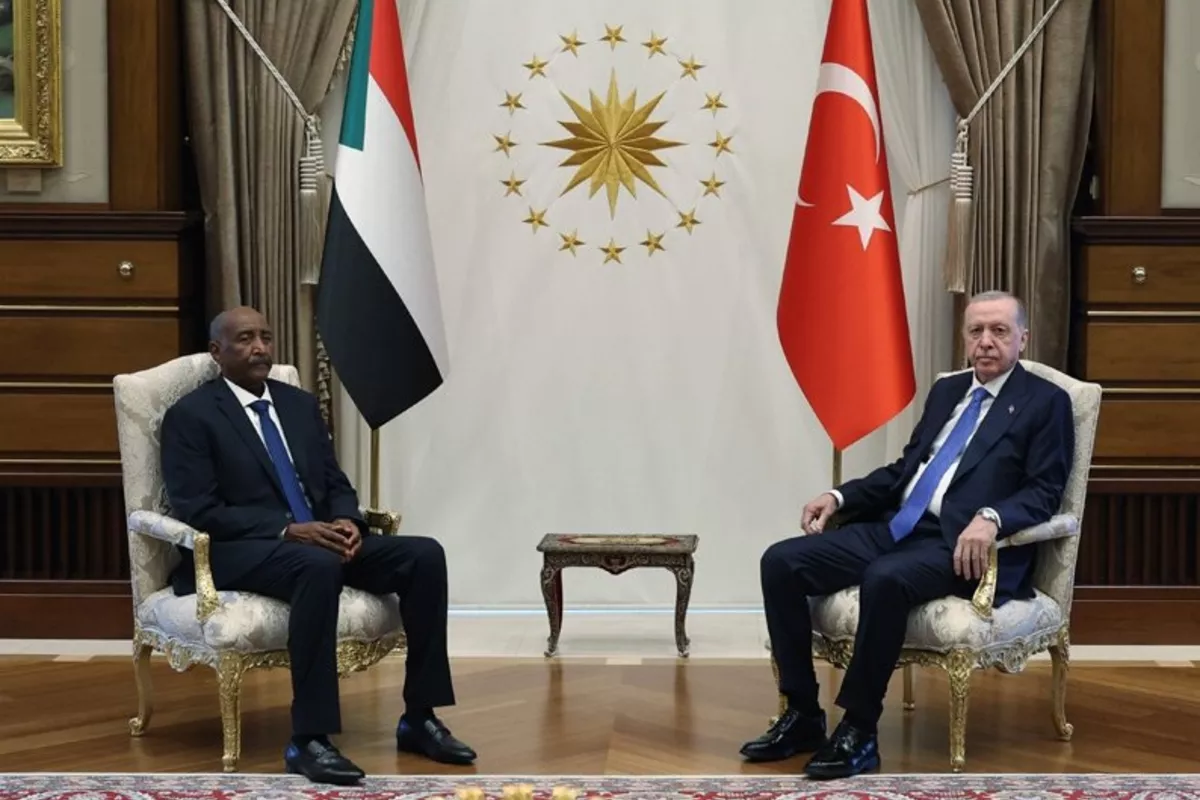
The visit of the Chairman of Sudan's Sovereignty Council, Abdel Fattah al-Burhan, to Ankara on June 2, 2026, carries significance far beyond a routine diplomatic encounter. Occurring in the fourth year of the war and at a juncture where the Sudanese Armed Forces (SAF) have secured significant territorial gains, this move represents a critical link in Khartoum’s broader strategy to tilt the global balance of power in its favor. Welcomed by Turkish President Recep Tayyip Erdogan at the Presidential Complex with full head-of-state protocol, al-Burhan sent a clear signal to the international community: Khartoum has broken through the spiral of regional isolation and is expanding its strategic depth by transcending traditional alliance frameworks.
This strategic rapprochement represents a sharp U-turn and a fundamental geopolitical correction in Sudan’s recent foreign policy. Following the 2019 revolution, the civilian transitional government chose to completely burn bridges with Ankara in pursuit of normalizing ties with the West, Israel, and specific regional actors. By freezing all strategic and military agreements forged up until 2019, the civilian administration reduced bilateral relations to zero. However, the outbreak of the civil war in 2023 radically altered Khartoum’s geopolitical calculus. Faced with an existential crisis, General al-Burhan engaged in a pragmatic pursuit of security, reintroducing Türkiye into Sudan's playbook as its most critical strategic partner. In this context, the high-level talks held in Ankara by Sudanese Prime Minister Kamil Idris shortly before al-Burhan’s own visit demonstrate that bilateral relations have transitioned from mere crisis diplomacy, evolving once again into a structural partnership. This diplomatic flurry reflects a long-term grand strategy aimed not just at the ongoing civil war, but at the geopolitical orientation and post-war reconstruction of a future Sudan.
Paradigm Shift on Ground and Limits of RSF
The Sudanese army has transitioned from a defensive posture to a decisive counter-offensive, reclaiming vital centers in Khartoum and Gezira State while swiftly re-establishing local administrative control.
Conversely, the Rapid Support Forces (RSF) have failed to achieve a strategic breakthrough despite heavy external backing. The SAF is fighting a highly complex proxy war and a regional encirclement, where nearly all neighboring states except Egypt and Eritrea have aligned against Khartoum, alongside mercenaries from 17 nations. Even the UAE’s recent escalation of logistics to the RSF via the Ethiopian border has failed to alter the war's trajectory.
The RSF's attempt to replicate its previous logistical models along the Ethiopian frontier to split SAF resources has failed. Hampered by the SAF's overwhelming air superiority and institutional military memory, the RSF has lost the strategic initiative and regressed into a defensive posture. More critically, the RSF is facing structural fragmentation; various tribal militias in Darfur and Kordofan are defecting or declaring neutrality due to growing discontent, eroding the group’s operational manpower and local legitimacy.
'Somali Model' and Future of Security Partnership
The strongest foundation for the Ankara-Khartoum rapprochement is Türkiye’s new security doctrine in Africa, where it has evolved from an economic player into a prominent "security provider."
A prime example is the "Somali model" -- a framework based on military training, institutional capacity building, and defense industry integration -- which many African nations are now requesting from Ankara to solve their sovereignty crises. For Sudan, facing urgent security needs and post-war restructuring, deepening defense cooperation with Türkiye is a natural fit.
Three-Dimensional Strategic Message
General al-Burhan’s visit to Ankara conveys three core messages directed at both global and regional actors:
First, the visit serves as a domestic political signal to the Sudanese public. The leadership in Khartoum is demonstrating that despite the ongoing conflict, state apparatuses remain functional, diplomatic channels are expanding, and the government continues to engage actively on the international stage. His reception by President Erdogan with full head-of-state protocol can be interpreted as a powerful symbolic validation of the Sudanese government’s international legitimacy.
Second, the visit carries a distinct message for regional actors. Khartoum has recently sought to recalibrate its foreign policy onto a more balanced footing, cultivating new strategic partnerships alongside its traditional alliances. The close alignment forged with Türkiye is a key component of Sudan's broader objective to break free from regional isolation and diversify its diplomatic engagements.
The third and most critical dimension is the long-term strategic cooperation perspective. As Sudan positions itself for the post-war era, it requires robust partners in sectors such as the defense industry, economic development, reconstruction, and infrastructure investment. With its expanding diplomatic and economic footprint across Africa over recent years, Türkiye stands out as a pivotal actor in this process. Consequently, the deliberations in Ankara were not merely confined to an assessment of the ongoing conflict, but evidently encompassed long-term cooperation frameworks for Sudan’s post-war reconstruction.
Al-Burhan’s reception in Ankara with full head-of-state protocol by President Erdogan highlights Sudan’s evolution from an actor merely surviving the conflict into a legitimate state authority and a key regional interlocutor.
The true significance of this visit lies in Khartoum’s ability to successfully convert recent military gains into diplomatic capital. Moving beyond the image of a war-torn nation, this engagement -- which progressed from Kamil Idris’s initial contacts to al-Burhan’s official visit -- demonstrates that Sudan is repositioning itself as a viable state capable of building long-term international partnerships.
Find the original article here