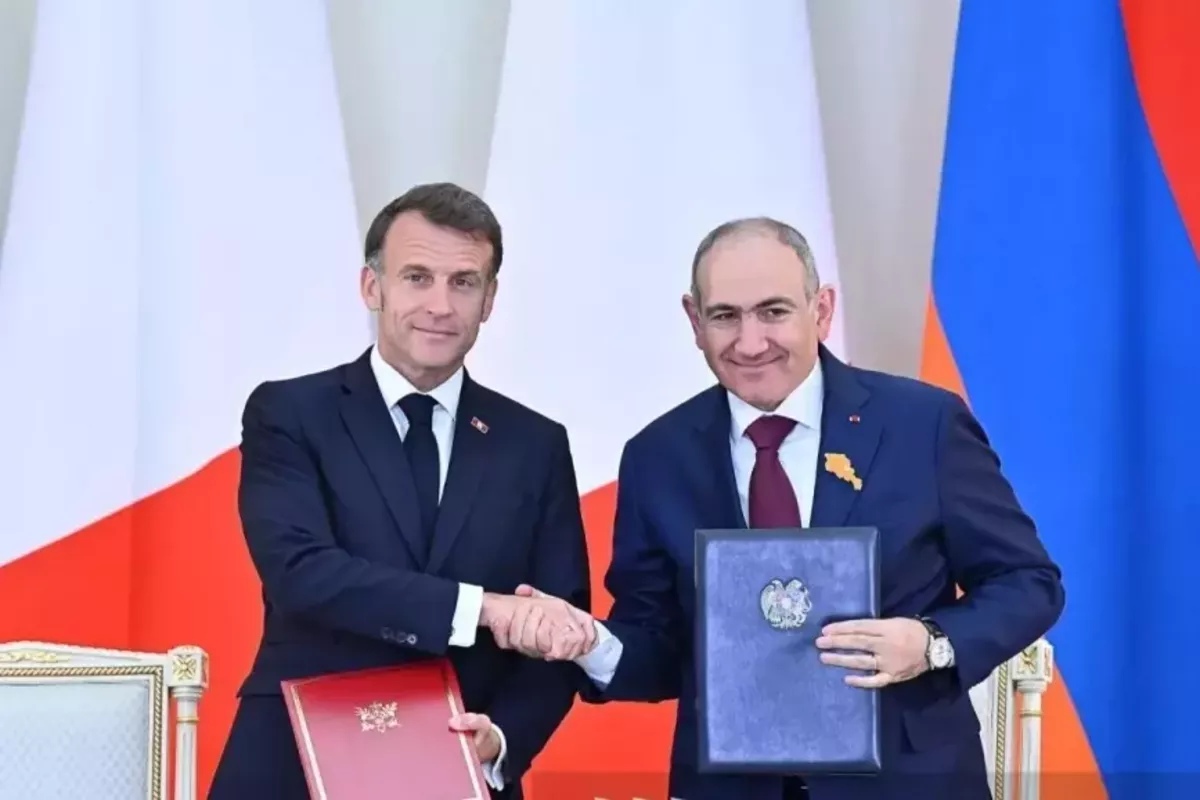
The European Political Community summit will likely be remembered for its emotional meetings and conspicuous displays of warm friendship between Armenian Prime Minister Nikol Pashinyan and French President Emmanuel Macron. Had these displays been somewhat more restrained and dignified, they might not have attracted much attention. After all, cordial relations between politicians from different countries are perfectly normal.
But Macron and Pashinyan went over the top. They showered each other with compliments, sang at an official reception, and walked together through Yerevan and Gyumri. The French president was particularly enthusiastic, behaving almost like a schoolboy on holiday. Outside observers unfamiliar with the broader context might have concluded that the summit in the Armenian capital had been organised primarily so Macron could stroll through Yerevan and so that the leaders of France and Armenia could perform a song by Aznavour. More precisely, Macron sang, while Pashinyan played the drums.
Still, it would be unfair to be overly critical, especially since Nikol Pashinyan also voiced a number of reasonable points during the summit. Macron, too, was unusually restrained on issues concerning the South Caucasus, although not entirely.
In his speech at the summit, the French president made two notable acknowledgements. First, he said that eight years ago Armenia was not fully sovereign and was seen as a satellite of Russia. Second, he stated that France supported Armenia during the 44-day war and assisted it in every possible way - something even Moscow did not do.
Let us take this step by step.
Macron correctly noted that eight years ago, that is, before Nikol Pashinyan was elected prime minister, few would have travelled to Armenia. However, he did not fully elaborate on the issue, referring only to the perception of Armenia as a dependent ally of Russia. In reality, the lack of engagement was also shaped primarily by Armenia’s status as an occupying state . Although this was rarely stated openly, even Armenia’s allies understood the situation clearly. Armenia was politically isolated due to its occupation policy, which was reflected in relevant UN Security Council resolutions.
Source: nato.it
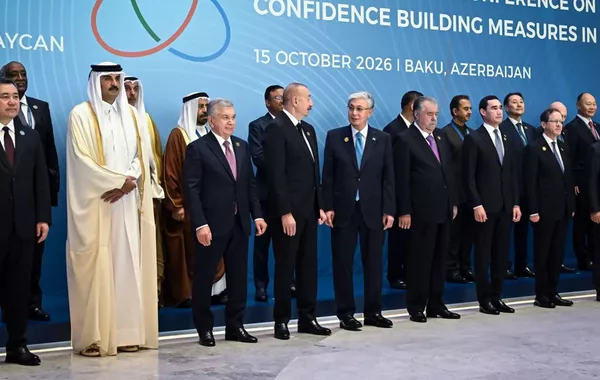
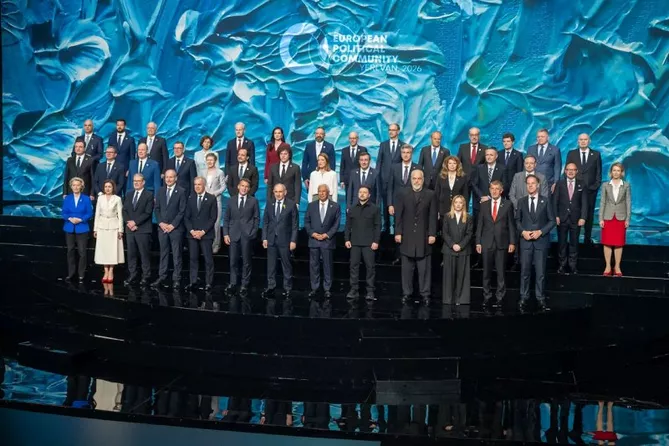
Had there not been a peace process in place today, and had the two countries not been pursuing a peace agenda, the European Political Community summit would not have been held in Yerevan. Even if the Azerbaijani side had not objected, many of the high-ranking guests whose presence Yerevan is now so proud of would still not have attended. Naturally, Azerbaijan would not have participated in the summit either. And yet it was precisely President Ilham Aliyev’s speech that became one of the key moments of the Yerevan summit.
However, Macron is not entirely wrong about Armenia’s lack of freedom. Armenia has never been fully independent or genuinely sovereign. Nor can the French president be described as a pioneer in making this assessment. What he said in Yerevan echoes a position that Baku has articulated for many years.
Long before the Second Karabakh War and before Nikol Pashinyan came to power, President Ilham Aliyev stated that “Armenia exists on the world map as an independent state only formally. Armenia is a dependent country that cannot determine its own future independently.” That was the prevailing assessment at the time. With Pashinyan’s rise to power, the situation began to change to some extent, but Armenia’s status as an occupying state continued to hinder its path towards real sovereignty.
In one of his post-war speeches, the head of state said that “calling Armenia an independent country is absolutely unjustified, because the Armenian state lacks the overwhelming majority of the attributes inherent to an independent country.” The President of Azerbaijan also noted, not without reason, that “there are many unsuccessful, dependent countries in the world that want to sit on two or more chairs at the same time, serve several masters, and have turned themselves into arenas of confrontation between larger states.” He cited Armenia as an example.
It is also difficult to dispute Macron’s remarks regarding France’s support for Armenia during the 44-day war. At the summit in Yerevan, he spoke about this with pride, presenting it in the context of contrasting the European choice with Russian influence. But there is little to be proud of here. France supported Armenia throughout the entire Karabakh conflict while serving as a co-chair of the OSCE Minsk Group. From the beginning of the Second Karabakh War, it openly sided with Armenia and actively participated in spreading claims and serious accusations against Baku.
There were also attempts to support Yerevan on the diplomatic front. Macron personally sought to bring the leaders of other European states into an anti-Azerbaijani campaign and tried to build a coalition against Baku. However, he failed - no country joined him against Azerbaijan. There were some mild and not particularly vocal criticisms of Baku’s actions, but no state joined the campaign led by Paris.
Let us recall that it was France that, at the height of the war, attempted to raise the issue of sanctions against Azerbaijan at the UN Security Council. However, the initiative did not even progress beyond closed consultations among the permanent members of the Council. Paris appeared to overlook the fact that Baku also has friends and allies.
Nevertheless, France’s support for Yerevan has consistently been highly tangible. After the war, and especially following the 2023 anti-terror operation, it went beyond diplomacy and took on the character of open interference in Azerbaijan’s internal affairs. Paris continued to push European institutions, putting forward one anti-Azerbaijani initiative after another. Macron personally did everything possible to maintain tensions in the region and to delay the start of the peace process for as long as possible. As a politically ineffective leader, he likely believed that by doing so he was helping Armenia. In reality, he only made Armenia’s situation more difficult.
Because of the French president’s unconstructive policy, relations between Baku and Paris seriously deteriorated. For several years, the two countries remained in a state of acute diplomatic confrontation. Only recently has Paris finally come to terms with the fact that it determines little in the South Caucasus and has adopted a more constructive position. Now, however, Nikol Pashinyan, like a loyal ally, appears to be trying to shift the image of successful mediator in achieving peace from Trump to Macron.
During his speech at the state dinner held as part of the summit, the Armenian prime minister showered the French leader with praise. Among other things, he claimed that it was thanks to Macron that peace now prevails in the region.
Pashinyan stressed that, at the current stage of Armenia’s development, Macron’s role had become decisive. According to him, it was only the French president’s “exceptional determination and principled stance” at the four-party meeting in Prague on 6 October 2022 that helped establish peace. The approaches formulated at that meeting, Pashinyan claimed, became one of the foundations of Armenia’s current reality.
Yes, Macron did indeed take part in the meeting held during the first European Political Community summit in Prague. Following the meeting, the sides issued a statement emphasising that “Armenia and Azerbaijan confirmed their commitment to the UN Charter and the 1991 Alma-Ata Declaration, through which both sides recognise each other’s territorial integrity and sovereignty.” In other words, they confirmed what Azerbaijan had been saying all along, while Armenia, relying on support from the same Paris, had previously sought to contest it.
What exactly Macron’s role in Prague consisted of, and what Pashinyan was thanking him for, remains unclear. It would be more accurate to put it this way: despite Macron’s interference, Armenia was for the first time compelled to publicly and officially recognise Azerbaijan’s territorial integrity in line with the Alma-Ata Declaration - that is, within the borders of the former Azerbaijan SSR.
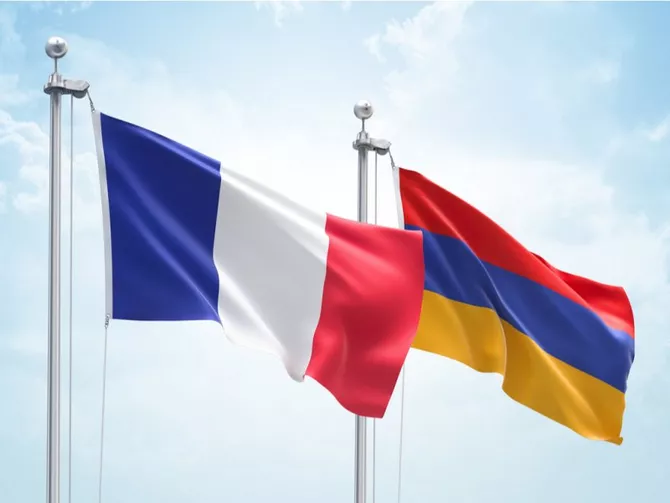
Source: Shutterstock
Incidentally, after Prague, Macron was no longer involved in the communication process between Baku and Yerevan. That was a condition put forward by the Azerbaijani side.
Today, Macron promises to support Armenia on the issue of “Armenian prisoners.” “You can count on me,” the French president declared in Yerevan. It would have been useful if he had also clarified how exactly he intends to do this, given that he has no instruments to achieve this unlawful objective. No one has the right to interfere in the judicial system of a sovereign state. No one has the right to pressure Baku to release individuals convicted of numerous atrocities against the Azerbaijani people. For a sovereign country, domestic legislation is of primary importance, while the decisions of international bodies and the views of foreign politicians carry no legal weight in such matters.
Has Macron promised to make the release of criminals his life’s mission? It seems Armenia is headed for yet another disappointment - just as it will be disappointed by Macron’s promises to “continue playing a mediating role” in the region. What mediating role is the French leader referring to? As already noted, after the Prague meeting, he was no longer involved in the talks between Baku and Yerevan. There is no need for his mediation, just as there is no need for anyone else’s mediation at all. Baku and Yerevan are discussing all issues directly. The involvement of the US president was needed to encourage Armenia to stop dragging out the process. Despite the fact that relations between Baku and Paris are now improving, French mediation is the last thing Emmanuel Macron should rely on.
The only tangible result of the exchange of compliments between Macron and Pashinyan was the signing of a Declaration on Strategic Partnership. An agreement was also signed on cooperation in the development of military technologies, research into defence systems, and the supply of military uniforms.
It is somewhat surprising that such documents had not been concluded between France and Armenia earlier. This suggests that even Armenia’s traditionally closest European partner was cautious about elevating relations with Yerevan to the level of a strategic partnership until stability had been established in the region and the risk of renewed conflict had significantly diminished.
Declarations on strategic partnership were also signed by Armenia during the summit with the United Kingdom, Croatia and Bulgaria. And for this - just as for the relatively stable situation in the region - Pashinyan should thank not Macron, but Azerbaijan.
By Tural Heybatov