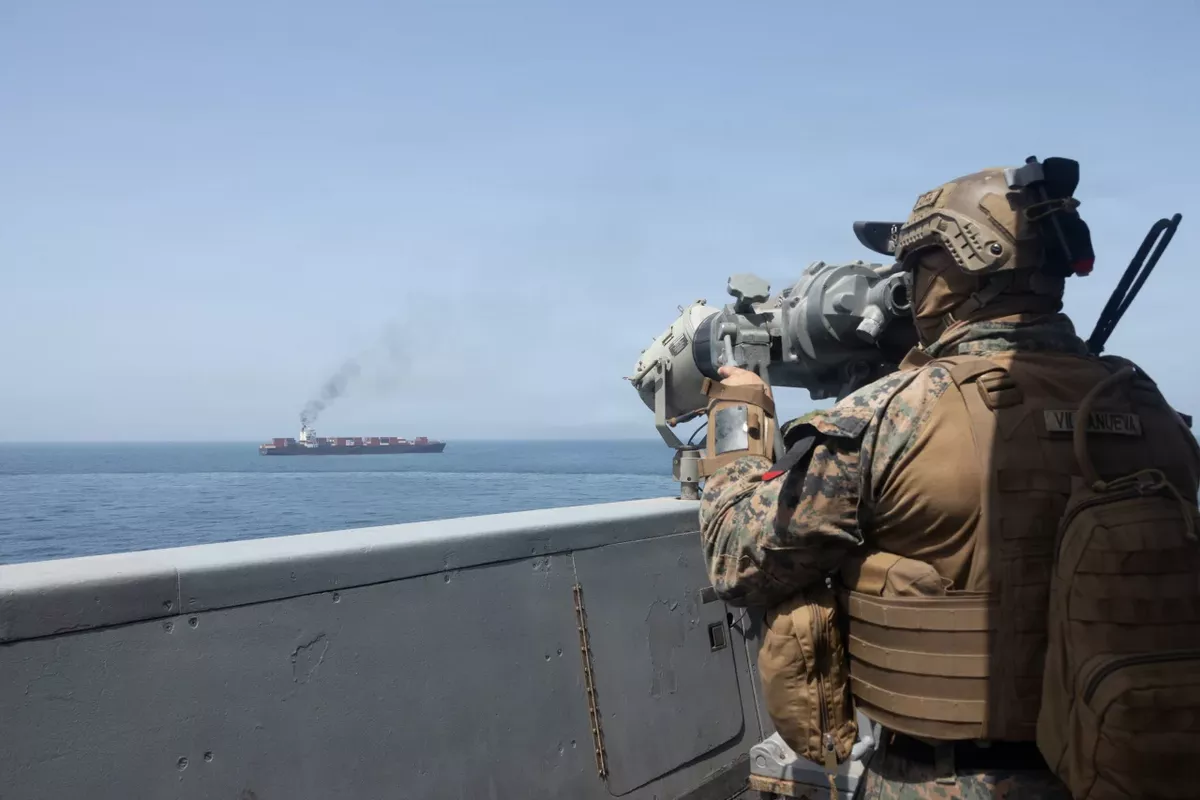
The US campaign to restrict Iran’s maritime trade-often described as a “blockade” in political rhetoric-has produced a far more complex outcome than either side publicly claims. Officially, Washington frames the policy as a way to choke Iranian exports, especially oil, by blocking access to ports and deterring shipping through enforcement pressure. Tehran, meanwhile, argues that exports continue largely unaffected through alternative routes and adapted logistics.
Ship-tracking data, tanker movement reports, and Strait of Hormuz traffic patterns all suggest a reality that sits between these competing narratives: Iran’s maritime trade has not been stopped, but it has been significantly reshaped, fragmented, and pushed into higher-risk, lower-transparency channels.
Maritime Pressure vs. Adaptive Shipping Networks
The core assumption behind the US approach is that restricting port access and raising the cost of compliance will gradually reduce Iran’s export capacity. However, shipping intelligence shows that Iranian-linked exports-especially crude oil-continue at substantial volumes, though with increased operational complexity.
Analysts tracking vessel movements report that Iranian oil continues to reach international markets through a combination of traditional routes, sanctioned intermediaries, and “shadow fleet” tankers operating with limited transparency. These vessels frequently switch off AIS transponders or manipulate location data, making full enforcement difficult.
Recent reporting indicates that despite tightened measures, Iran has still been moving around 1 million barrels of crude per day through maritime routes, only slightly below pre-conflict levels in some estimates . At the same time, enforcement pressure has clearly reduced the number of openly compliant commercial vessels servicing Iranian ports, suggesting that the policy is less about stopping flows entirely and more about forcing them into opaque systems.
This creates a paradox: visible shipping declines, but total trade does not collapse proportionally.
Strait of Hormuz: The Critical Pressure Point
Any assessment of maritime pressure on Iran is incomplete without the Strait of Hormuz, the world’s most strategically important oil chokepoint. Roughly one-fifth of global oil consumption normally passes through it, making it the most sensitive node in the entire system.
In 2026, the Strait has become a direct theater of US-Iran confrontation. Rather than being physically closed, it is functioning under extreme disruption and selective control.
Ship-tracking data shows that traffic has collapsed from normal levels of roughly 100-135 vessels per day to single-digit or low double-digit flows during crisis periods. Some estimates show reductions exceeding 90% in peak disruption phases, with occasional brief recoveries to around 10-20 vessels daily when tensions temporarily ease.
Recent operational snapshots show extreme volatility:
- Only about 6 vessels per day in some 24-hour windows during peak restrictions
- Short spikes of 14-22 transits per day during temporary easing phases
- A weekly total in some periods of just ~22 vessels compared to normal weekly flows of 700-900+
Despite this dramatic drop, the Strait has not fully closed. Instead, it has shifted into a controlled and militarized corridor.
A major development is Iran’s increased role in directing maritime movement. Shipping reports indicate that vessels are being routed through narrower, Iran-monitored lanes near Larak Island, and that compliance with these instructions often determines passage safety and timing. This has effectively turned transit into a conditional system rather than a free passage route.
Shadow Routing, AIS Manipulation, and Partial Enforcement Failure
The US strategy in the Strait of Hormuz relies heavily on surveillance, interdiction threats, and legal pressure on insurers and shipping companies. However, ship behavior suggests partial adaptation rather than compliance.
Several patterns undermine full enforcement:
- AIS “dark shipping”: vessels disable tracking systems to avoid detection
- Ship-to-ship transfers: oil is moved offshore to obscure origin
- Reflagging and ownership masking: tankers frequently change identity
- Route rerouting: ships avoid standard lanes or delay entry entirely
At the same time, even official tracking systems acknowledge gaps. Some ships are observed entering or exiting the Gulf without full visibility, meaning reported traffic is likely incomplete.
This is reflected in real-world outcomes: while official transits are lower, Iranian exports continue and global buyers-especially in Asia-still receive significant volumes of crude. In effect, the system filters trade rather than eliminating it.
Strategic Outcome: Disruption Without Decisive Control
The key question-whether the US “blockade” is working-depends entirely on what “working” means.
If success is defined as halting Iranian maritime exports, the evidence clearly indicates failure. Oil continues to move, and shipping networks have adapted faster than enforcement mechanisms can fully close gaps.
If success is defined as raising costs, increasing risk, and reducing transparency, then the policy is partially effective. Shipping insurance is more expensive, routes are longer and less predictable, and companies face higher operational uncertainty.
However, the Strait of Hormuz data highlights the limits of pressure-based maritime strategies. Despite severe disruption, the chokepoint remains open in functional terms. It is neither a closed blockade nor a normal transit corridor, but a managed crisis zone where movement is selectively controlled, not eliminated.
Recent developments underscore this instability. Reports of vessel seizures, gunfire incidents, and temporary closures continue to surface, even as ships still pass through in limited numbers. This reinforces the idea that maritime control is fragmented among multiple actors rather than centralized under a single authority.
Conclusion: A Disrupted System, Not a Broken One
The US maritime pressure campaign against Iran has not achieved a decisive blockade effect. Instead, it has produced a hybrid outcome:
- Iranian exports continue, but through less transparent channels
- The Strait of Hormuz is operational but heavily disrupted
- Ship traffic is sharply reduced but not eliminated
- Enforcement is partially effective but structurally bypassed
The most accurate characterization, based on current ship-tracking data and Strait of Hormuz conditions, is that the system is not working as a traditional blockade, but it is reshaping global maritime trade under sustained pressure.
In other words, the US has not stopped Iran’s shipping economy-but it has made it more fragmented, riskier, and far less visible.